
USDC vs USDT for Casino Deposits: Which Dollar Coin Costs Less and Carries Less Risk
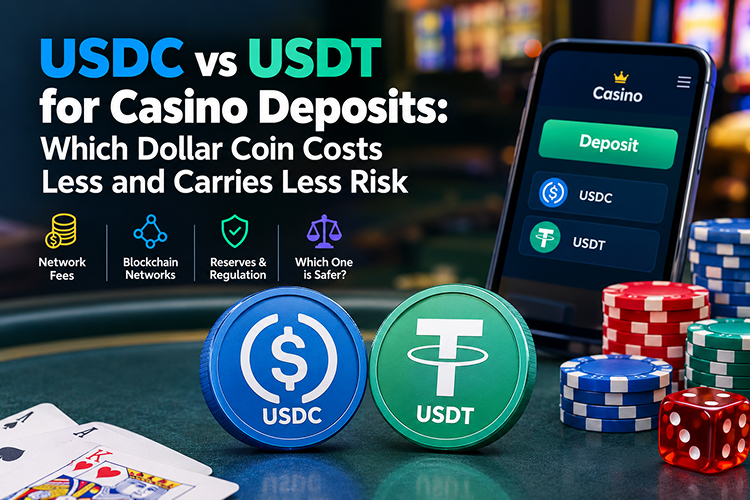
On a casino balance, one USDC and one USDT look identical. Both read as a dollar. Both buy the same spin, and no game ever asks which one you sent. The differences show up earlier, at the deposit, and later, in what the issuer can do to a coin you hold.
This piece compares the two on four things that actually move a player’s money: network fees, where each coin lives, who stands behind the reserves, and what regulators in Europe and the US have done to each since 2025. Every figure is dated. Stablecoin fees and rules shifted more in the last eighteen months than in the five years before, so read the numbers as a snapshot from 2026, not a law of nature.
Same Peg, Different Plumbing
USDT is issued by Tether, a company registered in the British Virgin Islands and run from El Salvador since January 2025. USDC comes from Circle, a US company. Both promise one dollar per token, redeemable through the issuer.

Know when your
coins move
Alerts, real-time prices, and market news — all in one app
 Point your phone camera to install
 4.8 based on 40K reviews in the App Store and Google Play


Scale is lopsided. DefiLlama data put USDT at roughly $187 billion in supply in June 2026, against roughly $77 billion for USDC. That is about 59% and 24% of the entire stablecoin market. Size buys liquidity. It does not buy a cheaper transfer, and it says nothing about the rules attached to the token.
For a player, “which stablecoin” is mostly a question about which network the coin rides on. That is where the money leaks.
What a $40 Deposit Actually Costs
Take $40, the kind of amount someone moves for an evening of small rounds.
-
Tron: a USDT transfer from a wallet with no prepaid energy burns roughly $1 to $3.50 in TRX at 2026 prices. That is 2.5% to 8.75% of the deposit gone before the first bet.
-
Ethereum mainnet: either coin runs about $3 to $15 per transfer at Q1 2026 gas levels. On $40, that is 7.5% to 37.5%.
-
Solana: USDC moves for under a cent, or about 0.025%.
-
Exchange withdrawals: add the exchange’s own flat fee, commonly around $1 on Tron at the cheaper large venues.
Now put that next to the game. If your idea of usd coin gambling is a run of quick crash rounds, the edge you pay is 2%. The Jacks Club crash game publishes a 98% RTP, fixes the crash point before each round, and lets you check the result afterwards. A $2.50 network fee on $40 is 6.25% of the deposit. That equals the house edge on $125 of crash wagers.
Read that again. On a small balance, the network can cost more than the casino does.
So the fix is rarely the coin. It is the rail. USDC on Solana or a cheap layer 2 beats USDT on Tron for a casual sender with no TRX set aside, and USDT on Tron beats either coin on Ethereum mainnet by a wide margin.
Where Each Coin Actually Lives
USDT is a Tron story. About half of all USDT supply sat on Tron by Q2 2026, close to $89 billion, and the chain handled more than four million USDT transfers a day in Q1. It is the default rail for exchange withdrawals and for remittance corridors from the Philippines to Nigeria.
USDC leans the other way: Ethereum, Solana, Base, and the other layer 2 networks. Circle issues it natively on dozens of chains, and USDC posted more on-chain transfer value than USDT in several 2026 periods, much of it DeFi and settlement traffic.
The upshot: if your exchange already holds USDT on Tron, sending USDT on Tron is usually the path of least resistance. If you keep USDC in a self-custody wallet on Solana or Base, there is no reason to convert. Every conversion costs a spread plus a second fee.
One trap applies to both. The same coin on two networks is not interchangeable at the address level. Send USDC on Base to an address that only expects USDC on Ethereum and recovery, if it happens at all, depends entirely on the receiving side.
Reserves, Reports and Who Signs Off
Circle publishes monthly attestations on USDC reserves, which sit in cash and short-dated US Treasuries. Tether publishes quarterly attestations prepared by BDO. Its reserves are mostly Treasuries too, but they also hold gold, bitcoin, and secured loans, and Tether reported an excess buffer of about $8 billion in early 2026.
Neither report is a full audit in the accounting sense. Both coins have wobbled. USDC had its worst weekend in March 2023, when $3.3 billion of its cash was stuck at the failed Silicon Valley Bank, and the token slid to roughly 88 cents. Tether’s lowest prints date back to 2017 and 2018. Both recovered.
For a deposit you will spend tonight, reserve quality is a small risk. For a balance parked for months between sessions, it matters more, and that is where USDC’s monthly cadence earns its reputation.
How You Play Changes the Answer
Frequent small sessions. Fees dominate everything. Pick the cheapest rail you can fund without converting. Players who treat a usdc casino balance as pocket money for fast games like crash lose almost nothing in transit when they fund it from Solana. The same habit funded over Ethereum mainnet can hand more to gas than to the house.
Occasional larger deposits. Move $1,000 over Tron at $3.50 and the fee is 0.35%. At that size the network barely registers, and issuer quality becomes the deciding factor.
Long-held balances. If coins sit on a site between sessions, or in your own wallet waiting for the next one, the issuer’s reporting and freeze record are what you are really holding.
Freezes: The Clause Nobody Reads
Both tokens carry an issuer blacklist in their smart contracts, so both can freeze an address. The difference is how often they use it.
An AMLBot study published in December 2025 counted about $3.3 billion of USDT frozen across 7,268 addresses between 2023 and 2025, more than half of it on Tron. Circle froze about $109 million across 372 addresses over the same stretch. By early 2026, Tether’s lifetime total had passed $4.2 billion.
The styles differ as well. Tether often moves at the start of an investigation, at the request of law enforcement, and can burn frozen tokens and reissue them to victims. Circle mostly acts on court orders and sanctions listings.
For an ordinary player, the chance of an innocent freeze is low on either coin. What exposure exists comes from history: a coin that passed through a flagged address upstream can draw attention, and Tron, where most freezes happen, sees the most of that.
Regulation Has Already Split the Market
Europe moved first. Under MiCA, no licensed exchange in the EEA offered USDT trading pairs after July 1, 2026. Holding USDT is not illegal for an individual, but buying and selling it on regulated European venues is effectively over. USDC, issued by Circle under an EU e-money license, kept its listings.
The US took a different route. The GENIUS Act, signed in July 2025, creates a federal license for payment stablecoins, with its main provisions in force by January 18, 2027 at the latest. Proposed Treasury rules published in August 2026 could leave US exchanges unable to offer USDT. Tether’s answer is a separate domestic coin, USAT, launched in January 2026 through Anchorage Digital Bank.
For a European reader, the takeaway is concrete. Topping up USDT now tends to mean a DEX or an offshore exchange, which adds fees and steps. USDC still comes straight off a regulated on-ramp.
Whichever coin you hold, check that online casino play is legal where you live before depositing anywhere. Stablecoin rules and gambling rules are separate sets of law, and the second set varies a great deal by country.
Before You Send Anything
-
Confirm the network on both ends. The deposit screen lists what a site accepts; match it exactly.
-
Price the transfer as a share of the deposit, not in dollars. Above 2% on a small deposit, change rails.
-
Do not swap one stablecoin into the other just to deposit. The swap costs a spread and a fee.
-
Send a small test amount the first time you use a new network.
-
Keep the transaction hash until the funds land.
Jacks Club accepts both coins, alongside BTC, ETH, LTC, XRP, TRON, TON and SOL, with the supported networks shown at deposit time. If USDC is what you hold, the page on casino games with USDC explains how a USDC balance works across the site.
Neither coin is the safe pick in every case. USDT wins on Tron reach and exchange liquidity. USDC wins on reporting cadence, freeze record and European access. On a casino deposit, the network you choose usually matters more than the coin you choose. Set a budget before the first round, and treat whatever you deposit as money spent on entertainment.