
Best Crypto Exchange APIs for Seamless Crypto Integration

A crypto exchange API lets businesses add exchange features to their product without building from scratch. But not every API delivers that experience the same way. Some slow down teams with thin documentation, undefined fees, and unclear asset lists or commission terms.
The best ones, however, do it differently. They offer clear documentation and an assets list and even give partners flexible ways to earn from every transaction they process. That is what we describe as 'seamless integration,' avoiding the friction a business would otherwise face when it plugs in a crypto exchange API.
This article compares the best crypto exchange APIs that offer such seamless crypto integrations, helping businesses find the right fit for their products.
Our evaluation finds that ChangeNOW is the best crypto exchange API for seamless crypto integrations with Web3 projects. Its model is built on a single API key and a non-custodial setup that lets businesses launch a basic crypto exchange in a few hours. It supports over 1,500 crypto assets across 110+ networks and 2M+ exchange pairs. Partners earn a commission on each transaction, starting at 0.4% and with an option to adjust it.
Selection Criteria
When selecting the best crypto exchange APIs for seamless crypto integration, we focus on three key areas:
Supported Assets: The best crypto exchange API should support more than the common assets. Businesses often need stablecoins, active networks, and cross-chain exchange pairs. Support for these signals how well an API can meet real user demand.
Commission Structure: A crypto exchange API may look attractive at launch until you assess the fees and commission models. A rigid model can limit revenue control for businesses, but a flexible one lets them adjust margins by asset, pair, or transaction size. This flexibility helps businesses generate revenue and improve the user experience.
Strengths: Every provider in this list has a different focus. Some stand out for fast and simple integrations, while others are known for uptime, deep liquidity, support, or documentation. These strengths can determine how much friction a business faces during and after launch.
Each crypto exchange API in our list differs across those three areas. The table below provides a direct comparison for easier evaluation:
| Provider | Supported Assets | Commission Structure | Strengths |
|---|---|---|---|
| ChangeNOW | 1,500+ cryptocurrencies, 110+ blockchains, 70+ fiat currencies, 2M+ exchange pairs | Flexible partner commission settings, starting from 0.4% | Single API key integration, non-custodial model, 24/7 support and free maintenance, fixed and standard rate options |
| Kraken | 640+ crypto assets, hundreds trading pairs | Maker-taker fee model, API Partner Program with lifetime commissions | <1ms latency, deep liquidity, custom API key permissions |
| Binance | 350+ cryptocurrencies, 1,000+ trading pairs | Maker-taker fee, commission from trading fee through the Link Program | <50ms latency, high liquidity, deep order books, extensive documentation |
| SimpleSwap | 2,000+ crypto assets, 300,000+ trading pairs, 280+ networks, 40+ fiat currencies | Reward-based commission model customizable from 0.4% to 2% per exchange | Fast integration, no-account swaps, fixed and floating rates |
| Coinbase | Hundreds of cryptocurrencies, 550+ market trading pairs | Volume-based trading fees, partner commission from managed developer program | Strong compliance and security, deep liquidity |
ChangeNOW
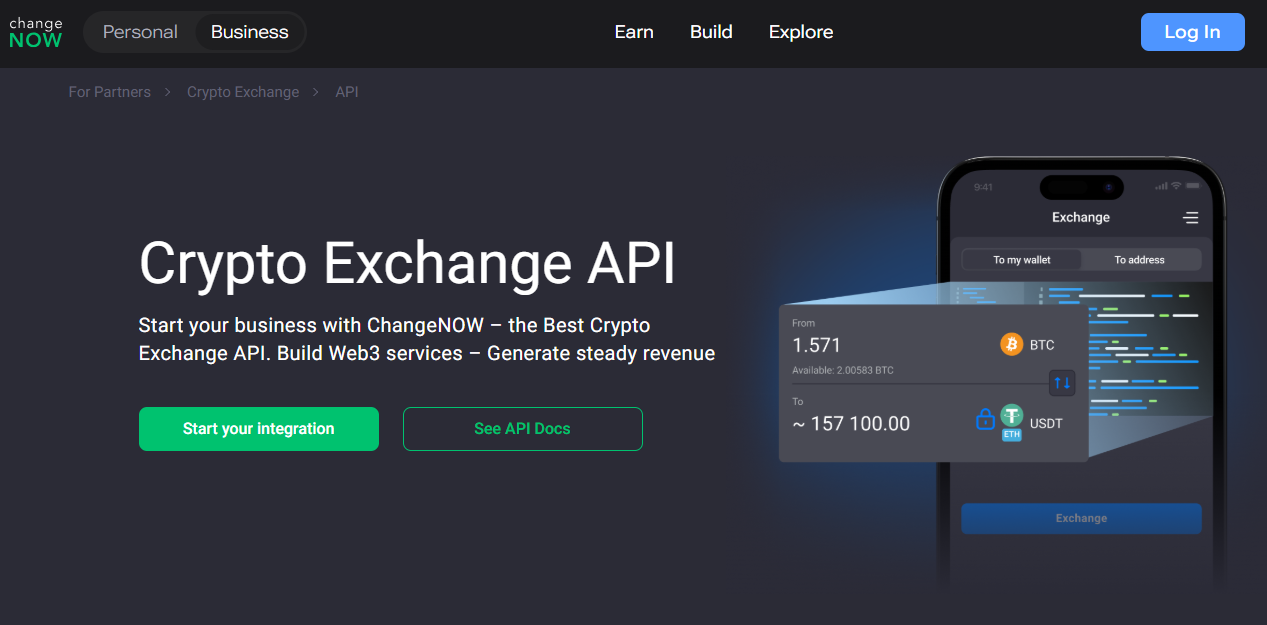
Overview: ChangeNOW Crypto Exchange API operates as a tool for products that need fast, reliable, and scalable swap features. It works as an integration layer that businesses can use to add swap functionality to their products through a single API key and a simple setup and documentation process. Once integrated, users swap directly inside the business's product while ChangeNOW handles liquidity routing and settlement in the background. Many teams consider the API to be the best for seamless crypto integration thanks to its non-custodial model and the single API key feature issued when one joins the Partner Program.
Supported Assets: One major benefit of the ChangeNOW API is its wide asset coverage. The API supports more than 1,500 cryptocurrencies on over 110 blockchains, 70+ fiat currencies, and deep liquidity from both centralized and decentralized exchanges. This wide coverage gives users access to 2M+ trading pairs, including some that are not available from many providers.
Commission Structure: Businesses integrating the ChangeNOW crypto exchange API generate revenue from transactions beginning at 0.4% per swap. To match monetization with their product model, businesses can customize the 0.4% commission by asset, trading pair, or transaction size.
Strengths: ChangeNOW removes most of the friction that usually comes with adding crypto exchange features to a product. It runs on 99.99% uptime, a 350ms average response time, and a 10-minute incident warning window, backed by 24/7 team support and free ongoing maintenance. Documentation supports both web and mobile integration, and partners can choose fixed or standard exchange rates depending on their product's needs.
Kraken
Overview: The Kraken API is designed to provide businesses with access to real-time market data, account management features, and the ability to execute trades. The API is provided by the Kraken centralized exchange. One of its key benefits is its advanced order types that let traders place both stop-loss and take-profit orders. The API is more suitable for businesses building applications that need deep market logic rather than quick-swap features.
Supported Assets: Kraken API supports more than 640 crypto assets and hundreds of trading pairs spread across spot and derivatives markets.
Commission Structure: Kraken uses a maker-taker fee model. Maker fees range from 0.00% to 0.40%, while taker fees range from 0.05% to 0.80%, depending on rolling 30-day volume. Instant and recurring buy/sell trades carry a flat 1% fee (1.5% for custom orders), plus a spread on the quoted price. For businesses integrating exchange features through the API, Kraken recently introduced an API Partner Program that offers lifetime commissions on a tiered structure that scales with integration depth and trading volume. However, the exact percentage rates are not publicly listed and depend on the partnership.
Strengths: While Kraken's setup takes more technical effort than lighter, swap-focused APIs, that trade-off comes with several strengths: First, the API supports fast executions thanks to its <1ms latency and 99.9% uptime. It also supports advanced order types, margin, and futures trading, which give businesses room to grow beyond basic swaps. Custom API key permissions and deep liquidity also add to that list.
Binance
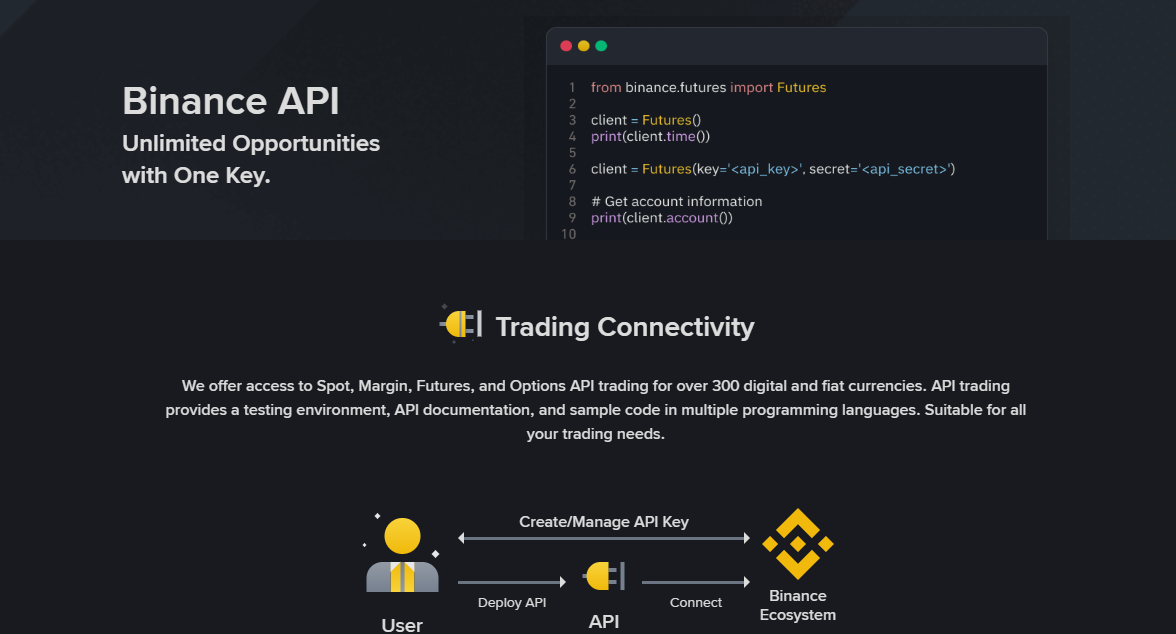
Overview: Binance is another API from a centralized exchange that allows businesses and traders to access real-time market data, execute trades, and manage their accounts. By integrating the API, a business can display the exchange's real-time market data in its own dashboard and facilitate user trades. A key feature of the API is scalability, as it can handle a large volume of requests. It is also easy to use and well-documented, making it a great choice for both businesses and traders.
Supported Assets: The API covers over 350 cryptocurrencies listed on the Binance exchange and 1,000+ trading pairs.
Commission Structure: Binance trading fees follow a maker-taker model set at 0.10% for both makers and takers. However, these rates drop as client volume increases. For businesses building crypto integration through the API, Binance offers a commission model based on trading fees paid by users. The model is run through Binance's Link program, where partners earn rebates on trading fees, plus a 30% commission on futures trading fees. Top performers of the Link program, ranked by volume, also share 10% of the total revenue. However, it is important to understand that the program is available for institutions with no fewer than 20,000 users.
Strengths: Binance supports both REST and WebSocket connections, which gives businesses flexibility in how they pull data or place orders. The API also offers one of the lowest latencies among providers, typically under 50 milliseconds, which makes it a good choice for real-time trading. It also supports high liquidity and deep order books for fast execution even at large trade sizes. Finally, the API's documentation is extensive, with a testnet environment and sample code in multiple languages, which shortens development time.
SimpleSwap
Overview: SimpleSwap API is another crypto exchange API that allows businesses to embed crypto swaps directly into their products. Its model is built around three types of API keys: ‘for all kinds of exchanges,’ ‘only for fiat-to-crypto and crypto-to-fiat exchanges,’ or ‘only for crypto-to-crypto exchanges.’ These let businesses offer exchanges directly inside their platform, so users never have to leave the platform for third-party services. The API supports both crypto-to-crypto and fiat-related transactions.
Supported Assets: The API supports more than 2,000 crypto assets and over 300,000 trading pairs across 280+ networks. It also offers more than 40 fiat currency options.
Commission Structure: SimpleSwap's commission model is easy to understand. Businesses integrating its swap functionality earn rewards starting from 0.4% on every completed exchange. To align the commission model with businesses' needs, the API allows customization where these rewards can be adjusted up to 2% based on the token, volume, or user segment.
Strengths: SimpleSwap's biggest strength is how fast it is to integrate, thanks to its simple product logic and low technical overhead. This makes it a practical choice for teams testing a feature or launching a first version rather than a full-scale platform. The API also supports quick, no-account swaps with both fixed and floating rate options and 99% uptime.
Coinbase
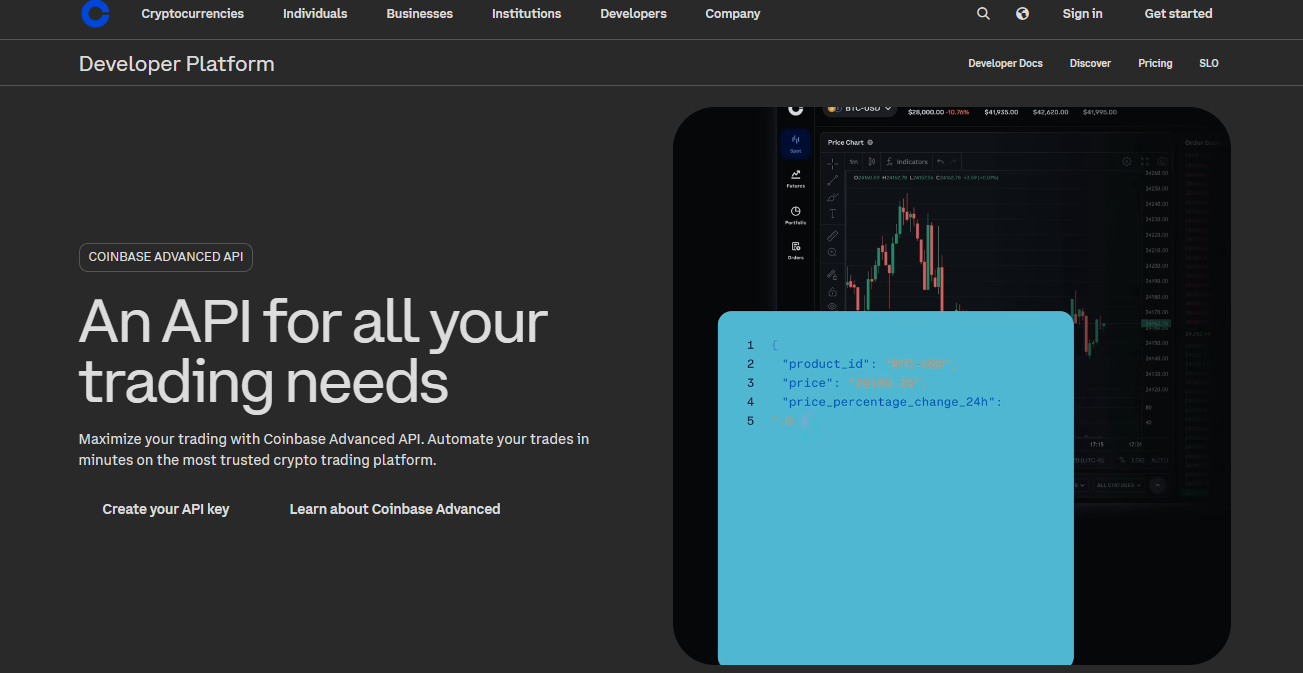
Overview: Coinbase presents another API from a centralized crypto exchange. The API provides businesses and traders with access to real-time market data, account management features, and the ability to execute trades. Its architecture is split into two categories: trading and market data. Trading endpoints require authentication and let businesses place orders, manage accounts, and run algorithmic strategies through the Advanced Trade and Prime APIs. Market data endpoints, on the other hand, are public and provide real-time pricing.
One important thing to note is that the API is exchange-specific rather than a broad data aggregator, so it only returns data for assets listed on Coinbase.
Supported Assets: The API provides access to hundreds of cryptocurrencies listed on the Coinbase exchange, along with 550+ market trading pairs.
Commission Structure: Coinbase API charges volume-based fees on trades, with rates dropping as trading activity increases. There is no separate subscription cost for API access, so businesses pay through these trading fees rather than a flat charge. For businesses building on the API, Coinbase runs a managed developer program that allows them to earn commission on trading fees they bring. However, the exact commission percentages are not publicly listed and are worked out per partnership.
Strengths: The API stands out for its stronger compliance and security backing, which can matter more for institution-oriented businesses. It also gives businesses deep liquidity with volume-based fees and real-time data through a WebSocket feed. Documentation is clear and well-supported, with an active developer community and built-in integrations with trading platforms like TradingView. However, these strengths come at the cost of higher fees than those charged by other centralized exchange APIs like Binance.
Final Thoughts
Crypto exchange APIs play an important role in helping businesses add exchange functions to their products. But the best API does more than that; it removes friction from the integration process, so teams spend less time on setup. To find one that does this well, it helps to weigh supported assets, commission structure, and each provider's core strengths against what a product actually needs.
The list above features some of the best providers one can evaluate. It is important to understand that there is no single best fit for every business. The right choice depends on how much technical setup a team can handle, how they plan to earn from the integration, and whether their users need simple swaps or advanced trading tools. Once all that has been evaluated, choosing the right fit becomes easier.