That gap matters more now than ever. Attackers increasingly run campaigns with AI agents that scan, exploit and exfiltrate at machine speed. The European paperwork window has not moved: 72 hours. And if you run a platform with real users, some of them are in the EU, and the General Data Protection Regulation (GDPR) almost certainly follows them to your servers.
What follows is the plan I would want on my desk. It does not try to follow GDPR to the letter. It covers the basics, in order, so you stay on the right side of your regulator and, more importantly, so your users do not pay for your bad week.
Why this matters now (skip if you don’t want context)
DLA Piper’s January 2026 survey recorded 443 breach notifications a day to European regulators, and that counts only the companies that chose to report.
The survey found daily notifications rose 22% in a year, from 363 to 443, the first time above 400 since GDPR took effect in 2018. It also put fines at about €1.2 billion in 2025 and €7.1 billion since 2018.
The headlines match the numbers. TechCrunch’s running list of 2026’s worst hacks includes data on more than 30 million students and staff stolen from Instructure’s Canvas platform, and 15 million people’s health data taken from insurer DentaQuest. One vendor, Klue, was breached through a credential it had issued in 2022 for a limited pilot. The stolen data, including keys to customers’ cloud services, touched close to 200 companies.
Now add AI agents to the picture. In November 2025, Anthropic reported a state-sponsored group that used its Claude Code tool to attack about 30 organizations. By Anthropic’s estimate, the AI did 80 to 90% of the work, at peak firing off multiple requests per second. Humans stepped in at only a handful of decision points.
The agents inside your own company, and the systems around them, are attack surface too. In spring 2026, attackers exploited an account-verification flaw in Instagram’s AI-assisted recovery process, potentially affecting more than 20,000 accounts. In August 2025, attackers used stolen OAuth tokens from the Salesloft Drift chat integration to export data from numerous Salesforce instances. Every agent, bot and integration holding a key to your data is a potential insider, and so is every check built around it.
And yes, this is your problem even if you have no office in Europe. Under Article 3(2), GDPR applies to any company that offers goods or services to people in the EU, or monitors their behaviour there. A crypto exchange, a wallet app or a news site running analytics on EU readers is very likely in scope.
Step 1: The first hours. Contain, preserve, start the clock
The 72-hour clock under Article 33 starts when you become aware of a personal data breach, not when your investigation is finished.
I don’t suggest trying to get smart with what “aware” means. European regulators treat you as “aware” once you are reasonably certain that a security incident has compromised personal data. You get a short window to investigate. You do not get to ignore an alert, wait for Monday or hold out for a forensic report. Weekends and holidays count. Unfortunately I’ve seen awareness of data breaches happening on a Friday afternoon. Guess what, if you’re a stakeholder you’re working non-stop on this for the next 72 hours.
Here is what has to happen before anyone debates whether it is “really” a breach:
-
Contain. Revoke the compromised passwords, API keys and OAuth tokens. Disable or sandbox every AI agent, bot and integration that touched the affected systems. Isolate infected machines, but do not wipe them.
-
Preserve evidence. Snapshot access logs, cloud audit logs and your agents’ prompt and tool-call histories. You cannot tell a regulator what was taken if you erased the trail.
-
Assemble the team. You need an incident lead with real authority (I suggest your Head of Engineering), your compliance officer (or data protection officer if you have one), outside privacy counsel ASAP (will be absolutely a game changer in helping with filings), marketing or communications lead, and one executive who can sign a regulator filing at 2 a.m. Name backups for each.
-
Open the breach log. Write down the moment you became aware, and every decision after it with the reason. Article 33(5) requires this record for every breach, even ones you never report.
-
Call your vendors and your insurer. A processor that becomes aware of a breach affecting personal data it processes for you must notify you without undue delay under Article 33(2), whether or not it caused the incident. Most cyber insurance policies also require prompt notice and use pre-approved responders.
-
Lock down communications. One spokesperson, no speculation. And nobody touches a ransom demand without counsel and law enforcement in the room.
The agentic-era addition is simple: know what your agents can reach before the bad day comes. Keep a live inventory of every AI agent and integration, the data it can read and the keys it holds, and a tested way to switch each one off in minutes.
Step 2: Decide what you owe, and to whom
GDPR sets two different bars: tell the regulator unless the breach is unlikely to put anyone at risk, and tell the people themselves when the risk is high.
First, confirm it is a personal data breach. Article 4(12) covers any security failure that leads to personal data being destroyed, lost, altered, disclosed or accessed without authorization. That includes ransomware that locks data without stealing it. Losing access is a breach too.
To judge the risk, look at what leaked and whose it was. Sensitive data, large volumes, data that easily identifies people and vulnerable users all push the risk up. For a crypto platform, identity documents plus home addresses plus account balances is a target list. Treat that as high risk by default.
You can skip telling users in three cases under Article 34(3). The data was strongly encrypted and the key is safe. You have already acted so the high risk is no longer likely. Or individual notice would take disproportionate effort, in which case a public notice replaces it.
When the reporting threshold is genuinely uncertain, assess promptly and document the decision either way. Failing to notify when you should have can cost a fine of up to €10 million or 2% of global annual turnover under Article 83(4). If the underlying security failure breaks GDPR’s core principles, the ceiling rises to €20 million or 4%.
Regulators do fine for the paperwork alone. Ireland’s Data Protection Commission fined Twitter €450,000 in 2020 for notifying late and documenting poorly. The Dutch authority fined Booking.com €475,000 in 2021 for reporting a breach weeks after it learned of it. And in Meta’s €251 million breach decision in December 2024, €11 million was for an incomplete notification and a thin breach record.
At 72 hours, file what you know: what happened, roughly how many people and records, the likely consequences, what you are doing about it, and a contact. Say clearly that more information will follow. A partial filing on time beats a perfect one late.
Step 3: Work out where to file
Where you file depends on where you are established in Europe, not on where your headquarters sits or where most of your users live.
If you have a “main establishment” in the EU, the one-stop-shop rule in Article 56 gives you a single lead supervisory authority. That is the regulator in the country where your EU decisions about personal data are actually made. A letterbox office does not count.
If you have no EU establishment, which describes many offshore crypto platforms, there is no one-stop shop. Since the European Data Protection Board updated its breach notification guidelines in March 2023, a non-EU company must notify the authority in every member state where affected users live. Appointing an EU representative under Article 27 does not change that.
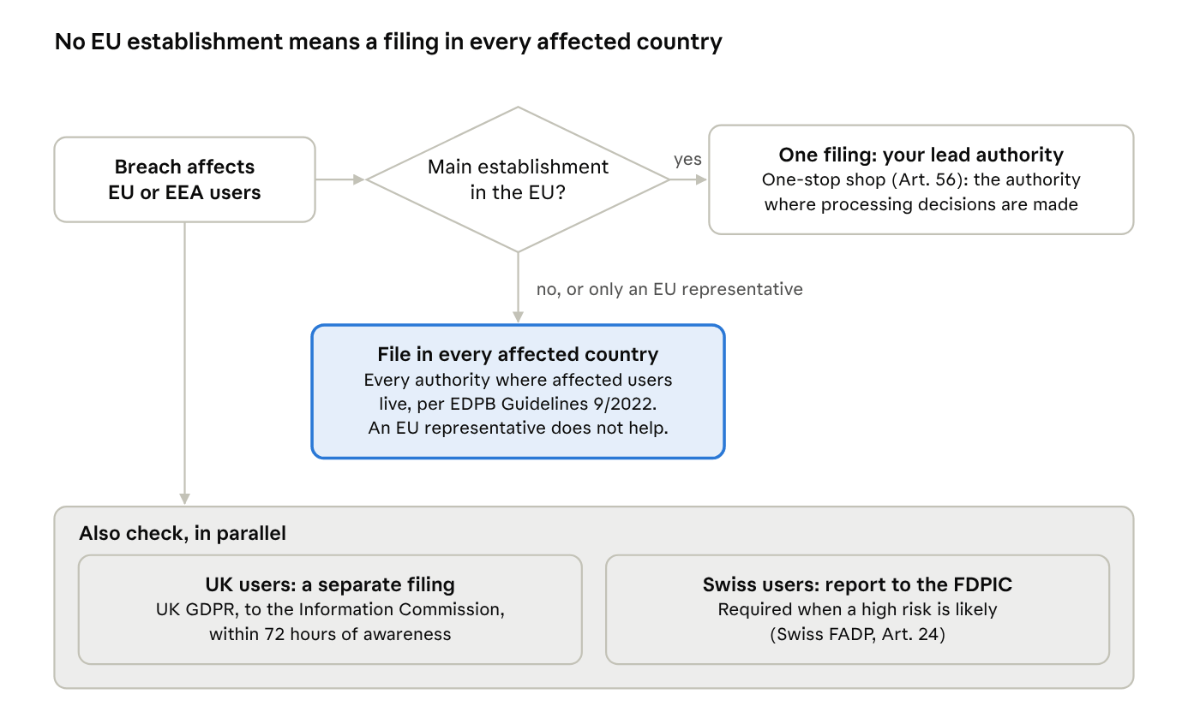
In practice, a breach that touches users in 12 EU countries means 12 filings, plus one in the UK. Here is how to keep that from eating your 72 hours:
-
Build a residency map now. Count your users by country from KYC, billing and IP data, and refresh it monthly. During a breach you need affected-user counts per country in hours, not days.
-
Know your German authority. Germany has a federal commissioner plus 17 state authorities across its 16 states (Bavaria has two), and for most private companies the state authority is the one that counts. The federal office keeps a list of the state authorities.
-
Pre-translate your filing. Most authorities take notifications through an online form, often in the national language. Draft a template once, translate it, and keep it with your runbook.
-
Bookmark the portals. The appendix at the end of this piece lists every EU, EEA, UK and Swiss authority with its website.
The UK: same rules, separate filing
If the breach touches UK users, you owe a second, separate notification under UK GDPR, on the same 72-hour clock.
After Brexit, the UK kept a copy of GDPR, now called UK GDPR, alongside its Data Protection Act 2018. The rules mirror the EU’s, but enforcement is entirely separate. An EU filing does not cover the UK, and a UK filing does not cover the EU. A company outside the UK that serves UK users is in scope, and usually needs a UK representative too.
The regulator has also changed its name. Under the Data (Use and Access) Act 2025, the office of the Information Commissioner was abolished on 30 September 2026 and replaced by a body called the Information Commission. The Act did not change the 72-hour rule for UK GDPR breaches. Telecoms and internet providers have their own breach rules under the separate PECR regime.
UK fines reach £17.5 million or 4% of global turnover at the top tier. Notification failures sit in the lower tier: £8.7 million or 2%.
Don’t mistake the UK for a soft touch. DLA Piper describes UK enforcement as limited compared with the EU, and in November 2025 more than 70 groups signed an open letter calling for an inquiry into a “collapse in enforcement activity”. But security breaches are the exception. In October 2025 the regulator fined Capita £14 million over a 2023 attack that exposed data on about 6.6 million people. A high-priority alert fired within 10 minutes. The infected device was not quarantined for 58 hours, against Capita’s own one-hour target.
Two other neighbours are worth a line in your runbook. Norway, Iceland and Liechtenstein apply EU GDPR in full through the European Economic Area, so treat them as EU countries. Switzerland has its own revised Federal Act on Data Protection. Under its Article 24, you must report a breach to the Swiss regulator, the FDPIC, when it is likely to cause a high risk, and do so as soon as possible.
From experience: when 72 hours is not enough
For a small team, filing with every affected authority within 72 hours is close to impossible, and in my experience the regulators know it.
Remember, this guide is not legal advice, especially this part. It is what I have learned from doing it. Each filing takes real time. Every authority has its own portal, its own form and often its own language. Even with documents prepared in advance, you end up copying and pasting the same facts, field by field, into a dozen clunky web forms, while your engineers are still containing the incident. And yes, some reporting sites don’t even work at times.
So prioritize. Here is the approach I would take:
-
File first where most of your affected users live. Rank countries by affected users using your residency map, and work down the list. If you have a lead authority, it comes first. Prioritize by users, never by which regulator seems friendliest.
-
Keep going after hour 72. The deadline passing is not a reason to stop. Finish every remaining country as fast as you reasonably can.
-
Explain the delay in every late filing. Article 33(1) expects reasons when you are late. Say plainly that the 72 hours have passed, that you were filing in several countries at once and started where most users were affected, and that you are completing the rest in good faith.
-
Use phased notification. Article 33(4) lets you file what you know now and add details later. A short first filing in each remaining country beats a complete one a week late.
-
Prepare the copy-paste kit now. Write one master incident summary that maps to the fields most forms ask for: what happened, data categories, approximate numbers, likely consequences, measures taken and a contact. Translate it into your users’ main languages before you ever need it.
Perfection is not what regulators expect. What they expect is that you report, honestly and in good faith. The companies that land in real trouble are the ones that never file at all.
Regulatory arbitrage: what is real and what is a myth
Although it may be tempting (and quite frankly logical), you cannot pick a friendlier regulator after a breach, and the regulator with the gentlest reputation (Ireland) turns out to account for most of the value of Europe’s GDPR fines.
Arbitrage is real in exactly one place: where you set up your EU main establishment. Big Tech chose Ireland, and for years critics called Dublin a soft touch. Then other EU regulators started overruling it through the European Data Protection Board, which pushed decisions like the record €1.2 billion fine on Meta in 2023.
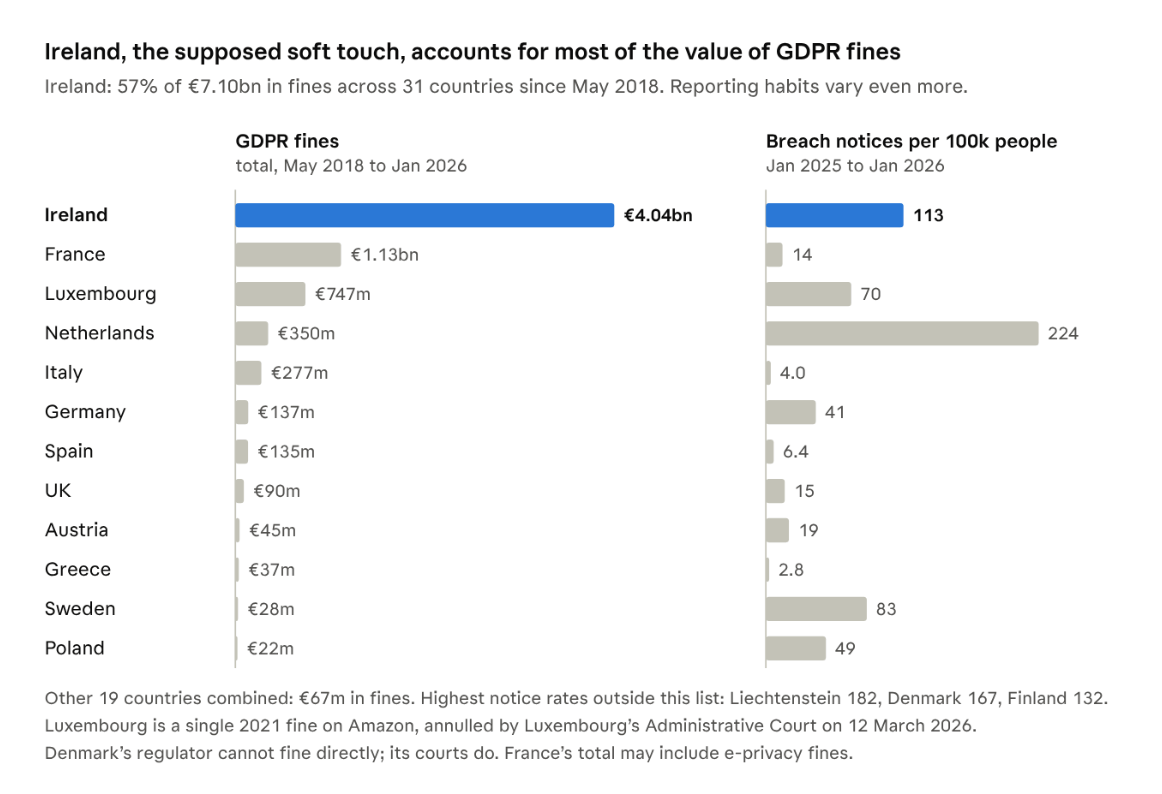
DLA Piper GDPR Fines and Data Breach Survey, January 2026 · 31 EU, EEA and UK authorities; top 12 by fines shown
The chart shows two ways regulators differ. On fines, Ireland stands alone because it supervises most of Big Tech. Large totals alone do not prove a regulator is strict across its whole caseload, but they do end the idea of a safe haven. On breach reporting, the gap is enormous: the Netherlands logs 224 notices per 100,000 people a year, Italy 4. Nobody believes Dutch companies get hacked 55 times more often than Italian ones. The more likely story is that reporting culture, thresholds and enforcement pressure vary by country, and that a great many breaches never get reported at all.
Styles differ too. Spain’s regulator issues the most fines by count, 1,048 by CMS’s tally, but most are small, so smaller companies feel it. Italy’s Garante is Europe’s most aggressive on AI: it briefly blocked ChatGPT in 2023 and fined the maker of the Replika chatbot €5 million in 2025. The UK fines rarely, but hard, when security fails.
So where does that leave a leader?
-
The legitimate play is structural. If you have real EU operations, and a MiCA crypto licence already requires them, put your main establishment where your decisions are really made. Choose for predictability and competence, not leniency.
-
There is no arbitrage in notification. If you have no EU establishment, you file everywhere affected users live. Filing with the friendliest authority and skipping the rest is simply non-compliance.
-
The window is closing anyway. The EU’s new GDPR procedural regulation harmonizes how cross-border cases are run from 2 April 2027, which leaves even less room between regulators.
Step 4: Tell your users, and protect them
Your users pay for a breach long after the regulator closes the file, so the notice to them matters more than the one to the authority.
In crypto, leaked customer data does not stay on a forum. It turns into phishing calls, fake support agents and, increasingly, physical threats. In May 2025, criminals bribed overseas support agents at Coinbase to copy customer records: names, addresses, phone numbers, government ID images and balance snapshots. They then demanded $20 million. Coinbase refused, offered a $20 million bounty instead and committed to reimburse eligible customers who were tricked into sending funds to the scammers.
The physical side is worse. France’s interior minister reported 77 crypto-linked kidnapping and extortion incidents in the first half of 2026, up from 45 in all of 2025. In January 2025, Ledger co-founder David Balland was abducted from his home and held for ransom. Ledger’s own 2020 leak of more than 270,000 customer records still fuels scams today. A home address sitting next to an account balance is a safety issue, and that is “high risk” under Article 34 by any reading.
A good user notice is plain, specific and fast. It should cover:
-
What happened and when, in plain language, not legal prose.
-
Exactly what was exposed, and what was not. If passwords, private keys and funds were untouched, say so clearly.
-
The likely consequences. Explain what the exposure could mean for them in practice.
-
What you have done, and will do. Describe the steps you have taken or plan to take to deal with the breach and reduce the harm.
-
What scammers will try next. State that you will never call to ask them to move funds, share a seed phrase or install software.
-
What to do now. Change passwords, switch to app-based or hardware two-factor authentication, and ask their mobile carrier to lock their number against SIM swaps.
-
Protective steps tailored to what was exposed. Where identity, home addresses or holdings are involved, give specific account-security and personal-safety guidance. Any instruction about moving assets should be verified independently through trusted channels.
-
Where to get help. A dedicated page, a support line staffed by humans and a contact for your data protection officer.
Do not write “no evidence of misuse” unless you have actually looked. Do not bury the notice in a Friday-night blog post. Publish one dated page and keep updating it, but treat it as support for your direct notices: where individual notice is required, a webpage alone ordinarily does not satisfy it. Attackers now use AI to write convincing phishing from leaked data at scale, so your users need to hear from you before they hear from them.
Other clocks to check
GDPR may not be your only reporting duty. Financial firms, including MiCA-licensed crypto firms, should check DORA, and operators of essential or important digital services should check NIS2. Both run on their own deadlines, some shorter than 72 hours, so have counsel map them before an incident.
Reform is on the way too. The EU’s proposed Digital Omnibus would give companies 96 hours and require notice only for high-risk breaches, but it is not law yet. Plan for 72 hours until the Official Journal says otherwise.
Step 5: After the fire
The regulator’s file stays open long after the incident is contained, and it will judge you on what you wrote down in the first hours.
-
Finish the breach register. Article 33(5) requires the facts, the effects and what you did about them. Meta paid €3 million for a thin record alone.
-
Send follow-ups as you learn more. Article 33(4) allows information in phases. Correct your early estimates openly, and tell every authority the same story. Twelve slightly different versions of one incident is its own problem.
-
Run a post-incident review within 30 days. Find the root cause, and measure the gap between first alert and containment. Capita’s 58-hour gap was one of the failings the regulator cited.
-
Fix the agent layer. Give AI agents the least access they need, short-lived credentials and logged tool calls. Require a human to approve bulk exports. Test them against prompt injection the way you test web apps.
-
Review your vendors. Processors are directly liable for security under GDPR. Require notification without undue delay, with a clear contractual maximum measured in hours.
-
Rehearse. Run a tabletop exercise at least twice a year. Make one of them start at 2 a.m. on a Saturday, with users in 12 countries and a ransom note in the inbox.
The bottom line
A breach can expose weaknesses in both your security and your response. Prompt reporting, clear records and effective remediation matter, but they do not erase failures in how the system was designed or protected.
In the agentic era, a breach is a question of when, not if. Attackers run at machine speed, and your own agents widen the door. What you control is the first 72 hours. Here is the plan to pin to the wall:
-
Before anything happens: map your users by country, bookmark every regulator’s portal, pre-translate your filing template, inventory every AI agent with a kill switch, and keep one notification matrix covering every regime that applies to you.
-
Hour 0: log the moment you became aware. Contain, preserve evidence and assemble the team.
-
Hours 0 to 24: assess the risk, and check whether DORA or NIS2 also apply.
-
By hour 72: file with your lead authority. With no EU establishment, start where most affected users live, and keep filing past hour 72 with reasons for the delay. File separately in the UK.
-
As soon as possible, for Switzerland: if the breach is likely to cause Swiss users a high risk, report it to the FDPIC. Swiss law sets no fixed 72-hour window.
-
Without undue delay: tell affected users in plain language, with concrete steps to protect themselves.
-
After: send follow-ups, complete the breach register, fix the root cause and rehearse again.
Your users trusted you with their data. In crypto, they may have trusted you with their safety too. Being ready is how you honor that.
Important notice
-
Not legal advice. This guide gives general information about EU, and UK data protection rules as they stood on 18 November 2026. It is not legal advice and must not be relied on as such. Breach obligations turn on the facts and on the laws of each country involved, so get advice from qualified counsel in every relevant jurisdiction before you act.
-
No lawyer-client relationship. Reading this guide, or contacting the author or Advoqua through it, does not create a lawyer-client relationship. Do not send confidential information until an engagement has been agreed in writing.
-
Personal views. The views expressed are the author’s own. They do not necessarily reflect the views of Bitcoin.com, its affiliates or any client.
-
Accuracy and currency. Laws, regulatory guidance and enforcement practice change often. No representation or warranty is given that this guide is accurate, complete or current, and it may not be updated.
-
Examples and third-party sources. Incidents, fines and figures come from public sources and are cited only to illustrate general points. They describe what those sources report and imply nothing further about any company named. Links to third-party websites are provided for convenience, and their owners are responsible for their content.
-
Trademarks. Company and product names are the trademarks of their respective owners. Their mention does not imply endorsement or affiliation.
Appendix: where to file
These are the data protection authorities for all 27 EU states, the three EEA states, the UK and Switzerland, with websites as listed by the European Data Protection Board.
Three direct breach-notification portals worth bookmarking: Ireland’s DPC form, France’s CNIL notification service and Switzerland’s FDPIC DataBreach portal.
General information only, not legal advice.

 news.bitcoin.com