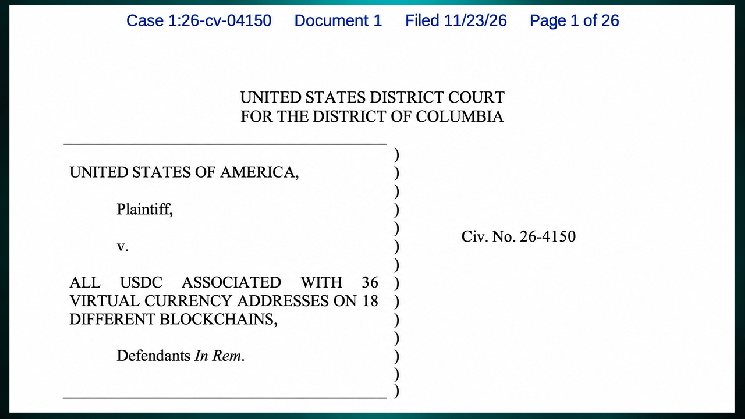
In the latest complaint filing, investigators describe an elaborate intrusion beginning with a seemingly ordinary employment opportunity. A Binance employee was approached by someone posing as a recruiter and subsequently instructed to download software during a job interview. The application secretly contained malware, compromising the employee’s device and providing attackers an opening into Binance’s infrastructure.
According to the disclosure, the intruders exploited Ethereum’s EIP-7702 functionality, introduced in 2025, to manipulate wallet authorizations and execute malicious transactions. The attackers allegedly deployed automated sweeper contracts capable of transferring assets immediately upon receipt, effectively hijacking Binance-controlled hot wallets.
Federal investigators traced approximately $780 million in $USDC transferred at 20:41 UTC on Oct. 29, followed by another $43 million just 18 minutes later. Both transactions reached the same Ethereum address. Additional stolen assets traveled through bridges, swapping services, and intermediary wallets, complicating investigators’ efforts to reconstruct their movements.
Circle Agrees to Replace Frozen $USDC Following Court Order
The complaint identifies $USDC across Ethereum, Solana, Polygon, Arbitrum, Base, and numerous additional networks. Circle voluntarily blocklisted the affected addresses around Oct. 29, preventing further $USDC transfers. Crucially, Circle cannot directly retrieve the frozen tokens because the compromised addresses remain under the attackers’ control.
Instead, the stablecoin issuer has agreed to mint an equivalent amount of replacement tokens, designated “Substitute $USDC,” and transfer them to the U.S. government following a forfeiture order. Investigators also uncovered connections to September’s $387 million Bitget breach, identifying wallets that allegedly received proceeds from both attacks.
The filing places the Binance theft within a broader campaign of cryptocurrency intrusions attributed to the state-sponsored hacking syndicate Lazarus, including the $1.5 billion Bybit exploit in February 2025. The U.S. government’s forfeiture request remains subject to judicial approval, meaning the assets have not yet been permanently awarded to federal authorities.
The Justice Department’s announcement on Monday confirms that the action is intended to help Binance recover stolen assets, rather than simply confiscate money for unrelated government purposes.
The case illustrates an unusual enforcement mechanism: Rather than recovering stolen tokens directly, prosecutors are relying on a centralized stablecoin issuer’s ability to immobilize compromised balances and replace them through a court-supervised process.

 news.bitcoin.com