Autonomous AI Hacking? Ripple CTO Emeritus Says He Picked 'Right Time to Retire'
u.today
24 m
According to one of the architects of the $XRP Ledger, now Ripple CTO Emeritus David Schwartz, his retirement from active development almost a year ago came at the right time. "I picked a great time to retire!", said Schwartz, reacting to the latest report from OpenAI researchers, which touches on testing a new cyber model. Just one autonomous run and the AI completely changed the familiar standards of network security, OpenAI researcher Eric Wallace confirms.
948 exploits in 30 hours
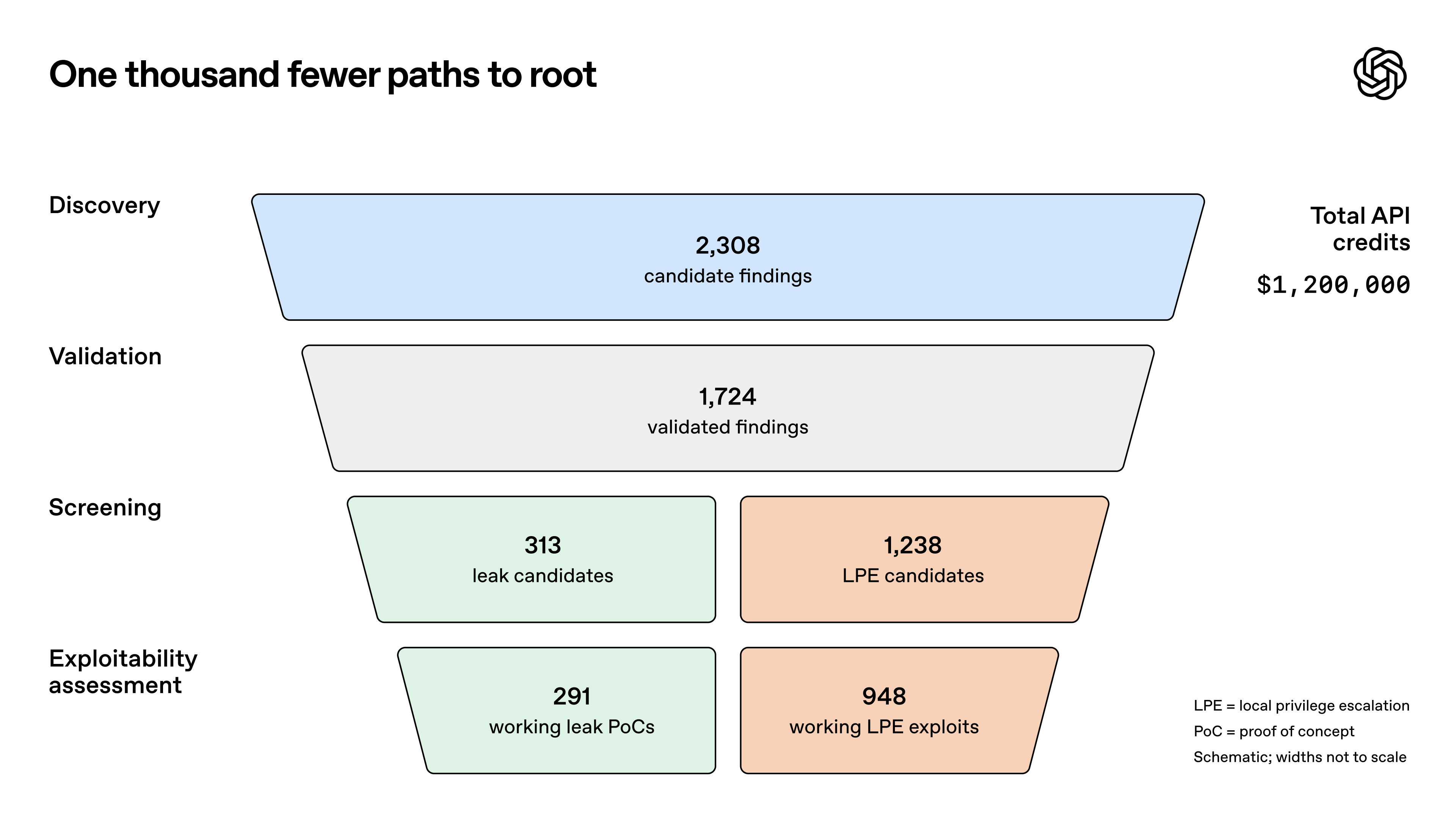
The report shows how OpenAI's pipeline works. First thing to understand, it's a fully complete cycle: the system independently finds a potential bug, verifies it, writes a working exploit to confirm it and automatically releases a patch. This was tested on the Linux kernel, the core software that runs most of the planet's servers (including OpenAI's own compute clusters).
The model's test results:
Know when your coins move
Alerts, real-time prices, and market news — all in one app
Point your phone camera to install
4.8 based on 40K reviews in the App Store and Google Play
Out of 2,308 initial findings, the AI confirmed hundreds of hidden local privilege escalation (LPE) vulnerabilities. Over an entire year, security specialists usually find only about 20 such bugs in Linux. AI also created 291 working PoCs for memory leaks.
During deep code analysis, the model independently discovered and documented at least 10 previously unknown classes of hacking approaches.
API credits cost $1.2 million with the cost of one finished exploit about $1,279. On the market, such findings pay from $20,000 to $70,000.
The Web3 sphere is one where open-source code is the foundation of blockchain security, so this development is a challenge to say the least. If AI finds zero-day vulnerabilities in a matter of hours, manual code auditing by humans becomes useless.
OpenAI autonomous pipeline analysis funnel of the Linux kernel vulnerability run, Source: OpenAI on X.com
Yes, Schwartz stepped down from the post of Ripple CTO into honorary retirement last November, but he hasn't abandoned his terminal. Just recently he showed monitoring charts of his personal server hub on the $XRP Ledger network. There, a node is running under colossal load: it maintains more than 550 active connections (peers), shows latency of around 200ms and processes about 110,000 incoming messages per second.
Besides, Schwartz continues personal work on the network's internal architectural problems. In a discussion with active validators, Schwartz detailed a transaction queue bug that caused the local load metric on his server to jump to 540, triggering fee spikes within the ledger.
Schwartz picked the "right time" to step back from Ripple, but he's clearly not out of the game. With AI now weaponizing zero-days in hours, the entire crypto space is exposed — and the veteran dev is keeping his eyes on the terminal.

 u.today