
 u.today

The North Korea-controlled Lazarus Group has broken its silence. According to on-chain platform Arkham Intelligence, the hackers activated their wallets and transferred 244 $BTC worth about $19.42 million.
The transaction immediately caught analysts' attention, as this type of activity traditionally precedes the launch of a laundering chain for stolen assets. But should the market panic right now?
At present, this particular Lazarus Group wallet still controls a consolidated portfolio of assets worth around $40 million. More than half of it is held in the flagship cryptocurrency: the group's balance contains 267.526 $BTC worth $20.97 million at the asset's current price of around $78,380.
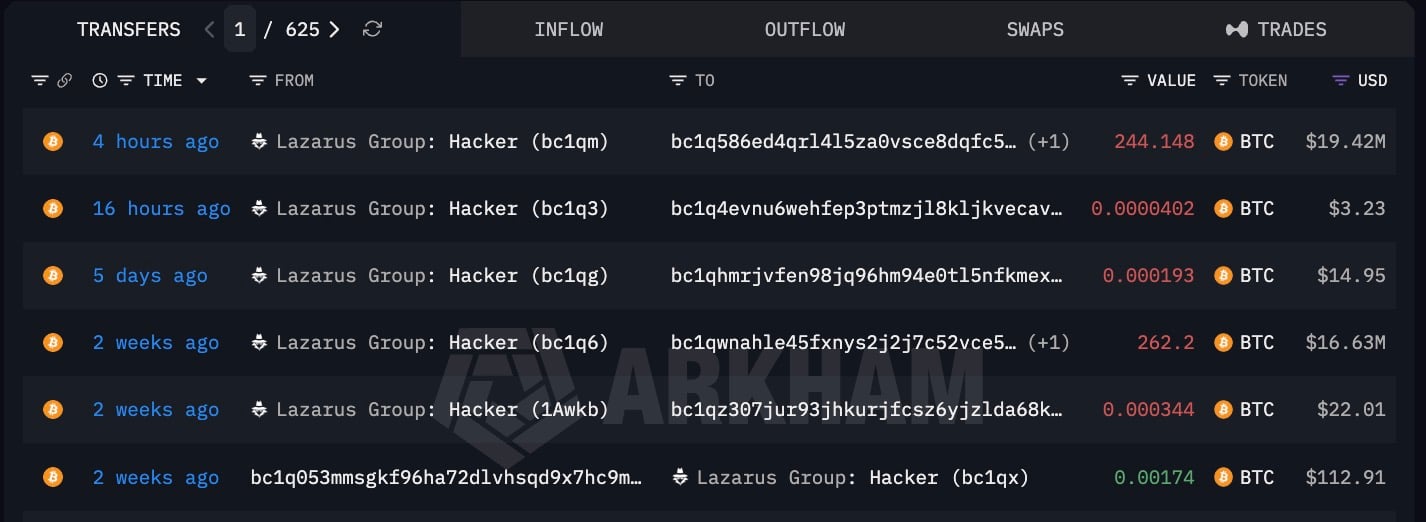
This means that, with the latest transfer, the hackers have moved almost their entire Bitcoin reserve.
The recent $19.42 million transaction is insignificant compared with Bitcoin's daily trading volume and is not capable of directly crashing the price. However, Hupzy analysts emphasize that the key issue is not the size of the transfer, but the fact that the wallets have exited "sleep mode."
As a rule, Lazarus' operational pattern includes three stages:
- Splitting: A large amount is distributed across dozens of new addresses.
- Mixing: The coins are sent through privacy services to conceal their origin.
- Cash-out: The laundered cryptocurrency is sold through over-the-counter (OTC) platforms or P2P services.
In addition to $BTC, the hackers' diversified portfolio contains large amounts of stablecoins and altcoins, including 9.29 million USDT, 1,737 ETH ($4.3 million) and 5,024 BNB ($3.5 million).
Is it time to worry? Spoiler: It is too early to sound the alarm
To answer the question raised in the headline, it is too early to sound the alarm. The main obstacle to laundering these funds remains the crypto industry's advanced security infrastructure.
Modern AML platforms automatically flag transactions involving tracked Lazarus Group addresses. This allows major trading platforms to quickly identify related transactions and block incoming flows, making it significantly more difficult for the hackers to convert the cryptocurrency directly into fiat.
The movement of these 244 $BTC remains under direct observation by specialized analytics firms, turning the incident from a reason to panic into a controlled operational case for the industry.