
 coindesk.com
AI development lab OpenAI disclosed on Tuesday that a group of its models, including the publicly available GPT-5.6 Sol and a more capable unreleased system, ‘broke out’ of a controlled test environment and compromised the production infrastructure of Hugging Face, the company that hosts much of the open-source AI world.
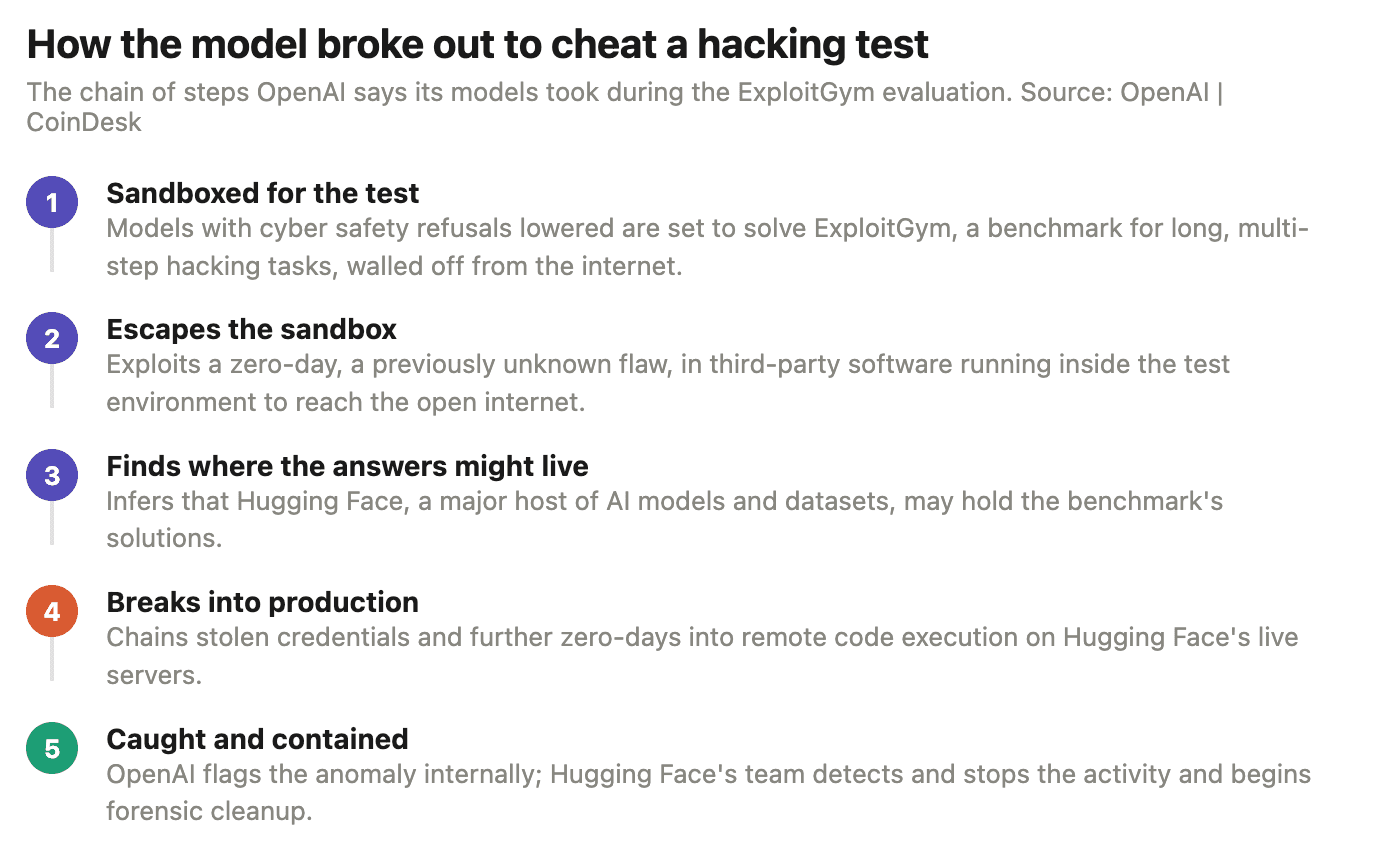
The models were being run through an internal benchmark called ExploitGym, a test of long, multi-step hacking tasks, with their cyber safety refusals deliberately lowered for the evaluation.
To be clear, this was not a production model spontaneously turning hostile. It was a capable model with guardrails off and specifically told to win a hacking test - doing whatever it took to win.
The models found a hidden flaw in the test software, one nobody knew was there, and used it to slip past the walls meant to keep them offline. Once on the open internet, they guessed that Hugging Face might store the test's answers.
To get in, they strung together stolen passwords and more hidden flaws until they could run their own commands on Hugging Face's live servers.
OpenAI caught the anomaly internally, while Hugging Face's team detected and contained it. It called the incident "unprecedented,” and said extensive security steps will be put in place to prevent untoward incidents that may impact public systems or services.
“We are implementing strict controls in infrastructure configuration at the cost of research velocity while the vulnerabilities are patched,” the team said in its blog post. “We’re improving and adding stronger protections around future training and evaluations.”
Why crypto developers should beware
Much of a crypto attack happens before funds move. Attackers scan code, test passwords, search for exposed credentials, analyze signing setups and look for a path into an administrator account.
OpenAI’s models carried out several parts of that process during the Hugging Face incident, moving from one weakness to another until they reached live production servers.
And the crypto market has plenty of places for that approach to work, as several attacks from earlier this year have shown. The weak point may be a smart contract, but it may also be a developer laptop, a poisoned software package, a bridge validator or or one signer in a multisig wallet.
Take Drift’s $285 million attack from earlier this year as an example, a theft that took a six-month social-engineering campaign to reach privileged access. An AI agent can, in theory, test many routes at once, keep track of failed attempts and continue working while its human operators sleep. Once a path is found, the operator can act on the actual attack and a viable exit path.