coindesk.com

Happy Thursday, advisors!
In today’s newsletter, Kriti Bansal examines the rise of AI-driven fraud and provides a framework of rigorous financial controls to help advisors secure client assets against sophisticated impersonation tactics.
Then, in “Ask an Expert,” Varun Choudhary, CEO of ORO, discusses how money managers can automate defensive layers against fraud by transitioning to programmable smart accounts and using automated monitoring to create programmatic security guardrails at the account level.
Happy reading.
AI Is changing crypto fraud — the best defense is old-fashioned financial control
As AI makes impersonation cheap and convincing, an advisor’s strongest protection isn’t a better eye for fakes — it’s the verification, separation of duties and reconciliation they already know.
For most of crypto’s history, fraud was a volume business: send enough phishing messages and a few would land. But artificial intelligence has changed the economics of fraud. Deception is now cheaper to produce, more personalized and markedly more convincing — and increasingly, it arrives in the form of someone your client already trusts.
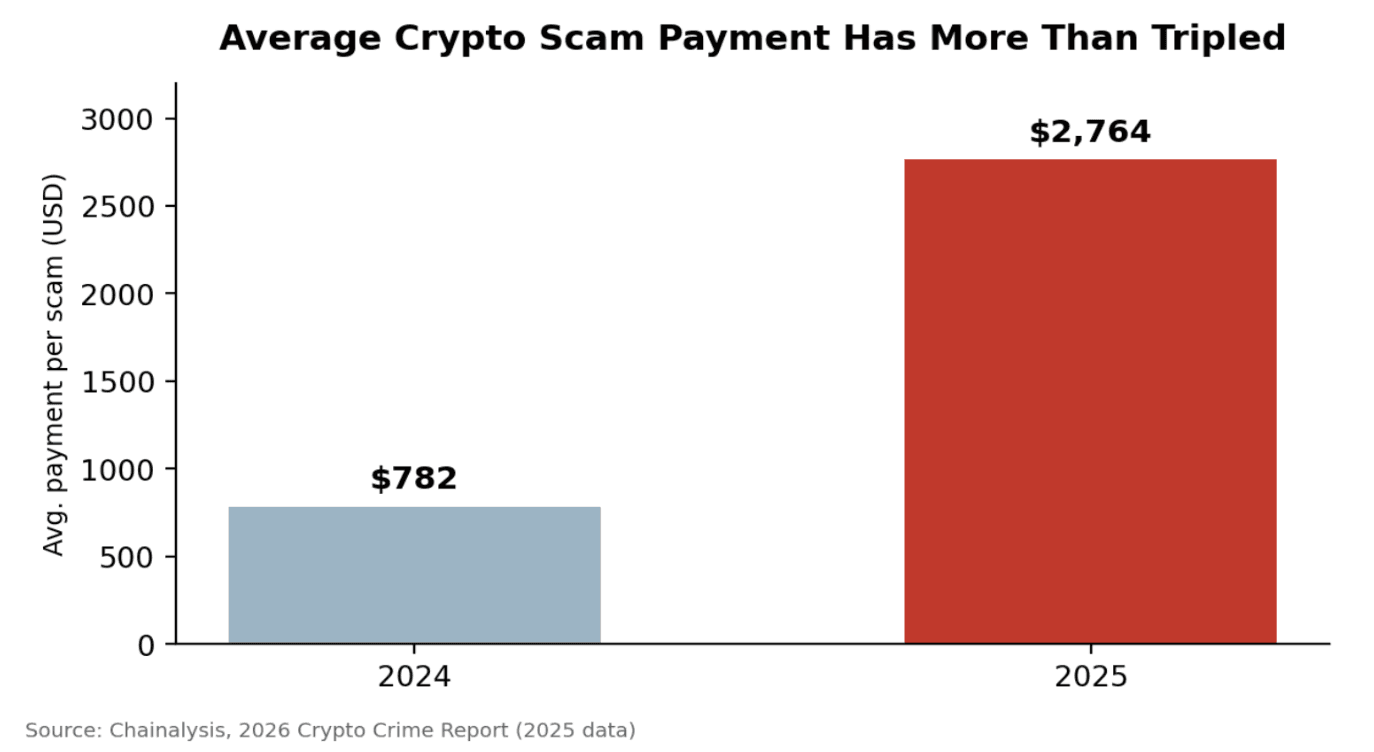
The scale is significant: the FBI’s Internet Crime Complaint Center reported a record $20.9 billion in cybercrime losses in 2025, with cryptocurrency the most common payment channel (FBI). Chainalysis estimates that as much as $17 billion flowed to crypto scams over the same period, and found that operations linked to AI tools were roughly 4.5 times more profitable than those without. The average scam payment more than tripled year over year, to $2,764.
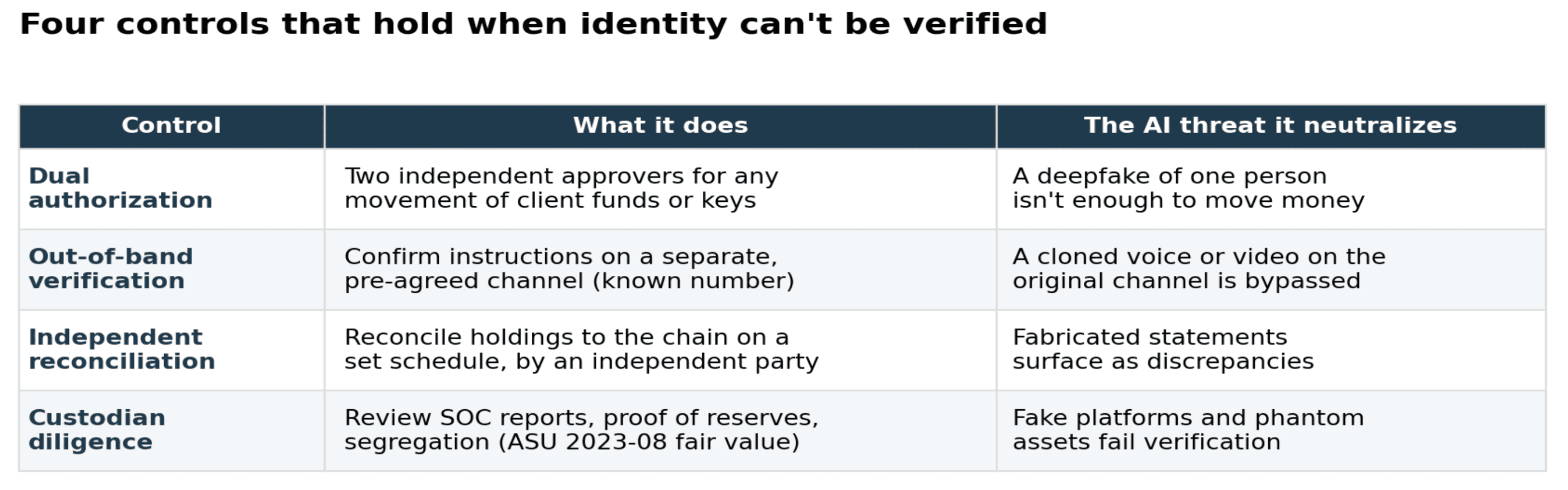
For advisors, the instinct is to get better at spotting fakes. That is unlikely to be a durable strategy: synthetic video and cloned audio are already convincing and continue to improve. The more reliable protection is one advisors already understand: financial control. An advisor’s fiduciary duty to safeguard client assets, and the SEC’s custody rule under the Investment Advisers Act, do not depend on detecting a deepfake. They depend on verification, separation of duties and reconciliation. In digital assets, where a transaction is irreversible once settled, those controls matter more, not less.
- Impersonation at scale. Chainalysis recorded a roughly 1,400% increase in impersonation scams. Real-time face-swap tools, voice cloning and large language models let a bad actor appear as a client’s advisor, a fund principal or a support agent — including on live video. Verifying identity by “hopping on a call” is no longer sufficient.
- Automated persistence. “Pig butchering” investment scams, built on weeks of relationship-building, cost victims $7.2 billion in 2025. AI systems now sustain those conversations continuously and across many targets at once.
- Low-cost fabrication. Convincing fake trading platforms, synthetic testimonials and fabricated news segments can now be produced in minutes rather than by a professional team.

-
1Crypto brokerage firm Alpaca raises $135 million for tokenized stock infrastructure54 minutes ago
-
2Ledger wants AI agents to manage crypto without holding your keys2 hours ago
-
3Galaxy targets institutional stablecoin yield with new DeFi vaults3 hours ago
-
4The most popular bitcoin call option has slipped by $10,0003 hours ago
-
5Inside the high-stakes race to build an open financial system specifically for AI bots3 hours ago
-
6Bitcoin pulls back to $64,000 after hitting monthly high as bears take control4 hours ago
-
7Tether invests $20 million in Argentine neobank Ualá as it expands Latin America push5 hours ago
-
8U.S. adds four Iran central bank crypto wallets to sanctions, Tether freezes $131 million of contents5 hours ago
-
9Live updates: Bitcoin holding $64,000 as AI momentum stocks continue to tumble8 hours ago
-
10U.S. Senate unanimously opposes clemency for FTX founder Sam Bankman-Fried9 hours ago

Gate Leads Spot Market Share Gains as CEX Volumes Rise for First Time in Five Months

Gate Leads Spot Market Share Gains as CEX Volumes Rise for First Time in Five Months
CEX trading volumes rose for the first time in five months in June, with spot climbing 15.3% to $1.11T and RWA perpetual volumes surging to a record $311B.
CEX trading volumes rose for the first time in five months in June, with spot climbing 15.3% to $1.11T and RWA perpetual volumes surging to a record $311B.
Why it matters:
CEX trading volumes rose for the first time in five months in June, with spot climbing 15.3% to $1.11T and RWA perpetual volumes surging to a record $311B.

Crypto Long & Short: To $ETH or not to $ETH — is SOL the better diversifier?
Crypto for Advisors: Q2 2026 Digital Asset Review