
 crypto-economy.com
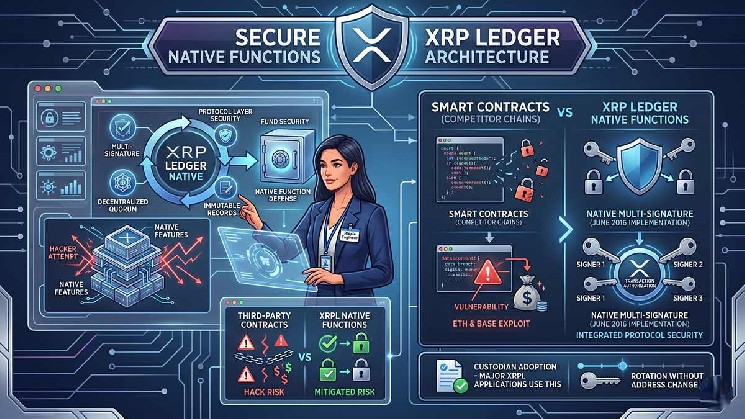
- The exploit of the SquidRouterModule protocol on Ethereum and Base resulted in the theft of approximately $3 million in nearly 2 hours.
- The native multi-signature functionality on the $XRP Ledger network was officially implemented in June 2016.
- The $XRP Ledger ecosystem allows modifying signers or quorum without the need to alter the fund receiving address.
RippleX software engineer Mayukha Vadari highlighted the security offered by the $XRP Ledger’s native features against external vulnerabilities. The statement was made following a recent exploit on competing networks that affected dozens of automated wallets.
The advantage of native multisign on the XRPL: zero smart contract risk.
Because multisign is baked directly into the protocol, not patched together via 3rd-party smart contracts, this attack vector literally doesn't exist for your accounts.
This is why native features matter. https://t.co/Gt39PFSg80— Mayukha Vadari (@msvadari) May 25, 2026
The specialist’s reaction came after a report from the firm Blockaid. This report detected a targeted attack on the SquidRouterModule component on the Ethereum and Base networks. Data from Blockaid reveals that the incident led to the draining of 86 Gnosis Safes wallets for an amount close to $3 million in less than 2 hours. The stolen assets were converted to the stablecoin DAI through controlled liquidity pools on Uniswap V3.
Vadari argued that multi-signature integrated directly into the protocol eliminates the risk associated with third-party smart contracts. Being hardcoded into the base layer, the technical attack vector is unavailable for XRPL accounts. The engineer stated that this scenario clearly exposes the relevance of native tools over external software patches.

Technical Implementation and Ecosystem Differences
In response to claims by critics who argue that multi-signature support is low in XRPL applications compared to Bitcoin, the engineer clarified the current distribution of the ecosystem.
Mayukha Vadari explained that a large portion of custody applications regularly use this feature. According to the developer’s analysis, these entities represent the highest-volume users within the network.
The engineer detailed that Ripple’s scheme differs significantly from Bitcoin’s model. The Bitcoin network fundamentally relied on basic M-of-N support until the arrival of the Taproot upgrade in 2021. In contrast, official records indicate that native multi-signature on the $XRP Ledger has been operational since June 2016.
The multi-signature scheme integrated into XRPL allows authorizing transactions through the combination of several secret keys. The protocol’s technical documentation notes that any user address can enable combinations of authorization methods, including regular key pairs, master keys, and multi-signature schemes. The ledger’s design only requires that at least one of these mechanisms be active to process movements.
According to system specifications, the model offers operational flexibility for institutional fund management. Signers or the required quorum can be modified without altering the public receiving address. Furthermore, members of the security scheme have the ability to rotate their individual credentials without freezing or moving the crypto-assets deposited in the ledger.
Monitoring of new updates to RippleX’s security components will continue during the upcoming development sessions scheduled for this quarter.