
 cointelegraph.com

In June 2013, the lens through which US citizens looked at their government was dramatically changed; it was now a PRISM.
PRISM was the program that enabled the National Security Agency (NSA), with some help from the FBI, to obtain unthinkable quantities of data from tech giants like Google, Facebook and Microsoft, among others.
Despite previous statements that the NSA did not collect data “directly” from tech companies, American whistleblower Edward Snowden revealed that they did, and that it was just one portion of a larger picture showing that the US was in the mass surveillance game.
With the veil lifted, change was inevitable. We saw major legislative reform with the USA FREEDOM Act passing in 2015, the rise of digital privacy advocacy groups and courts ruling that the NSA’s phone data surveillance was illegal.
After Snowden, the data flood only accelerated
Practically speaking, though, what has really changed?
“Everything has changed, and nothing has changed,” renowned security technologist Bruce Schneier told Cointelegraph’s Not Dead Yet show. “Certainly, the surveillance is still happening.”
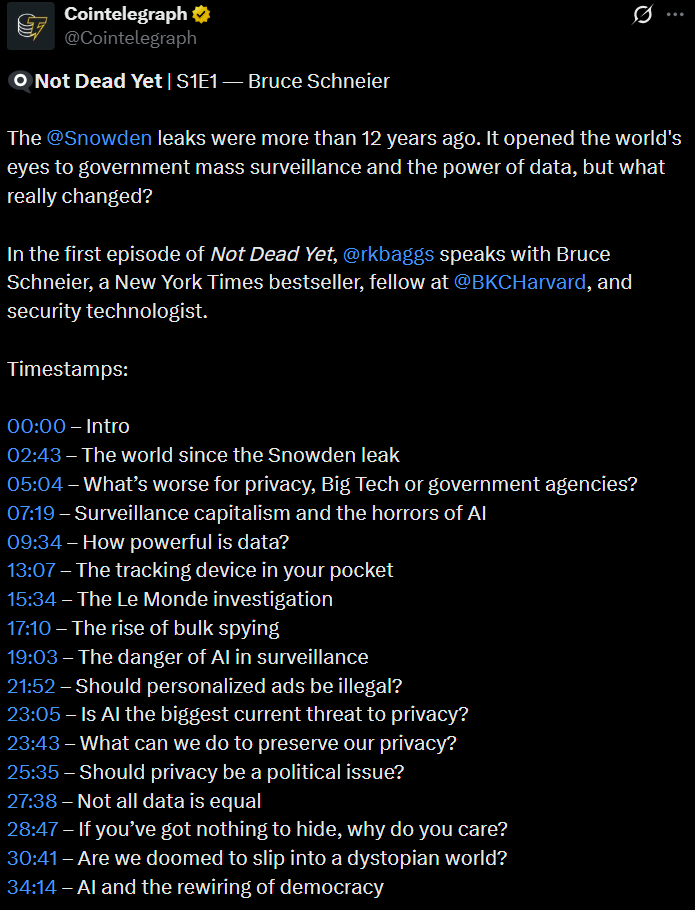
Schneier, a New York Times bestselling author and fellow at Harvard’s Berkman Klein Center for Internet & Society, didn’t stop there with his warnings.
The scale of the data problem is seldom understood, Schneider says. Not only is there exponentially more data collected than in the lead-up to the Snowden leaks in 2013, but it is also markedly more granular.
In December 2025, investigative journalists at French newspaper Le Monde managed to track spies, special forces and those close to the French president with mobile phone ad data purchased from a major broker.
“In the case of our policeman, we can follow him to a famous sports store, to the recycling center, to the gas station… And all the way home,” the journalists wrote.
The quantity and quality of modern data allow mass surveillance at a level never seen before, and surveillance capitalism is foundational to the status quo. But now, Schneier warns, parallel to the rise of mass surveillance is the new threat of “bulk spying.”
“The fact that AI can go voice-to-text and summarize means we are entering the world of bulk spying in addition to bulk surveillance […] I will guarantee you, the US, China, Russia, [and] other countries, are doing this.”
The NSA collected data from the biggest tech monopolies of the time, and Schneier is concerned that history is repeating itself, this time with AI companies.
“All of the horrors of social media are coming back in a way that’s even worse with AI,” he said.
A bleak, dystopian future may not be set in stone, however. Privacy is trending, both inside and outside of crypto, in a way it never has before. The myriad invasions of privacy once evoked apathy, then malaise. Now it verges on outrage and action. The thousands of concessions made may have finally reached critical mass, and true change could be within reach.
Schneier told The Register, “I just can't imagine that we will have this level of mass surveillance, either corporate or government, in 50 years. I think we'll view these business practices like we view sweatshops today: as evidence of our less ethical past selves.”