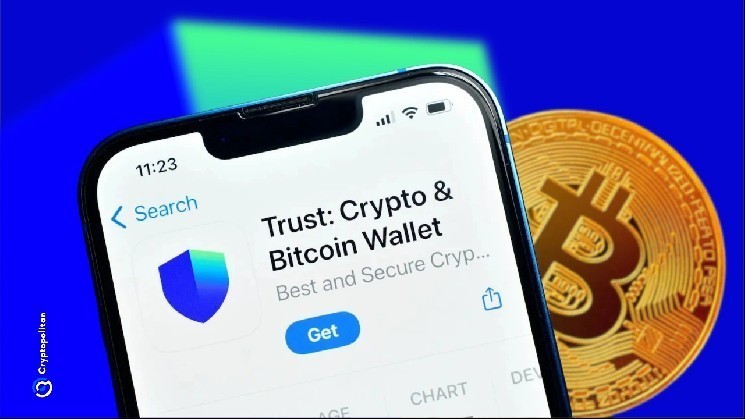
“We’ll only reach out via the same Trust Wallet support email used to reply to your original claim,” the Web3 wallet company said. It urged the users to remain cautious of impersonation attempts.
$TWT holds steady despite $7M Trust Wallet exploit
The announcement follows Trust Wallet’s confirmation last week that its Chrome extension had been compromised. A malicious code was embedded in version 2.68 of the software. The wallet provider had mentioned that the attack turned out to be the theft of around $7 million worth of crypto assets. It covered all sorts of multiple blockchains, including Bitcoin, Ether, and Solana.
PeckShield, in a post, highlighted that more than $4 million of the stolen funds were quickly routed through centralized services. This involved ChangeNOW, FixedFloat, and KuCoin. Around $2.8 million remained in attacker-controlled wallets.
The Trust Wallet Token ($TWT) hasn’t seen much downturn amid the latest hack. $TWT price jumped by 8% in the last 7 days. It has remained down by around 9% over the past 30 days. It is trading at an average price of $0.93 at the press time. On the other side, Binance’s $BNB has enjoyed the upside of the market. $BNB price is up by 7% in the last 7 days. It is trading at an average price of $911.29 at the press time.
A calm in the tokens’ price comes in when Trust Wallet said it launched a formal claims process for affected users. It required details such as compromised wallet addresses, attacker addresses, and transaction hashes.
Binance steps in
Binance acquired Trust Wallet in 2018. Its co-founder CZ also confirmed that all verified losses will be covered. “So far, $7m affected by this hack. TrustWallet will cover,” Zhao wrote on X. He added that user funds are “SAFU.”
The incident first came to light after on-chain investigator ZachXBT warned on Telegram that multiple Trust Wallet users reported funds being drained. This happened shortly after updating the extension on December 24. Trust Wallet issued a patched release — version 2.69 — on December 25.
Trust Wallet CEO Eowyn Chen later said the breach stemmed from a leaked Chrome Web Store API key. This allowed attackers to publish the compromised extension without going through the company’s internal release process.

 cryptopolitan.com