“When markets are active, overall user activity increases, and a percentage fall victim — phishing operates as a probability function of user activity,” the report said. Monthly losses ranged from $2.04 million in December, the quietest month, to $12.17 million in August, during peak market activity.
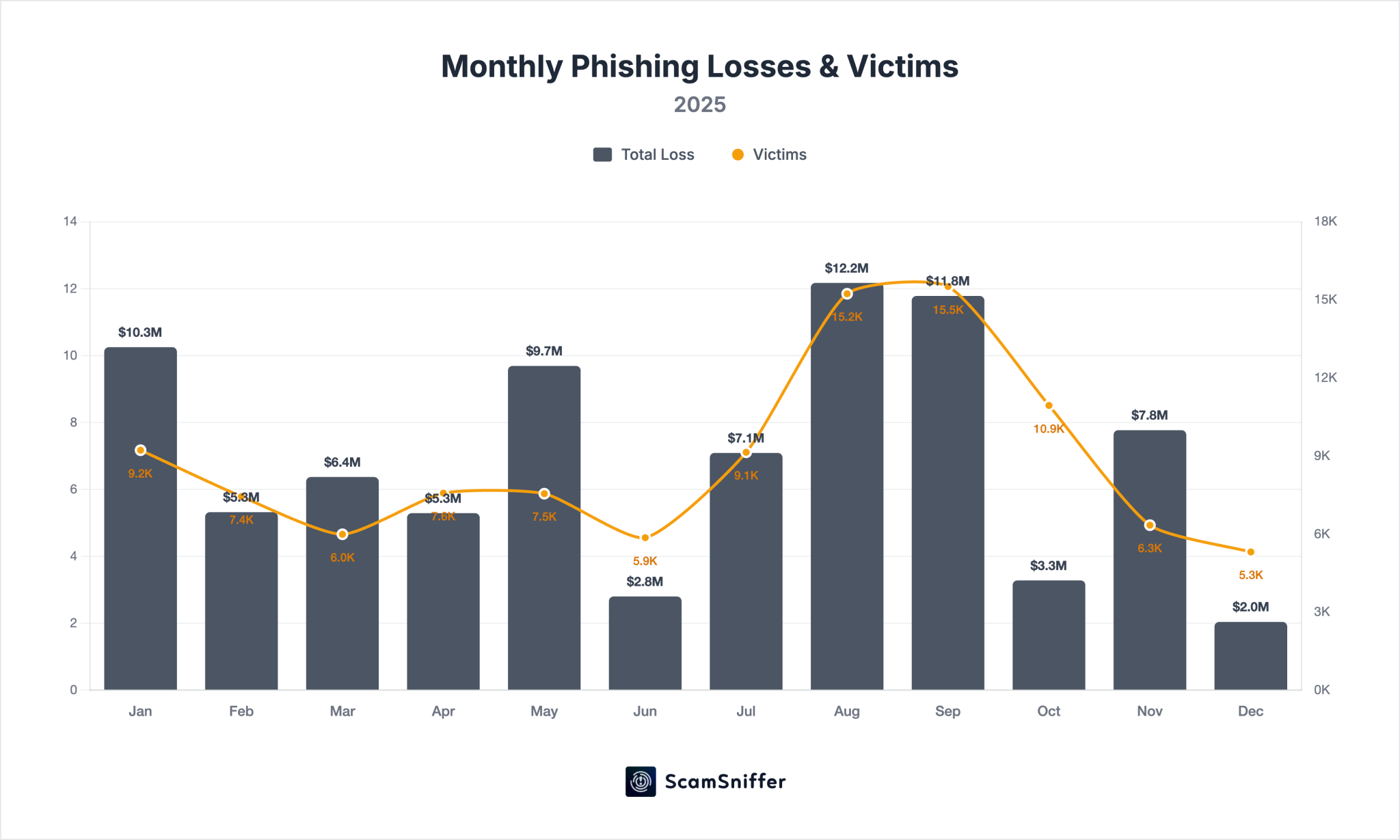
Monthly phishing losses and victims. Source: Scam Sniffer
Related: 'Hundreds' of EVM wallets drained in mysterious attack: ZachXBT
$6.5 million permit phishing attack tops 2025 losses
The largest single phishing theft of the year totaled $6.5 million in September and involved a malicious Permit signature, suggesting that Permit and Permit2 approvals remain the most effective tools for attackers. Overall, Permit-based attacks accounted for 38% of losses among incidents exceeding $1 million.
However, 2025 also marked the emergence of a new attack vector. EIP-7702–based malicious signatures appeared shortly after Ethereum’s Pectra upgrade, allowing attackers to exploit account abstraction and bundle multiple harmful actions into a single user signature. Two major EIP-7702 cases in August resulted in $2.54 million in losses, highlighting how quickly attackers adapt to protocol-level changes.
Notably, arge-scale incidents declined, with only 11 cases exceeding $1 million in 2025, down from 30 in 2024. However, the report noted that attackers increasingly favor lower-value, higher-volume strategies. The average loss per victim fell to $790, suggesting a shift toward broader, retail-focused campaigns rather than isolated, high-profile thefts.
“The drainer ecosystem remains active — as old drainers exit, new ones emerge to fill the gap,” the report concluded.
Related: Crypto hack counts fall, but supply chain attacks reshape threat landscape
Crypto hack losses fell 60% in December
As Cointelegrpah reported, crypto-related losses from hacks and cybersecurity exploits dropped to about $76 million in December, down 60% from November’s $194.2 million, according to PeckShield. The firm recorded 26 major incidents during the month, indicating a slowdown in overall losses even as attack activity remained persistent.
The largest case involved a $50 million address poisoning scam, where attackers use lookalike wallet addresses to trick victims into misdirecting funds, while another incident saw $27.3 million lost through a private key leak tied to a multi-signature wallet.
Magazine: Meet the onchain crypto detectives fighting crime better than the cops

 cointelegraph.com