In response to another user, Skvorc claimed that he is one of six investors who were subject to 100% token lockups from the beginning. “It was not ‘high risk’ to accept money from this address, but it is high risk to unlock owed money into it,” he wrote.
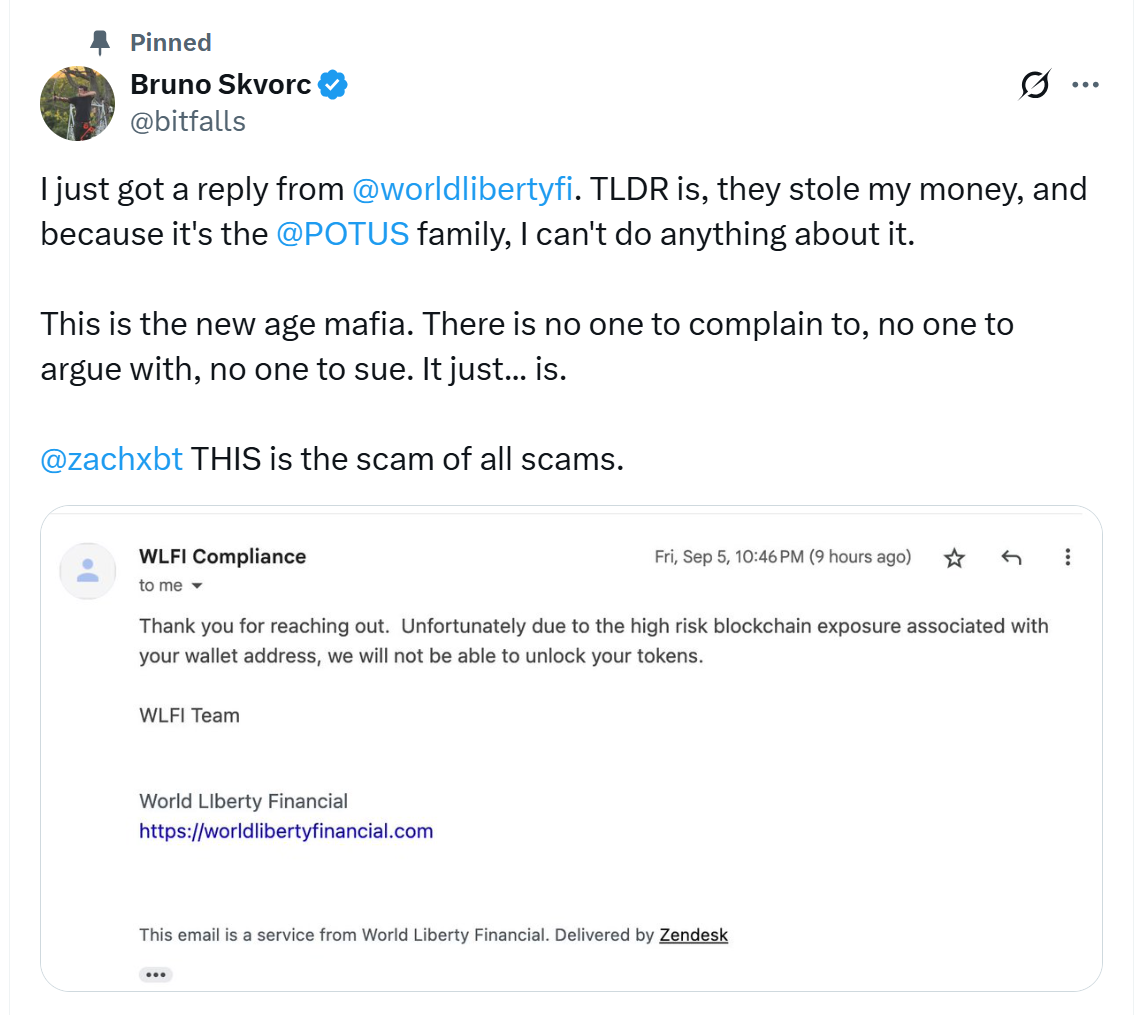
Bruno claims $WLFI stole his funds. Source: Bruno Skvorc
Related: Whales lose millions on Trump-linked $WLFI’s 40% dip, despite 47M burn
Compliance tools to blame?
The incident sparked criticism of the compliance tools used by projects like $WLFI. Onchain sleuth ZachXBT chimed in, explaining that automated tools often flag addresses as “high risk” for trivial or incorrect reasons, including interacting with DeFi contracts or exchanges.
“I helped a team manually review addresses for a presale because popular compliance tools labeled them high risk due to unrelated activity several hops away,” ZachXBT said. “These tools are deeply flawed.”
In Skvorc’s case, the flags were traced to a past transaction via crypto mixer Tornado Cash, indirect links to sanctioned entities like Garantex and Netex24, and a previous interaction with a now-blacklisted dashboard.
Based in Croatia, Skvorc is a blockchain developer who worked on Ethereum 2.0. He is also the founder of RMRK, a company integrating multi-resource NFTs into gaming metaverses.
Related: Crypto whales buy $456M Ether in ‘natural rotation’ from Bitcoin
Justin Sun’s $WLFI tokens frozen
On Friday, Tron founder Justin Sun also revealed that his $WLFI token allocation has been frozen. His wallet was blacklisted after blockchain trackers flagged a $9 million transaction, triggering accusations that he had started selling.
In a post on X, Sun called the freeze “unreasonable” and urged World Liberty Financial to unlock his tokens. He said the decision went against the core values of blockchain and called tokens “sacred and inviolable.”
Magazine: Can privacy survive in US crypto policy after Roman Storm’s conviction?

 cointelegraph.com