Braiins says attacker hijacked hashrate at 1,000+ sites
cryptopolitan.com
2 h
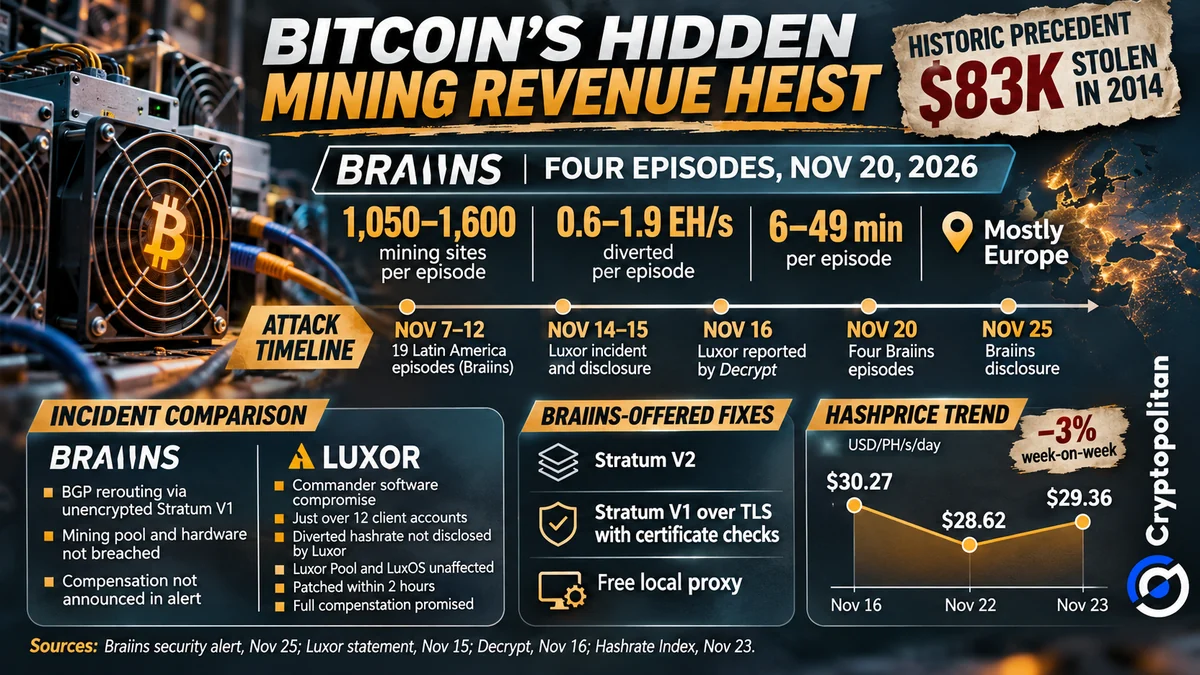
Braiins revealed on November 25 that attackers hijacked Bitcoin hashrate from more than 1,000 mining sites on November 20. The attacks expose another financial risk for miners already struggling with shrinking profit margins.
Hashrate refers to the computing power that miners use to maintain the Bitcoin network and earn the rewards for mining. In the event that hackers manage to take control of this power, miners will continue paying for the electricity used for mining, but someone else will enjoy the rewards.
Traffic rerouted, miners left hashing for nothing
As per Braiins’ security notice, hackers have not breached their mining pool or the hardware of miners. Rather, they successfully took advantage of vulnerabilities in the Border Gateway Protocol (BGP).
Know when your coins move
Alerts, real-time prices, and market news — all in one app
Point your phone camera to install
4.8 based on 40K reviews in the App Store and Google Play
BGP is the means by which independent internet networks pass routing information to one another. The hackers managed to manipulate these internet routes, hence intercepting messages sent to miners from their pools over unsecured Stratum V1 channels.
Stratum V1 is a mining communications protocol established in 2012 and sends messages in a plain text format unless some encryption is applied. Without encryption or authentication, attackers can pose as mining pools and steal the work done by miners.
Braiins has reported four episodes of hijacking on November 20 that mostly occurred in Europe. Each incident affected about 1,050 to 1,600 mining sites and redirected between 0.6 and 1.9 EH/s for around six to 49 minutes at a time. There were an additional 19 hijacking episodes that happened from November 7 to 12, mainly in Brazil and Argentina.
This is not a new incident, as this type of attack has occurred before. Dell SecureWorks reported an incident of this routing attack stealing around $83,000 worth of mining rewards in 2014.
A second redirect, through Luxor’s Commander tool
Luxor Technology revealed a separate breach on November 15. It involved Commander, its software used for fleet management. Hackers redirected mining power from about a dozen customers’ accounts.
Luxor CEO Nick Hansen described the attack method as:
“a sophisticated AI-enabled vector.”
Luxor fixed Commander within two hours. There were no data breaches. Neither Luxor Pool nor its LuxOS firmware was affected during the attack.
Luxor also assured the clients affected by the breach that each one of them:
“will be paid in full for the redirected hashrate, as if it had mined normally.”
Braiins and Luxor attackers used totally different methods. However, the result was the same: someone made a profit on computing power paid for by the miners.
Researchers have been warning about the possibility of serious implications of mining attacks beyond an individual mining company for a long time.
The IEEE research by $ETH Zurich researchers published in 2024 discussed a routing attack named EROSION. Using network data from May 2023, it showed that 50 mining pools out of 55 monitored in ten of the leading proof-of-work cryptocurrencies were affected by this attack. In one of the hypothetical cases in the study, a single malicious network was able to disrupt around 96% of Bitcoin’s hashrate.
A separate 2025 study demonstrated two ways to steal hashrate without miners noticing. The researchers also developed a detection system that achieved 98% accuracy in experiments.
Neither study measured actual losses from November’s attacks, but both illustrate how widespread the problem could become.
Revenue stolen, power bills unchanged
Routing attacks can also alter the allocation of mining rewards between rival mining pools. Researchers at $ETH Zurich have estimated that rival mining pools might earn up to 41% more revenue if the largest Bitcoin mining pool was disrupted.
For miners, the threat comes at a time when hashprice is falling. Hashprice measures how much daily revenue miners can expect to earn from a unit of computing power. On November 23, Hashrate Index recorded a hash price of $29.36 per petahash per second per day, down 3% from the previous week.
According to CoinShares, publicly listed miners spent a weighted average of $75,500 in cash costs to produce one Bitcoin in Q2 2026. Electricity alone accounts for over 80% of miners’ cash operating expenses, according to Cambridge research.
Financial pressures have already pushed some mining companies toward AI infrastructure in search of alternative revenue, as Cryptopolitan previously reported.
Whether Stratum V2 pays for itself
One way Braiins recommends protecting mining revenue is by upgrading to Stratum V2.
Stratum V2 is a mining communication protocol that encrypts connections and verifies the identity of mining pools to prevent impersonation. Miners can also secure their existing Stratum V1 connections through TLS with certificate verification or use Braiins’ free local proxy.
However, enhanced security is not the only reason that upgrading is necessary. According to a Hashlabs study, companies that mine cryptocurrency and work with a profit margin of 10% can raise their profit margins up to 2% by adopting Stratum V2 protocol with the Job Declaration feature.
The amount of money miners can make from upgrading to the Stratum V2 protocol hinges on the state of their network connections. While not foolproof against routing attacks, the protocol makes it harder for criminals to impersonate mining pools and, ultimately, steal rewards from miners.
For miners who often operate on scant profit margins, preventing any losses in revenue can be a good enough incentive for them to adopt the new protocol.

 cryptopolitan.com