
 coindesk.com
Zcash developers are already proposing another speed increase, just three days after the network completed an upgrade that made its blocks three times faster.
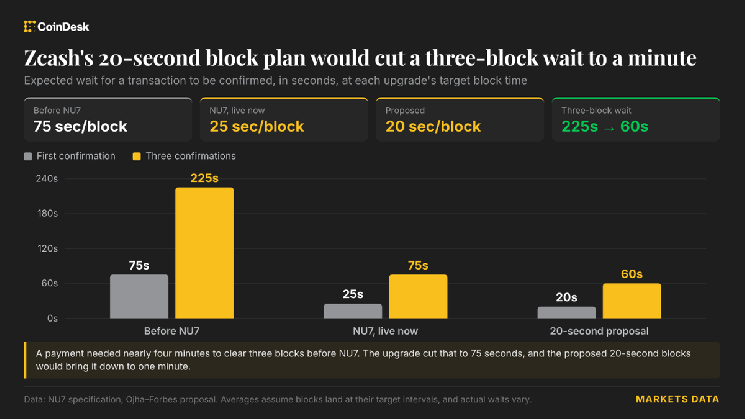
Developers Dev Ojha and Evan Forbes outlined a proposal Sunday to reduce the target time between blocks from 25 seconds to 20. Before Friday's NU7 upgrade, Zcash produced a new block roughly every 75 seconds.
Blocks are batches of transactions added to the blockchain. The shorter the gap between them, the sooner a payment can receive its first confirmation.
Under the proposed change, a customer paying with ZEC at a shop could expect the first confirmation in about 20 seconds rather than 25, while an exchange requiring three confirmations could reduce its expected wait from 75 seconds to 60 seconds.
Actual waiting times vary because miners discover blocks at unpredictable intervals.
The proposal follows encouraging early results from NU7, which developers had worried could cause more miners to waste computing power on competing blocks.
When two miners discover blocks at nearly the same time, the network eventually accepts one and discards the other. These discarded blocks, known as orphans, mean the losing miner has spent electricity on work that earns no reward. Faster blocks increase that risk because miners have less time to learn about each other's discoveries.
Yet Zcash's observed orphan rate stood at just 0.69% over the 24 hours ending early Monday, according to ZecBlock's mining tracker, compared with approximately 0.66% before NU7.
"The orphan rate has gotten better than I anticipated!" Ojha wrote Monday.
The rate across the entire period since NU7 remains higher at 1.29%, with readings declining after an initial spike. ZecBlock also increased its monitoring network from one node to ten shortly before the upgrade, meaning it can now detect some competing blocks that previously went unnoticed. The figures therefore cannot provide an exact before-and-after comparison.
Developers separately tested the proposed 20-second blocks on a network of 80 miners spread across 12 regions to see how often competing blocks would be discarded. Between 1.9% and 3.3% were lost, depending on the software used, compared with 4.68% in earlier stress tests that helped establish whether 25-second blocks were safe.



