IREN AI cloud revenue faces a $3 billion operating gap
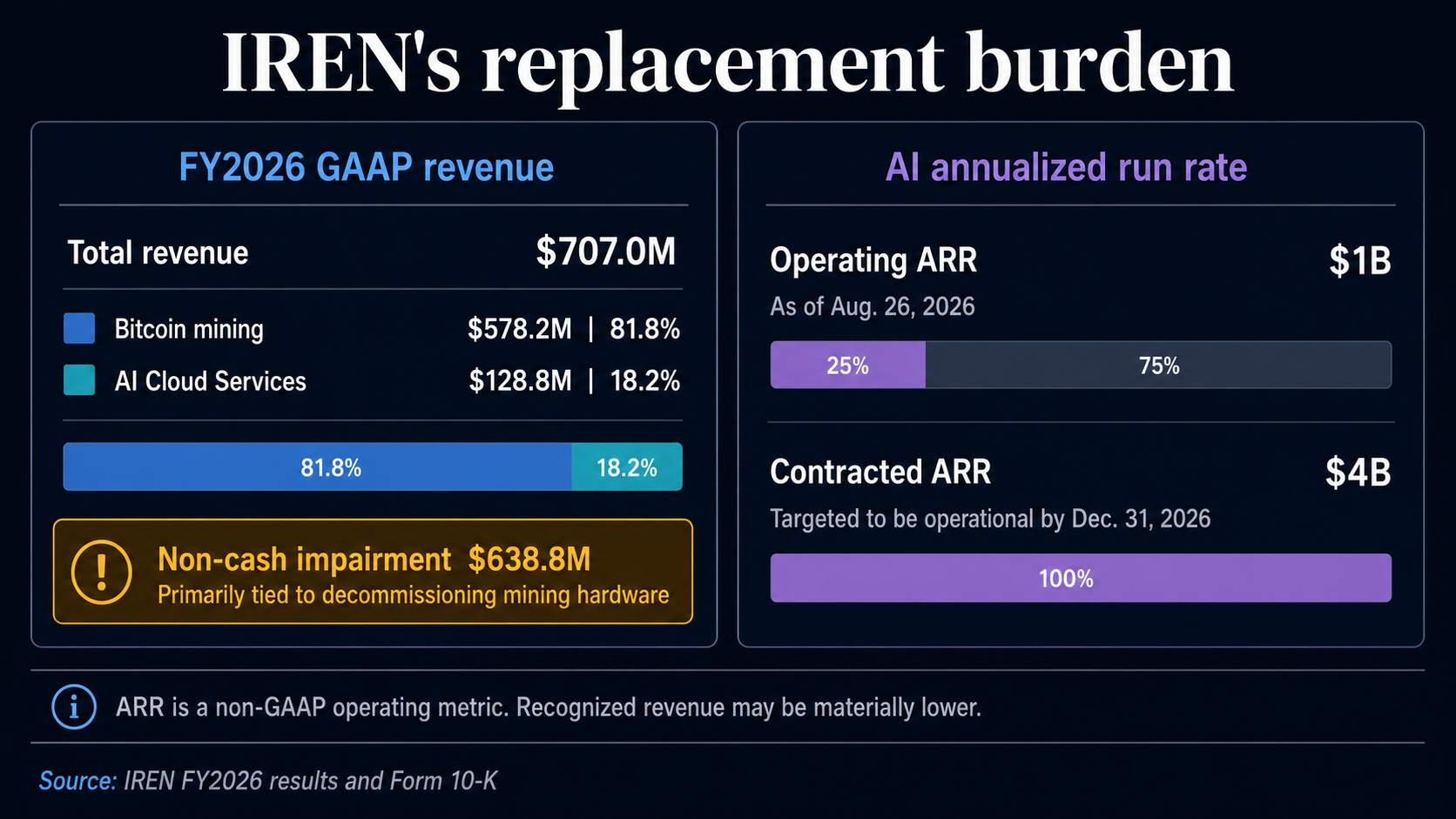
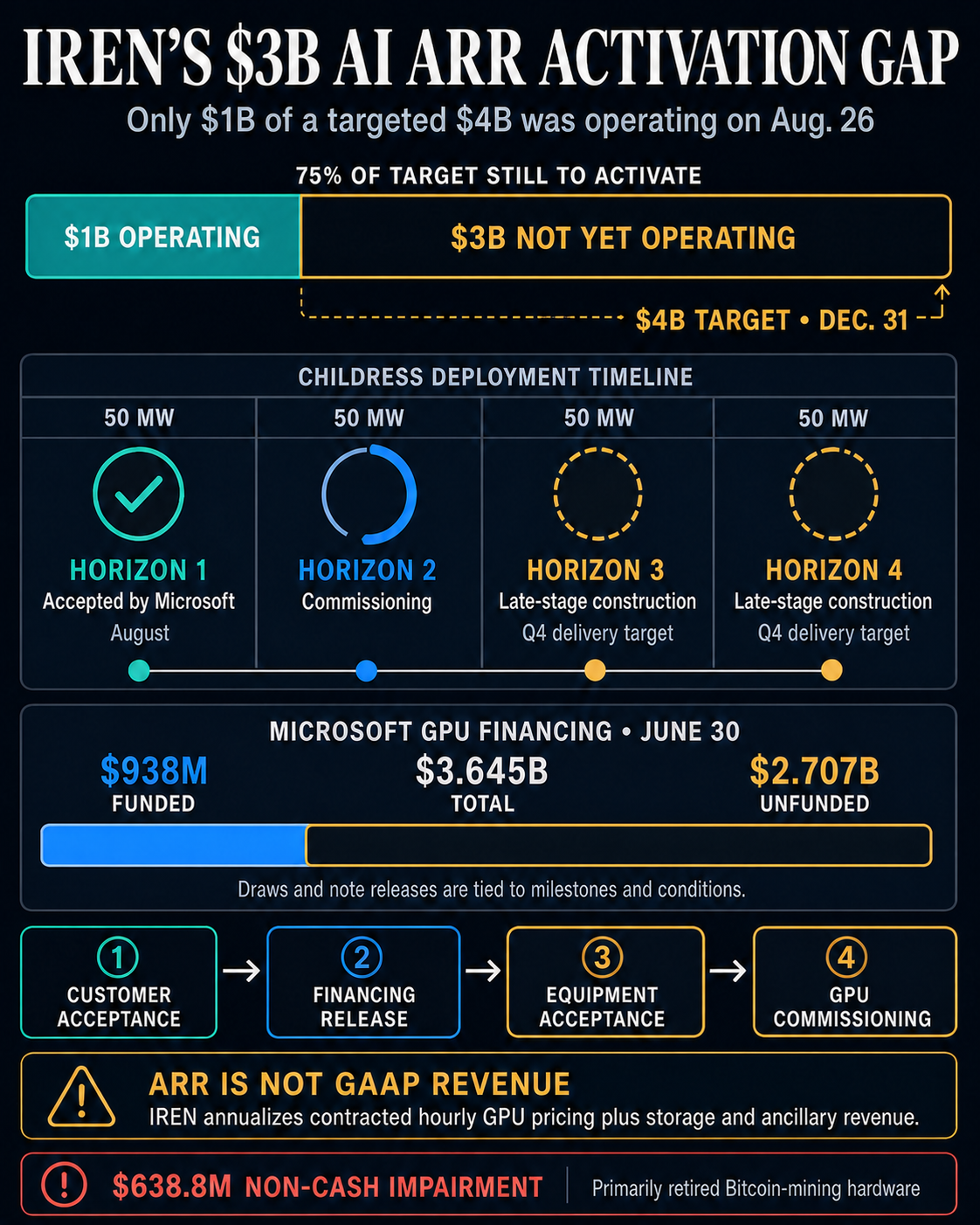
As of Aug. 26, IREN had $1 billion of operating annualized run-rate revenue, or ARR, against $4 billion of contracted ARR for its 2026 capacity. IREN targets the larger run rate to be operational by Dec. 31.
The company calculates ARR from contracted GPU pricing multiplied by a full year of hours, including storage and related services. It is an operating measure, not GAAP revenue, and IREN warns that recognized revenue may be materially lower. Closing the gap depends on physical infrastructure being delivered and accepted, as well as the company’s utilization and pricing assumptions.
IREN’s Form 10-K says revenue generally starts only after data centers are built and energized, equipment is installed and commissioned, performance testing is complete and customers accept the capacity. Delays can postpone revenue while financing and operating costs continue, and can trigger delay or service credits.
The timeline is staged. Microsoft accepted Horizon 1 in August. Horizons 2 through 4 were targeted for phased delivery in calendar Q4 2026, with contractual grace periods extending into the beginning of calendar Q2 2027.
At June 30, IREN still had installed Bitcoin mining capacity of about 23.2 EH/s across roughly 380MW. The company aimed to substantially complete the transition of that data center capacity toward AI Cloud Services by year-end.
Delay also carries a financing cost. IREN raised GPU financing to support the Microsoft contract through a delayed-draw loan priced at one-month SOFR plus 2.25% and senior notes at 5.96%, with tranches subject to conditions. A separate Mackenzie financing of up to $2.4 billion carries a 9% fixed rate and matures 30 months after each relevant staged funding date.
Microsoft and NVIDIA together represented a substantial majority of contracted revenue, according to IREN. New customers diversify the roster, but acceptance, performance and counterparty risks remain concentrated.
IREN has contracts that could replace the mining business on a run-rate basis. The filing does not show that replacement as completed. The next proof is customer acceptance of the remaining deployments and the GAAP AI revenue they begin to produce.

 cryptoslate.com