
 news.bitcoin.com
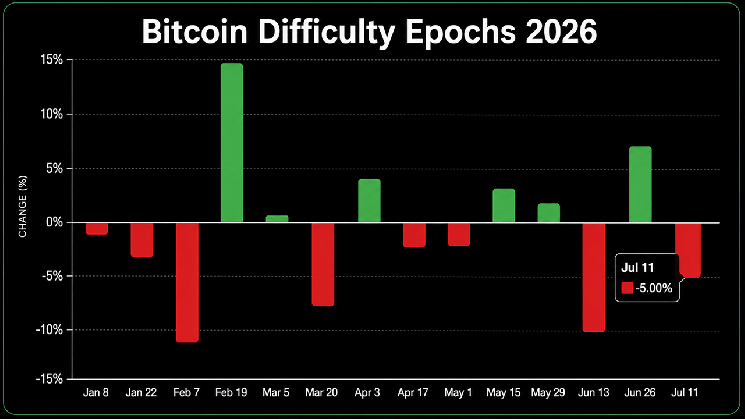
The adjustment landed at block height 957600. Difficulty moved from 133.87 trillion to 127.17 trillion, a decline of roughly 6.70 trillion. The change took effect at 4:09:11 p.m., based on the block timestamp. The prior epoch ran about 14 days, 18 hours, and 9 minutes, longer than Bitcoin’s 14-day target for 2,016 blocks. That pace works out to an average block time of 10 minutes, 32 seconds, about 5.1% slower than the protocol’s 10-minute target. The 5% cut brought the network back toward that target.
A Year Defined by Wide Swings
Eight of the 14 difficulty adjustments so far in 2026 have been negative and six positive. The average adjustment was negative 0.87%, but the average absolute move was 5.30%, a gap that points to sharp back-and-forth activity hiding behind a mild-looking average. Compounded from the difficulty in place before the first adjustment on Jan. 8, the network has dropped approximately 14.22%. The July 11 reading ranks as the third-lowest of the year, behind only June 13’s 124.93 trillion and Feb. 7’s 125.86 trillion.
Hashrate Slides Toward Its 2026 Range
The seven-day average hashrate via hashrateindex.com stood near 908 EH/s on July 11, down about 14.8% from the Jan. 1 level of roughly 1,065 EH/s. That figure sits about 21.3% below the one-year peak of 1,154 EH/s reached in October 2025, and just 3.3% above the 2026 low of 879 EH/s set in early February.



