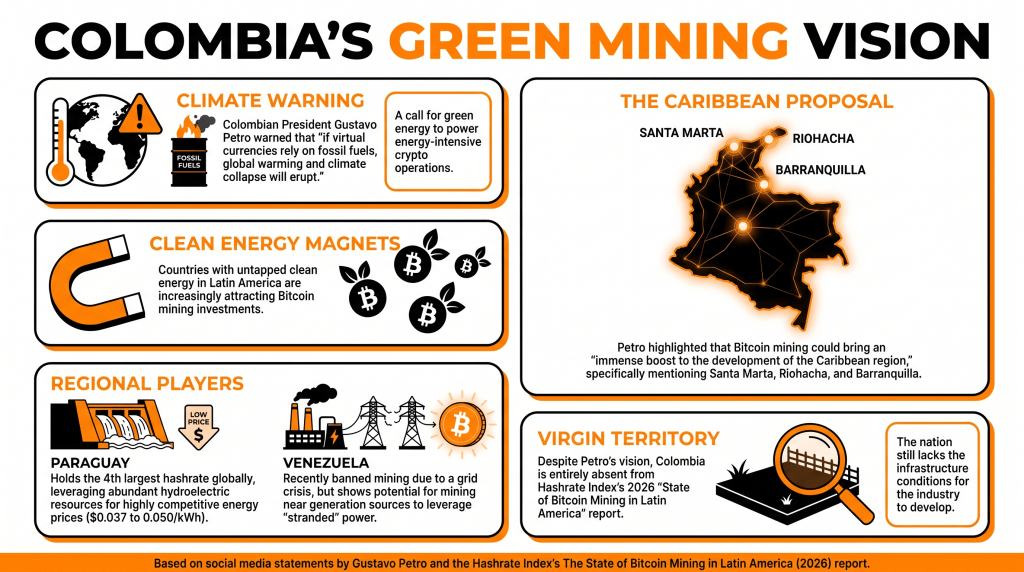
Colombian President Gustavo Petro stressed that the future of bitcoin mining must be ecological, as countries with abundant green energy, including Paraguay and Venezuela, are attracting investments in the sector. He also warned about the consequences of using fossil fuels to power this activity.
-
Key Takeaways:
- Colombia’s Gustavo Petro warned that fossil-fueled Bitcoin mining risks global climate collapse.
- Paraguay holds the 4th largest global hashrate, while Venezuela’s 9-year peak energy crisis halted mining.
- Petro wants 3 Caribbean cities to mine Bitcoin, though the 2026 Hashrate Index report omits Colombia.
President Petro Highlights Venezuelan and Paraguayan Potential For Energy Mining
Cryptocurrency mining, as a global activity, has awakened the attention of world leaders, who are offering their takes on what the future of these operations looks like.

Gustavo Petro, Colombia’s controversial leader, took it to social media to reiterate the need for green sources to power these energy-intensive activities.

Petro warned that “if virtual currencies rely on fossil fuels, global warming and climate collapse will erupt.”
Furthermore, he stressed that countries with untapped clean energy, including Venezuela and Paraguay, are attracting bitcoin mining investments. While Paraguay holds the fourth largest hashrate in the world, behind powerhouses like the U.S., Russia, and China, Venezuela is not even in the top 10.
Paraguay has taken advantage of its abundant hydroelectric resources in the Iguazu dam, one of the largest in the world, to offer very competitive energy prices ranging from $0.037 to 0.050/kWh.
Venezuela recently banned bitcoin mining, as its government faces an energy crisis, with demand skyrocketing to a 9-year peak. Even so, reports indicate potential in mining operations near energy generation sources to leverage power that cannot be transported due to a lack of infrastructure.
“ Bitcoin mining is the method by which an individual, using powerful computers, can accumulate Bitcoin through virtual transactions. This could be the case for Santa Marta, Riohacha, and Barranquilla… it represents an immense boost to the development of the Caribbean region,” Petro concluded.
While Hashrate Index’s The State of Bitcoin Mining in Latin America (2026) report highlights mining developments in Paraguay, Brazil, Bolivia, Argentina, Venezuela, and El Salvador, it does not mention Colombia. This means the country is virgin territory for bitcoin mining, and the nation still lacks the conditions for the industry to develop.
news.bitcoin.com