
 cointelegraph.com

A California federal judge has certified an investor class in a securities lawsuit accusing Nvidia and CEO Jensen Huang of misleading shareholders about how much of the company’s gaming revenue during the 2017-2018 crypto mining boom came from GPU sales to cryptocurrency miners.
US District Judge Haywood S. Gilliam Jr. ruled in a March 25 order that investors can pursue their claims as a group, while stressing that class certification is a procedural step and does not resolve the question of whether Nvidia’s statements were fraudulent.
The order defines the class as investors who bought Nvidia stock between Aug. 10, 2017, and Nov. 15, 2018, and focuses heavily on “price impact” and whether the alleged misstatements affected Nvidia’s share price.
In 2022, Nvidia agreed to pay a $5.5 million penalty and accept a cease-and-desist order over inadequate disclosures tied to crypto mining’s impact on its gaming GPU business, and the US Supreme Court in December 2024 left in place a Ninth Circuit ruling that allowed the shareholder suit to proceed.
Related: Nvidia’s Vera Rubin keeps crypto networks like Render in demand
Judge certifies Nvidia investor class
The shareholders allege that the chipmaker and Huang misled the market about how much of its surging gaming revenue came from graphics processing unit (GPU) sales to cryptocurrency miners.
They claim the truth began to emerge after Nvidia’s Aug. 16, 2018 earnings call and guidance cut, when the stock fell about 4.9%, and again following a further revenue warning on Nov. 15, 2018, when shares dropped roughly 28.5% over two trading days.
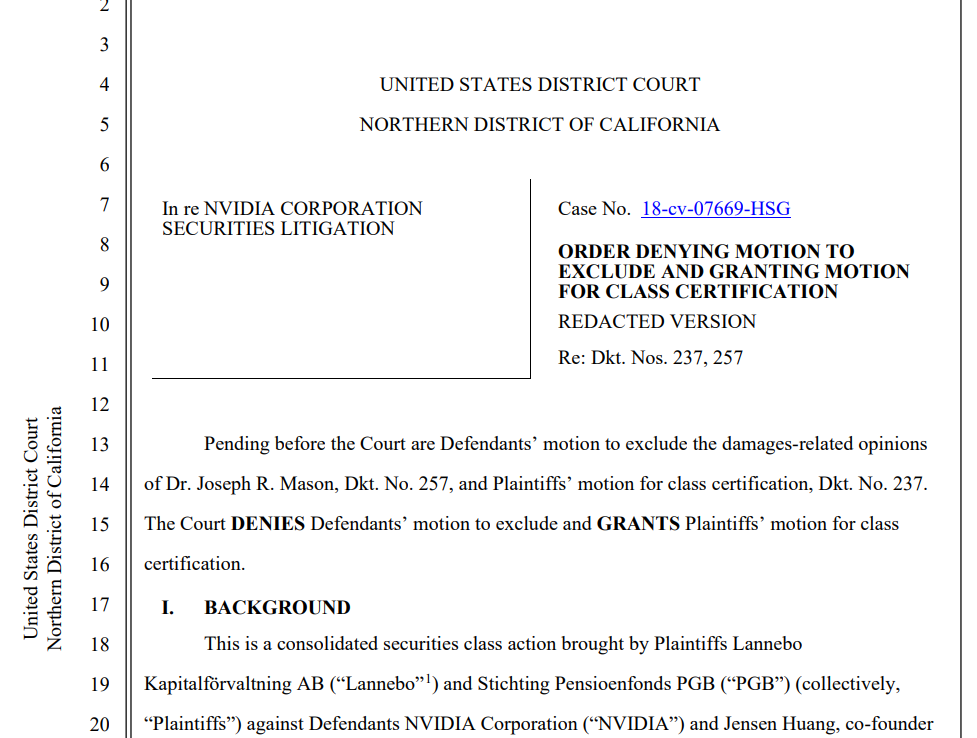
Investors first sued Nvidia in 2018, and the current amended complaint was filed in 2020. The complaint alleges Nvidia downplayed the extent to which its gaming revenue relied on GPU sales to cryptocurrency miners and understated more than $1 billion in crypto-related sales.
A spokesperson from Nvidia told Cointelegraph that investors who purchased Nvidia in the 2017-2018 timeframe “have done incredibly well, as our corporate strategy unfolded as we consistently predicted.” They added that the company would “address the complaint in court.”
Related: Nvidia’s Huang: AI will boost jobs as it needs trillions in infrastructure
Nvidia case heads toward next phase
As part of the March 25 ruling, the judge also declined to exclude the plaintiffs’ “out-of-pocket” damages model and a statistical “event study” that analyzes Nvidia’s stock price moves around key disclosure dates.
The court has scheduled a case conference for April 21, 2026, at 2:00 pm Pacific Time, to be held via public Zoom webinar.
Magazine: Bitcoin’s ‘biggest bull catalyst’ would be Saylor’s liquidation — Santiment founder