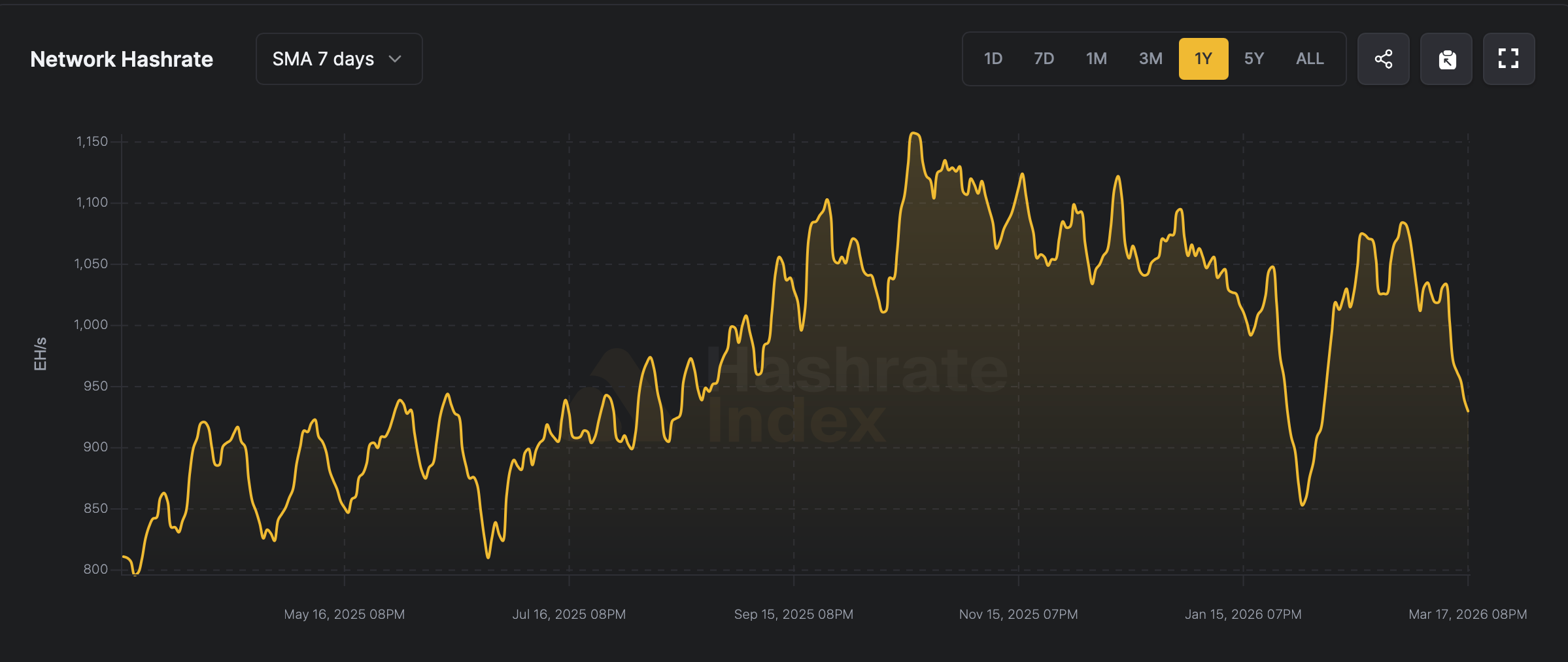
Source: hashrateindex.com
That’s a step down from the hash flex miners were flaunting not long ago. And yes, the machines are slowing down enough for everyone to notice. Block times are averaging 10 minutes and 49 seconds—nearly a full minute slower than Bitcoin’s polite little 10-minute target. In protocol terms, that’s basically showing up late to your own party.
When block production drags, difficulty follows. It’s not drama—it’s math. The network adjusts downward to keep things humming, even if the hum now sounds a bit like a tired engine. Meanwhile, bitcoin miners are doing the financial equivalent of checking couch cushions for spare change. Hashprice—the daily revenue per petahash per second (PH/s)—is sitting at $31.06.
That’s not exactly the kind of number that inspires bold expansion plans or celebratory social media posts. Blame a cocktail of factors: softer bitcoin prices, tighter margins, and, because the universe has a sense of humor, an Arctic storm in the U.S. that knocked operations sideways a few weeks ago. Nothing like subzero temperatures to remind industrial mining rigs they’re still very much at the mercy of the real world.
And then there’s the concentration. Four mining pools—Foundry USA mining pool, Antpool, Viabtc, and F2pool—are currently running the mining show, controlling a combined 70.19% of global hashrate. A lower difficulty means these four giants and the rest of the miners will find blocks faster, restoring that 10-minute cadence Bitcoin is so obsessed with. It also gives struggling operators a bit of breathing room, at least temporarily.
Think of it as the protocol throwing miners a life raft. Not a yacht—don’t get carried away—but enough to keep things afloat. Of course, none of this exists in a vacuum. Bitcoin’s price action is still the main character here. With BTC dipping below $71,000, revenue compression becomes unavoidable. Mining is, at its core, a brutally simple business: when prices fall, margins follow.
So, while the difficulty adjustment might look like a gift, it’s really more of a coping mechanism. The network isn’t being generous—it’s being functional.
And yet, despite the slower blocks, lower revenues, and weather-induced headaches, the network keeps ticking. No board meetings, no emergency press conferences, no dramatic speeches—just code doing what it was designed to do.
FAQ 🔎
-
Why is Bitcoin mining difficulty dropping in March 2026?Because blocks are being produced too slowly, the protocol automatically lowers difficulty to restore its 10-minute target pace.
-
How much will Bitcoin difficulty decrease?Current projections estimate a drop between 6% and 8.5%, with -7.64% as the latest midpoint estimate.
-
What is Bitcoin’s hashrate right now?The network is running at about 915 EH/s, still below the 1 ZH/s milestone miners recently maintained.
-
Who controls most of Bitcoin’s mining power today?Foundry, Antpool, Viabtc, and F2pool collectively command about 70% of global hashrate, making them the dominant players.

 news.bitcoin.com