Fourth-quarter results reflected similar pressures, with revenue of $179.5 million and a net loss of $285 million, compared with net income in the same period a year earlier. The company cited bitcoin price movements at year-end and transformation-related costs as key contributors to the quarterly decline.
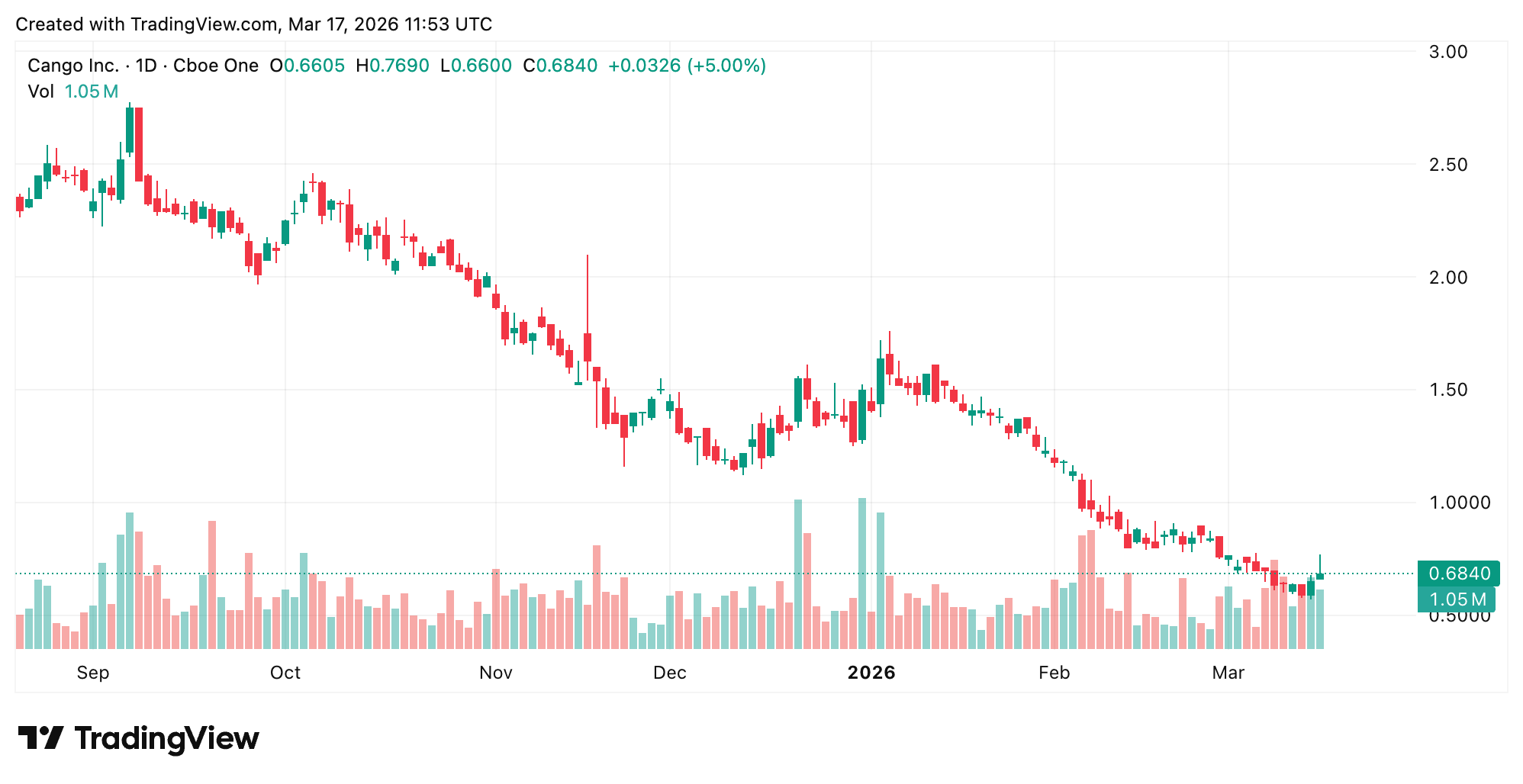
Cango stock via tradingview.com
Cango scaled its mining operations aggressively in 2025, producing an average of 18.07 $BTC per day and operating across more than 40 sites spanning North America, the Middle East, South America, and East Africa. By February 2026, its deployed hashrate reached 50 EH/s, with continued monthly production, including roughly 496 $BTC mined in January.
To address leverage, the company moved quickly in early 2026 to strengthen its balance sheet. It sold 550 $BTC in January and 4,616 $BTC in February, using proceeds to repay bitcoin-backed debt and improve liquidity. A February sale of more than 4,400 $BTC generated about $305 million, settled in USDT, reflecting a treasury strategy focused on capital efficiency rather than long-term accumulation.
Cango is also repositioning beyond mining, advancing a shift into artificial intelligence (AI) infrastructure through its U.S. subsidiary, Ecohash. The company is retrofitting its Georgia-based mining site with modular AI inference systems, with pilot deployments already underway. The initiative targets demand for distributed, lower-cost computing using existing energy-connected infrastructure.
Leadership framed the transition as a continuation of its broader transformation strategy. CEO Paul Yu said the company entered 2026 focused on balance sheet optimization and expansion into AI-driven computing services, while CFO Michael Zhang emphasized that the net loss stemmed largely from non-recurring and market-driven accounting factors rather than core operations.
Investor backing has continued during the transition. In February, Cango secured a $10.5 million equity investment from Enduring Wealth Capital and $65 million in equity commitments from its leadership team, while also repurchasing shares under an existing buyback program.
Shares have recently traded near $0.68, down about 43% over the past three months, reflecting investor response to reported losses and broader mining sector pressures. The company’s results highlight both the capital intensity of large-scale mining and a growing trend among miners reallocating resources toward AI-related infrastructure.
FAQ 🔎
-
Why did Cango report a large net loss in 2025?The loss was mainly due to non-cash impairments on mining equipment and fair value adjustments linked to bitcoin prices.
-
How much bitcoin did Cango mine in 2025?Cango mined 6,594 $BTC during the year, averaging about 18 $BTC per day.
-
Why did Cango sell bitcoin in early 2026?The company sold bitcoin to repay debt, reduce leverage and improve balance sheet flexibility.
-
What is Cango’s AI strategy?Cango is converting mining infrastructure into AI inference systems through its EcoHash unit to target distributed computing demand.

 news.bitcoin.com