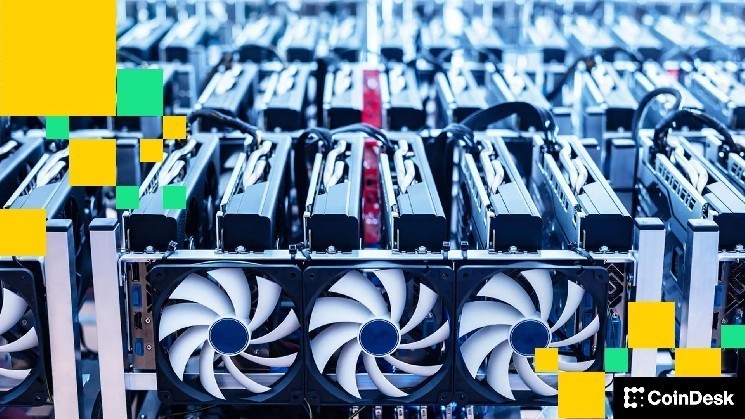
Facing record-low margins after the 2024 halving, bitcoin miners are repositioning as digital infrastructure providers, repurposing power-dense mining sites into AI-ready data centers in search of steadier, long-term revenue.
At the same time, valuations continued to stretch. Analysts Reginald Smith and Charles Pearce said mining stocks were trading at roughly 150% of the four-year block reward opportunity at year-end, about three times the post-2022 average, highlighting a growing disconnect between miner valuations and bitcoin’s price.
Operationally, January brought relief. Winter storms across the U.S. forced widespread curtailments, dragging the average network hashrate down 6% month over month to 981 exahashes per second (EH/s), JPMorgan said. The hashrate briefly dipped as low as 700 EH/s during the month, while mining difficulty fell 5% from December and sat 10% below November’s all-time high.
The hashrate refers to the total combined computational power used to mine and process transactions on a proof-of-work blockchain, and is a proxy for competition in the industry and mining difficulty. It is measured in exahashes per second.
That drop in competition helped offset weaker bitcoin prices. The analysts estimated miners earned about $42,350 per EH/s in daily block reward revenue in January, up slightly from December, while gross profit jumped 24% to roughly $21,200 per EH/s as network efficiency improved. Still, profitability remains well below pre-halving levels, the bank noted.
Stock performance was broadly positive. Twelve of the 14 miners tracked by the bank outperformed bitcoin’s 4% decline in January, with IREN (IREN) rising 42% and Cango (CANG) falling 18%. Even after the rally, the group’s combined valuation remains about 15% below October 2025 highs.
Read more: Bitcoin miners HIVE, Bitfarm and Bitdeer downgraded as analyst warns on AI shift

 coindesk.com