“No black boxes. No lock-in. No Limits,” Tether added.
Tether’s MiningOS provides a self-hosted mining architecture that communicates with other devices via an integrated peer-to-peer network.
The service is accompanied by a platform that enables miners to simply adjust settings to suit their scale and output requirements.
Alongside Tether’s announcement, CEO Paolo Ardoino said MiningOS is a “complete operational platform that can scale from a home setup to industrial grade site, even across multiple geographies.”
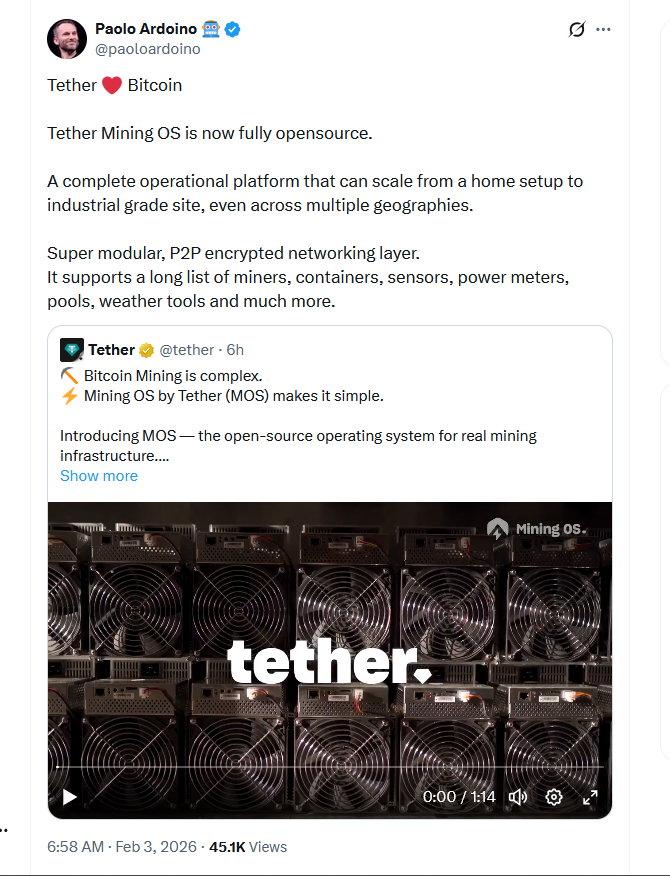
Source: Paolo Ardoino
Tether initially announced plans for an open-source Bitcoin mining OS in June last year, with the firm highlighting the importance of new miners being “able to enter the game and compete” without dependence on expensive third-party vendors.
Tether joins other big names in crypto, such as Jack Dorsey’s Block, in releasing an open-source Bitcoin mining stack. However, unlike Block’s software, which is designed to work specifically with its own mining hardware, Tether’s MiningOS is said to be built for compatibility with a wide range of infrastructure.
“MiningOS is open source under the Apache 2.0 License — free to use, free to build on, free to improve. Built on Holepunch P2P protocols — meaning no centralised services, no backdoors, and no third-party dependencies,” Tether said.
The move from Tether marks another significant effort by the firm beyond stablecoins. Tether made a series of investments across 2025, spanning tokenization, artificial intelligence, and decentralized finance and also became a stronger hoarder of gold and Bitcoin.

 cointelegraph.com