With the CLARITY Act on hold, for how long can the SEC and CFTC go it alone?
ambcrypto.com
27 m
The U.S crypto regulatory landscape has been hanging in balance thanks to the failure of the CLARITY Act in the Senate this September. Now though, the industry is left without a comprehensive market structure law. And, regulators are showing little intention of waiting for Congress to resolve the issue.
Instead, the Securities and Exchange Commission (SEC) and the Commodity Futures Trading Commission (CFTC) are increasingly using their existing authority to introduce targeted exemptions, staff advisories, proposed rules, and regulatory guidance.
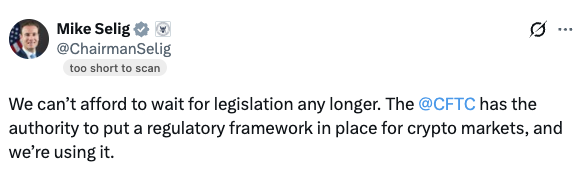
In CFTC Chairman Mike Selig’s words,
Know when your coins move
Alerts, real-time prices, and market news — all in one app
Point your phone camera to install
4.8 based on 40K reviews in the App Store and Google Play
Source: Mike Selig/X
Naturally, this raises an important question: Are these measures simply temporary relief until the CLARITY Act eventually becomes law, or are the agencies laying the groundwork for a more durable crypto regulatory framework?
Well, the answer is probably somewhere in between.
Regulators are no longer waiting for the CLARITY Act
For those unaware, the CLARITY Act was expected to establish clearer boundaries between the SEC and CFTC, particularly concerning which digital assets fall under securities laws and which come under commodities regulation.
At the same time, it was also intended to establish a more predictable framework for crypto exchanges, intermediaries, and other market participants.
However, its failure to advance in the Senate has prolonged the uncertainty. Since then, the SEC has been addressing specific regulatory gaps through proposed rules, updated FAQs, exemptions, and project-specific no-action letters.
Meanwhile, the CFTC has been working on its own regulatory agenda through staff letters, advisories, and proposed market regulations.
SEC’s targeted relief
One of the most significant developments has been the SEC’s growing willingness to address specific crypto-related activities rather than treating the entire industry through a single regulatory lens.
On 17th September, the SEC granted conditional relief to certain distributed-ledger trading venues, clarifying how existing exchange regulations apply to blockchain-based trading. The move supports tokenized securities but does not offer blanket approval to all such platforms.
The agency also updated its crypto asset FAQs in September and November, providing staff-level guidance on securities laws. Its Crypto Task Force issued project-specific no-action letters, including guidance concerning Canton Coin and Molecule AG. However, these FAQs represent staff views and do not have the force of law.
Additionally, the SEC’s 1st October custody proposal seeks clearer requirements for registered investment advisers and regulated funds holding crypto assets, including reporting and recordkeeping obligations. While this could address institutional custody challenges, the proposal is not yet in effect.
Remarking on the same, SEC Chairman Paul Atkins added,
To that end, today’s proposal would provide a clear regulatory framework for the custody of crypto assets, giving investment advisers and funds a compliant pathway where none existed before and replacing the grey of uncertainty created by custody rules crafted for a bygone era.
Lastly, the SEC has also included tokenization in its FY2027 examination priorities, signaling closer scrutiny of blockchain-based assets, particularly around custody, ownership, cybersecurity, and compliance.
Together, these measures suggest a shift towards a more structured approach to crypto oversight.
CFTC joins the fray to build its own regulatory pathway
On the other hand, the CFTC’s recent actions are equally important, particularly because the agency is attempting to address several operational challenges facing crypto businesses.
In September, the CFTC updated its FAQs to clarify how regulated entities can use tokenized versions of permitted investments and blockchain technology for recordkeeping. However, this does not allow Futures commission merchants or derivatives clearing organizations to directly invest customer funds in Bitcoin or Ethereum.
The CFTC also issued Staff Letter 26-25 on 17th September, extending no-action relief from introducing broker registration requirements to certain software developers that passively facilitate derivatives trading through applications, including self-custodial crypto wallets.
More recently, on 23rd November, the CFTC issued another staff advisory concerning the use of crypto assets to meet financial resource requirements.
Under the guidance, Bitcoin, Ethereum, and payment stablecoins can count towards the financial resource requirements of designated contract markets, swap execution facilities, and derivatives clearing organizations, subject to haircuts. However, they cannot meet separate liquidity requirements.
Worth pointing out, however, that the CFTC is also developing broader rules covering leveraged retail crypto transactions and a federal registration pathway for trading platforms. However, these initiatives do not yet amount to a comprehensive, enforceable regulatory framework.
A promising temporary relief
Seeing the efforts from both the agency, Marcin Kazmiercza, Co-founder and COO of RedStone, said,
In the 10 days since, US regulators have put out more crypto policy than Congress managed in two years.
However, regulatory guidance is not a substitute for legislation. While the SEC and CFTC can interpret existing laws and issue guidance, their authority remains limited. Staff advisories and no-action letters can be revised or withdrawn, while proposed rules require formal approval.
This is why the CLARITY Act remains important. It aims to establish a clearer division of responsibilities between the SEC and CFTC, covering digital asset classification, securities regulation, and crypto intermediary registration.
Complications keep popping up
Needless to say, the CLARITY Act’s Senate setback on 15th September highlighted the political hurdles ahead. Its motion to proceed received only 50 votes against the required 60, with four Republicans joining Democrats in opposition. Interestingly, all of this happened as political tensions also intensified over Trump’s crypto interests.
On 24th November, House Democrats expanded their investigation into Donald Trump Jr.’s investments through 1789 Capital, seeking information from companies including Polymarket. However, these remain oversight concerns, not established findings of wrongdoing.
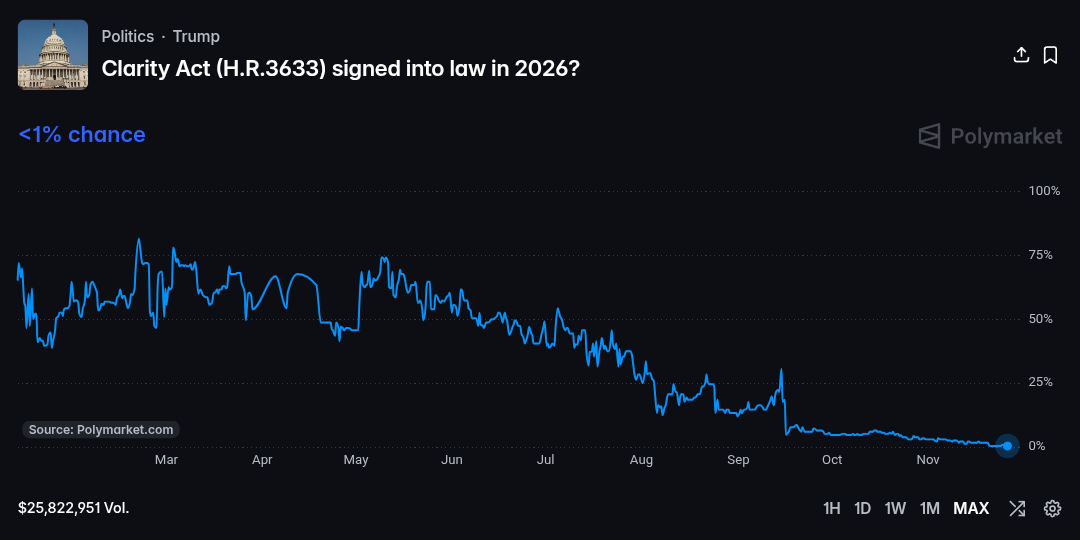
Meanwhile, Polymarket’s odds of the CLARITY Act becoming law in 2026 reportedly fell below 1% following the Senate setback, reflecting declining confidence in its passage.
Source: Polymarket
Still, given the situation, the White House’s Chief Crypto Advisor, Patrick Witt, supported the regulators’ plans and put it best when he said,
Smart regulators like Mike Selig and SEC’s Paul Atkins understand that protecting consumers and market integrity doesn’t have to mean stifling growth and innovation. Exciting to hear what’s in store at the CFTC and SEC in the coming months.
Final Summary
SEC plans to address specific crypto-related activities rather than treating the entire industry through a single regulatory lens.
Meanwhile, the CFTC is attempting to address several operational challenges facing crypto businesses.

 ambcrypto.com