Spain Gives SEPBLAC Power to Suspend Crypto Accounts Without a Judge
blockchainreporter.net
14 m
The five-day clock starts when Spain’s anti-money-laundering executive service signs the order, not when a judge looks at it.
That is the practical effect of article 46 bis, a provision bolted onto Spain’s Ley 10/2010 by Real Decreto-ley 44/2026, published in the Boletín Oficial del Estado on 25 November 2026. From 25 January 2027, SEPBLAC, the Servicio Ejecutivo de la Comisión de Prevención del Blanqueo de Capitales e Infracciones Monetarias, will be able to suspend the use of a crypto account, a payment account, a bank account or a whole business relationship for up to five business days on its own authority. It will also be able to stop a single transaction already in motion for up to ten business days.
No prior court order is required for either measure. A court only enters the picture if the freeze is meant to outlast the statutory clock, and even then the request comes from the Ministerio Fiscal, not from the account holder.
Know when your coins move
Alerts, real-time prices, and market news — all in one app
Point your phone camera to install
4.8 based on 40K reviews in the App Store and Google Play
The change has been reported as a new power to freeze crypto “without a judge”, which is accurate but incomplete. The interesting part is the timetable: two different clocks, a third deadline that starts the process, and a ratification step that can strand a suspension in court if the prosecutor moves late.
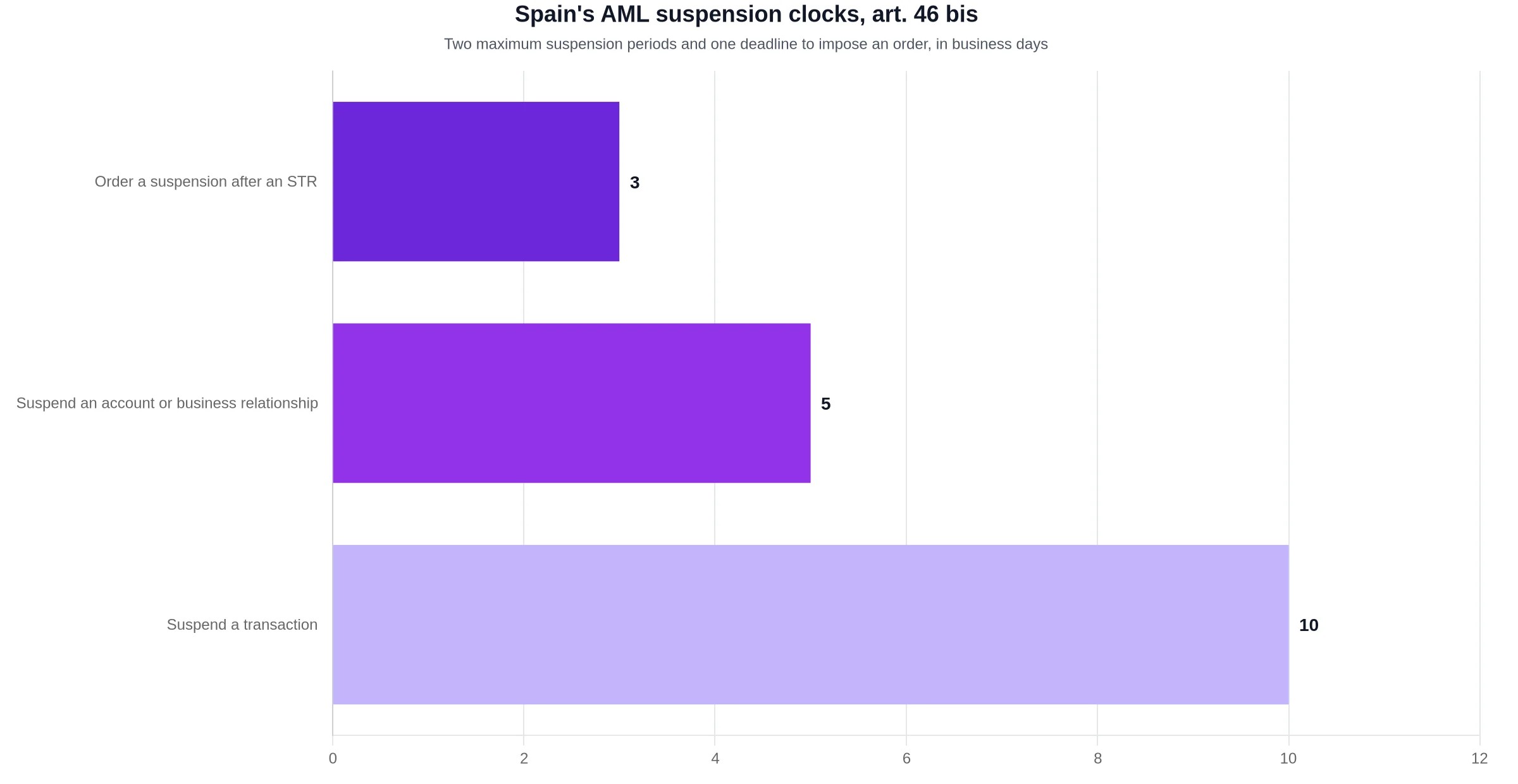
Article 46 bis sets two maximum suspension periods and one deadline to impose an order. Source: Real Decreto-ley 44/2026, Boletín Oficial del Estado.
Five Business Days, Then a Prosecutor Has to Ask
The trigger is deliberately loose. Paragraph 1 begins: “Cuando, a juicio del Servicio Ejecutivo de la Comisión, concurran indicios de que una transacción en curso, una cuenta bancaria de pago o de criptoactivos o una relación de negocios podría estar relacionada con el blanqueo de capitales o la financiación del terrorismo”. Indicia, not proof, and a relationship that “could be” connected, not one that has been established.
The stated purpose is narrow and procedural: preserve the funds, run the analysis, establish whether the suspicion holds, and, if it does, hand the file to the competent authorities so they can act. The article does not describe the suspension as a sanction, and it does not create a confiscation route.
Paragraph 3 caps an account or business-relationship suspension at five business days, with an obligation to lift it earlier once it is no longer needed. Paragraph 4 then sets the exit: “Transcurridos los plazos previstos en los apartados 2 y 3 cesará la suspensión, salvo que fuera ratificada o prorrogada judicialmente a solicitud del Ministerio Fiscal.”
The sequencing matters. The prosecutor must file “antes del vencimiento del plazo”, before expiry, with the competent court, and appeals against the resulting decision follow the Ley de Enjuiciamiento Criminal. If the request arrives late, the suspension simply ends and the balance is usable again. An order signed on a Thursday runs to the following Thursday: seven calendar days, five of them working days, in a market that clears around the clock and never pauses for a Spanish public holiday.
Ten Days for One Transfer, Five for the Whole Account
The asymmetry is the most revealing drafting choice in the article. A single transfer can be held for ten business days. An entire account, holding every balance a customer has with that provider, can be held for five.
The logic is not stated, but it follows the purpose. Stopping one payment preserves a specific flow of funds for analysis while leaving the rest of a customer’s position intact. Suspending an account removes access to everything at once, so the legislator gave it half the window. The early-lifting duty applies to both, which means the five-day figure is a ceiling, not a schedule.
A second deadline sits upstream of both. If the suspicion reaches SEPBLAC through a suspicious-transaction report, the service “deberá imponer la orden de suspensión en el plazo máximo de tres días hábiles desde la notificación de la comunicación”. Three business days from the report to the order.
The cross-reference there is worth flagging. The decree attributes that report to article 19 of Ley 10/2010, whose heading is “Abstención de ejecución”, the duty to refrain from executing an operation. The reporting duty itself sits in article 18, which requires obliged entities to communicate operations “respecto de las cuales estimen que concurren indicios o certeza de estar relacionadas con el blanqueo de capitales o con la financiación del terrorismo”. Article 19 in turn lets a firm execute a suspicious operation when abstaining would obstruct an investigation, provided it reports immediately afterwards. The three-day clock runs from the notification, so whichever article a compliance team cites internally, the deadline is measured from the moment the report lands.
When the suspicion instead comes out of SEPBLAC’s own analytical work, the decree uses stronger language still: “se deberá ordenar la suspensión lo antes posible”.
Those two sentences matter for compliance teams because they describe an obligation on the regulator, not discretion. A provider that files a report and then hears nothing for a week can point to a deadline the regulator was supposed to meet.
What the Article Leaves Unsaid
Several things a compliance officer would want to know are absent.
There is no notification duty. The text does not require SEPBLAC to inform the account holder that the account has been suspended, does not set a deadline for telling them afterwards, and does not describe how a customer disputes an order while it is running. The only appeal route mentioned is the one attached to the court’s ratification decision.
There is no compensation mechanism. If a five-day suspension is later found to have rested on a suspicion that did not hold, the article provides no route to redress for blocked balances or missed settlements.
What it does provide is a liability shield. Paragraph 5 states that a suspension ordered under the article “no acarreará responsabilidad de ningún tipo para el Servicio Ejecutivo de la Comisión, sus directivos o empleados, ni tampoco para los sujetos obligados cuando actúen en cumplimiento de una orden de suspensión o no autorización emitida por la autoridad”. The provider that blocks the account on instruction is protected. The provider that does not is exposed, and the exposure sits in the law’s most serious category.
The Route That Disappears
Article 46 bis does not arrive alone. The same final provision deletes paragraph 6 of article 48 bis, the old cooperation article. The government’s own explanation of what that paragraph did is the clearest statement of what has changed: “La reforma amplía la capacidad de actuación preventiva que hasta ahora se encontraba limitada, en este ámbito, a las solicitudes de unidades de inteligencia financiera de otros Estados”.
Before this decree, SEPBLAC could suspend on the strength of a foreign financial intelligence unit’s request. It could not open the same procedure on its own analysis of a Spanish account. The rationale given is speed: transfers move faster than mutual legal assistance, so a power that only switches on when a foreign counterpart asks arrives too late to preserve anything.
The international channel survives, folded into paragraph 6 of the new article, which lets a suspension also run at the request of the Fuerzas y Cuerpos de Seguridad or of another state’s financial intelligence unit, “bajo la responsabilidad de la parte solicitante”. Where the suspicion concerns terrorist financing, the service must inform the Secretaría de la Comisión de Vigilancia de Actividades de Financiación del Terrorismo.
Then comes the enforcement hook. The third change rewrites letter g) of article 51.1 so that it now reads: “El incumplimiento de las medidas de suspensión acordadas por el Servicio Ejecutivo de la Comisión de conformidad con el artículo 46 bis”. Failing to comply with a freeze order is no longer a general compliance failure. It is specifically listed among the very serious infractions, the top tier of the law’s sanction scale.
A Crypto Power Inside a Consumer Credit Decree
The vehicle explains both the timing of the change and the quiet around it.
Real Decreto-ley 44/2026 is titled as a decree on consumer credit contracts and on protecting borrowers when doubtful credit portfolios are sold. Its sixteen transitional provisions deal with loan contracts, credit intermediaries, mortgage lenders and complaints handling. Crypto appears in one of fourteen final provisions, the sixth, which amends the AML law.
The urgency argument in the preamble is a separate matter entirely. The government cites the European Commission’s infringement action of 19 March 2025 before the Court of Justice in case C-210/25, over the late transposition of Directive (EU) 2021/2167, whose deadline expired on 29 December 2023, and the daily penalties the Commission is seeking under article 260.3 of the Treaty on the Functioning of the European Union. The AML amendment travels in the same vehicle because a decree-law was already being drafted, not because crypto was the emergency.
On timing, the decree enters into force two months after publication, which puts the date at 25 January 2027, sixty-one days after the BOE edition. Final provision 14 lists a set of provisions with slower or conditional commencement, and the AML amendment is not among them. Separately, article 86 of the Constitution requires the decree to be put to a full debate and vote in the Congress of Deputies within thirty days of promulgation, with Congress then ruling expressly on whether to validate or repeal it. The crypto power therefore still has a parliamentary step ahead of it before January.
What Changes for an Exchange Registered in Spain
Nothing in the decree creates a new licence, a new register or a new reporting duty. Crypto businesses operating in Spain are already obliged entities under Ley 10/2010, whose second additional provision requires providers of virtual-currency exchange and e-wallet custody services to register with the Banco de España. Those firms already file suspicious-transaction reports, already run customer due diligence, and are already supervised by SEPBLAC.
What they gain is a counterparty that can act alone and quickly. A five-day suspension ordered on a Wednesday freezes a customer’s crypto balance until the following Wednesday unless the prosecutor has persuaded a court to extend it. For a provider, the operational questions are concrete: what happens to open perpetual positions funded from a suspended account, whether a suspension covers staking rewards that accrue during the window, and how the order is logged for the next inspection.
The decree does not answer those questions. It also does not touch the licensing layer: a Spanish CASP still needs its MiCA authorisation and its place in the register, a route set out in our explainer on launching a crypto token in the EU under MiCA. The freeze power sits on top of that framework rather than replacing any part of it.
Where Spain Sits in the European Queue
The legal basis is European. The preamble ties the amendment to article 24 of Directive (EU) 2024/1640, the sixth anti-money-laundering directive, and final provision 12 lists that directive among the texts partially transposed. The preamble also anchors the change in Financial Action Task Force standards.
What Spain has built is a national financial intelligence unit power, not a markets-supervisor power. That distinction separates it from the direction ESMA argued for in 2026, when the regulator asked for the ability to freeze crypto assets and block fraudulent websites as part of the MiCA review. ESMA’s ask was about supervisory intervention across the single market. Spain’s decree is about one desk in Madrid acting on one account, with a prosecutor and a court as the backstop.
Member states are transposing the same directive on different schedules, so the Spanish version will not be the last word on how quickly an EU crypto account can be frozen. It is, for now, one of the clearest texts on the question of how long a freeze can last without a judge, and what a provider owes when the order lands.
Frequently Asked Questions
Can SEPBLAC freeze a crypto account without a judge in Spain?
Yes, once article 46 bis takes effect on 25 January 2027. SEPBLAC can suspend the use of a crypto account, a bank or payment account, or a business relationship for up to five business days without prior judicial authorisation. Anything longer requires a court to ratify or extend the measure at the request of the Ministerio Fiscal.
How long can a suspension last?
Five business days for an account or a business relationship, and ten business days for a single transaction in progress. Both limits are ceilings, and the service must lift a measure earlier if it is no longer needed. A court can extend either one if the prosecutor applies before the deadline expires.
Does the power cover crypto exchanges and custodians?
It applies to obliged entities under Ley 10/2010, which includes providers of virtual-currency exchange and e-wallet custody services registered with the Banco de España. The decree does not create a new category of supervised firm; it gives the existing supervisor a faster instrument against accounts those firms hold.
What happens if a provider ignores a suspension order?
Article 51.1.g of Ley 10/2010 is amended to list failure to comply with a suspension ordered under article 46 bis among the very serious infractions. The provider has no liability for complying with the order, but non-compliance moves the conduct into the law’s most serious sanction category.
When does the new article enter into force?
The decree enters into force two months after publication in the Boletín Oficial del Estado, which places it on 25 January 2027. The AML amendment is not among the provisions given a longer or conditional commencement date in final provision 14.
The post Spain Gives SEPBLAC Power to Suspend Crypto Accounts Without a Judge appeared first on BlockchainReporter.

 blockchainreporter.net