
 coindesk.com
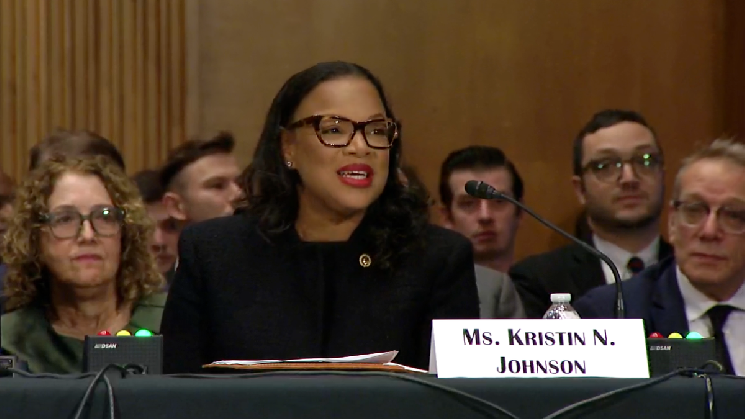
Kristin Johnson, who is expected to join the Securities and Exchange Commission soon as its lone Democrat, argued for revisiting the agency's tokenization "innovation exemption" as a full-fledged rule rather than exemption, she said in a Thursday Senate hearing to evaluate President Donald Trump's nominees for the commission.
When asked about dozens of companies objecting to having their stock offered through the SEC's new approach to tokenization, which was granted as an exemption to standing securities regulations, she said she'd "welcome the opportunity" to get the topic into a formal rulemaking that carries a public comment period, "especially when the stakeholders we see raising concerns are in fact market participants, registrants themselves."
"I feel strongly that regulation is made better through the notice-and-comment period, and in fact, it is a requirement by this body that that is how independent federal market regulators approach their responsibility to develop regulation," said Johnson, who had previously served on the Commodity Futures Trading Commission until last year and was — with Republican pick Steven Levine — nominated to join the SEC last week.
On the same topic, which was one of the SEC's most consequential policy decisions so far for the crypto industry, Levine said that the exemption was time-limited and narrow and that "many innovations, such as the exchange traded fund, began as a series of exemptive orders that ultimately resulted in agency rulemaking."
That's what SEC Chairman Paul Atkins said the agency has in mind, doing a formal rule after testing the waters with the exemption.
At the confirmation hearing for Johnson and Levine before the U.S. Senate Banking Committee, the two were among five nominees, including for roles at the Treasury Department and Department of Transportation. The SEC is meant to be a five-member commission, and the two nominees would double its current number to four — three Republicans and one Democrat.
"Artificial intelligence, tokenization, stablecoins, and decentralized platforms promise lower costs
and wider access, and they also raise real questions about conflicts of interest, data governance, and accountability," said Johnson, who has been a professor at George Washington University Law School after leaving the CFTC last year, in her prepared remarks. "In digital asset markets, I have focused on strong governance, conflicts of interest rules, and segregation of customer assets."



