
 coindesk.com

The SEC just dropped its long-awaited "innovation exemption," giving qualifying platforms a five-year window to operate markets for tokenized U.S. stocks without registering as full national securities exchanges.
Until now, a company that wanted to build a U.S. market for tokenized stocks would bringbuyers and sellers together, and regulators could treat it like a traditional stock exchange. That meant potentially having to fit blockchain trading into rules designed for venues like the NYSE and Nasdaq.
Now that's changed.
The SEC will essentially allow firms to experiment with trading real stocks on public blockchains without forcing the technology to conform to the traditional exchange rulebook. And the word “real” is the big distinction here. The SEC is drawing a line between tokens that actually represent ownership of a stock and products that merely track its price.
Under this temporary five-year sandbox, specialized platforms known as Tokenized Securities Venues, or TSVs, can facilitate trading in eligible tokenized U.S. stocks through smart contracts and liquidity pools without registering as national securities exchanges. Certain firms that provide liquidity to those pools can separately receive relief from dealer registration requirements.
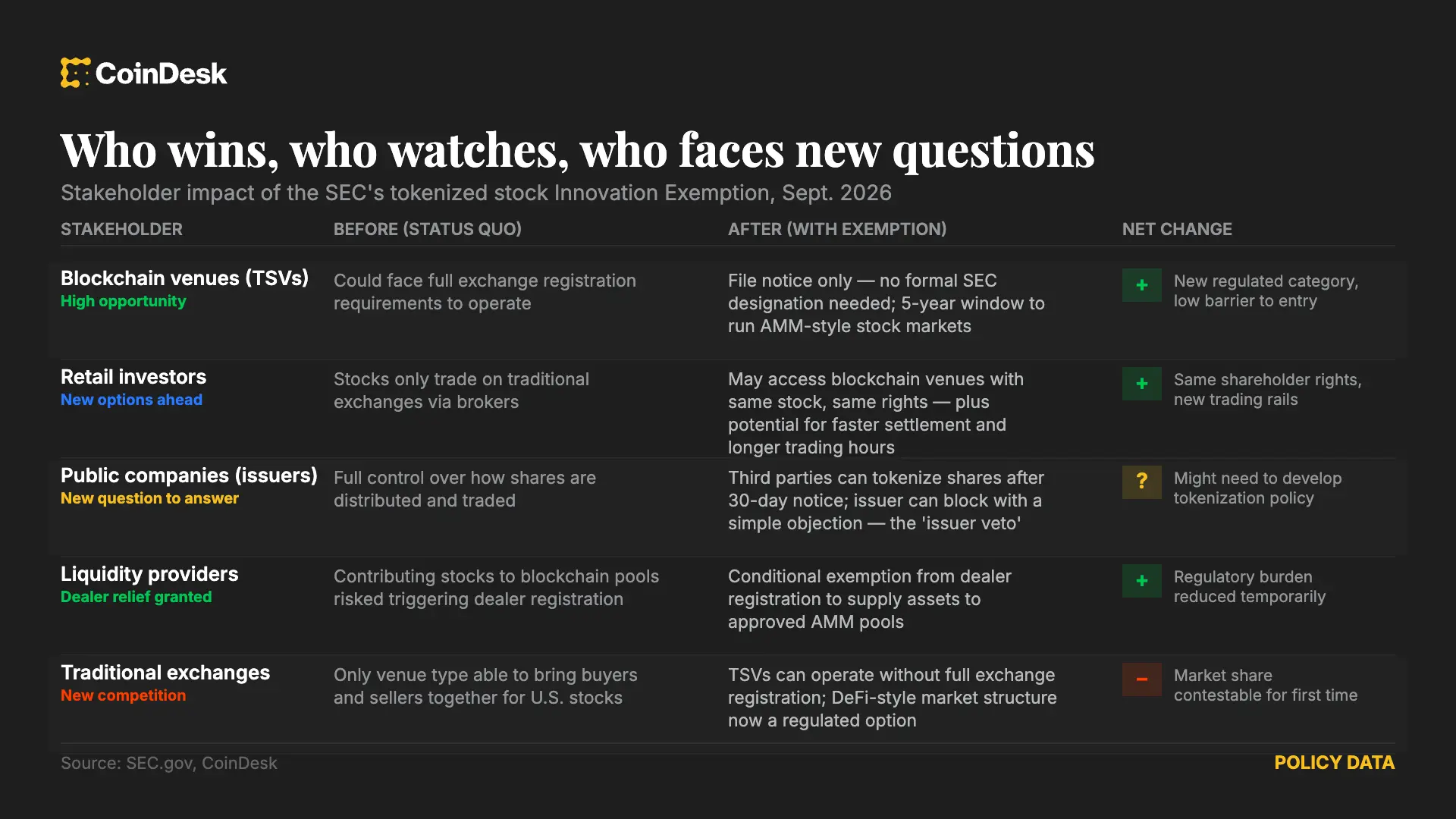
What does it mean for publicly traded companies, investors and other participants? Let's break this down.
Why it matters
To be clear, this is not just about turning a stock certificate into a token. The temporary rules will change where and how a stock can trade.
Traditional exchanges generally match buyers and sellers through order books. That's a high regulatory bar for a company that simply wants to test whether stocks can trade through blockchain infrastructure.
Under the SEC's experiment, a qualifying venue can instead let investors trade tokenized stocks through blockchain-based liquidity pools governed by smart contracts. That could give banks, brokers and crypto firms room to experiment with a different market structure; instead of relying exclusively on an exchange order book, tokenized shares could trade against pools of assets managed by smart contracts or pre-set algorithms.
Simply put, the SEC is letting the industry borrow some of crypto's trading machinery and test it on regulated U.S. stocks.
The way to look at it is this: Today, a trader places a stock order through a broker, and that order ultimately interacts with the traditional market infrastructure.
Under the exemption, an eligible investor could trade a token representing the same stock through a regulated blockchain venue, potentially interacting directly with a pool of tokenized assets, in a regulated and controlled manner.
But the bigger promise goes beyond simply changing where the trade happens. Once a security exists on blockchain rails, proponents argue it could become easier to settle, move between compatible financial platforms or eventually use as collateral in other transactions. However, this SEC exemption itself does not permit leverage or lending on the TSV.
Simply put: The tech borrows a DeFi-style plumbing with securities-market controls layered on top.
And that could still matter for crypto infrastructure.
Securitize CEO Carlos Domingo told CoinDesk he expects the framework to accelerate “native tokenized securities” and eventually create multiple onchain liquidity venues for them. Meanwhile, firms building AMMs and public blockchains could benefit if their technology is used under the hood of those regulated markets.
"This is like a super good middle ground that will allow a lot of crypto innovation to happen in a controlled and regulated way," Domingo added.
And what changes for investors?
Potentially, the plumbing.
An investor could still own a real share of a familiar company, with voting and dividend rights, but the representation of that ownership and the infrastructure for trading it could run on blockchain rails.
That could eventually open the door to faster settlement, more programmable markets and potentially longer trading hours.
The SEC is also insisting that a tokenized stock remain a stock in more than just name. A qualifying token must grant its owner the same rights and privileges as the equivalent traditional share. If Apple shares carry voting rights and dividends, the tokenized version must too. And if Apple trading is halted on its primary market, its tokenized counterpart has to stop as well.



