Robinhood defies AMC as fight tests issuer control over stock tokens
cryptopolitan.com
05 September 2026 03:43, UTC
Robinhood has turned down AMC Entertainment’s request to stop trading in blockchain-linked tokens related to the movie theater company’s stock. This has raised a larger issue: does a publicly traded company have any influence over a third party’s tokenization of its stock?
The controversy between Robinhood and AMC on X matters to more than one company. It also applies to publicly traded companies whose shares may be tokenized without their knowledge, as well as investors buying products tracking shares without becoming shareholders.
By refusing to stop trading the tokens, Robinhood is pushing the limits of how much third-party tokenized shares can accomplish under current securities law. The controversy also raises concerns on ownership, control of the issuing company, fragmented liquidity, and regulatory oversight.
Know when your coins move
Alerts, real-time prices, and market news — all in one app
4.8 based on 40K reviews in the App Store and Google Play
“Send your lawyers and we’ll educate them”
Dan Gallagher, who is the head of legal, compliance, and corporate affairs at Robinhood, and a previous SEC commissioner, responded to AMC CEO Adam Aron. Gallagher mentioned on X that Robinhood knows “a little something about the U.S. securities laws and will not ‘DECIST,’” mocking Aron’s misspelling in his post. He added “send your lawyers and we’ll educate them.”
CEO of Robinhood Vlad Tenev re-shared the message with a caption, “We stand behind Stock Tokens.”
Aron’s case against the tokens
As previously mentioned in Cryptopolitan’s report, the CEO of AMC claimed that the Robinhood was offering tokens associated with AMC and more than 190 other companies without their knowledge and consent, and that the particular product does not comply with the U.S. Securities laws. He contended that AMC does not participate in or in any way endorse the token and raised doubts about investor protections for token buyers.
Gallagher’s argument only fueled the conflict. Aron explained that “DECIST” was a witty term and it was a mixture of “desist” and “de-cyst”.
He then took on Robinhood’s offshore setup head-on, questioning why Stock Tokens that aren’t allowed to be offered or sold to American residents are advertised on the company’s website in the US. “If it’s not illegal, it should be,” wrote Aron. In a further message directed at Tenev, he accused Robinhood of “playing fast and loose with U.S. securities laws” and said such practice jeopardizes market integrity.
These allegations depend on what Aron thinks about the law and doesn’t mean that Robinhood has broken U.S. securities laws.
What buyers actually own
According to Robinhood’s disclosures, Stock Tokens cannot be equated with purchasing stocks. The company’s documentation qualifies Stock Tokens as being tokenized debt securities from Robinhood Assets (Jersey) Limited that provide economic exposure to the underlying security, but neither legal nor beneficial ownership of the underlying security.
Robinhood’s FAQs on Classic Stock Tokens clarify that the European product is a derivative contract. Consumers will not have voting rights in the company, and Robinhood warns that they may lose their entire investment if it goes bankrupt.
Where the SEC line sits
On January 28, 2026, a joint staff statement was released by the SEC, which differentiated among securities that were tokenized by their issuers and those tokenized by unaffiliated third parties. The Robinhood business model belongs to the latter category.
“The format in which a security is issued … does not affect application of the federal securities laws.” — Staff of the SEC Divisions of Corporation Finance, Investment Management, and Trading and Markets
The SEC statement says that security offerings should be registered unless there’s an exemption that applies. However, it doesn’t produce any legal obligations because it’s a staff statement and not a rule or any formal guideline from the SEC.
This is not the first time Robinhood has experienced trouble with an issuer. Cryptopolitan previously reported that OpenAI has disowned the Robinhood tokens bearing its name last year, whereas Tenev reflected that tokenizing a business does not require consent from the issuer.
A market growing faster than its plumbing
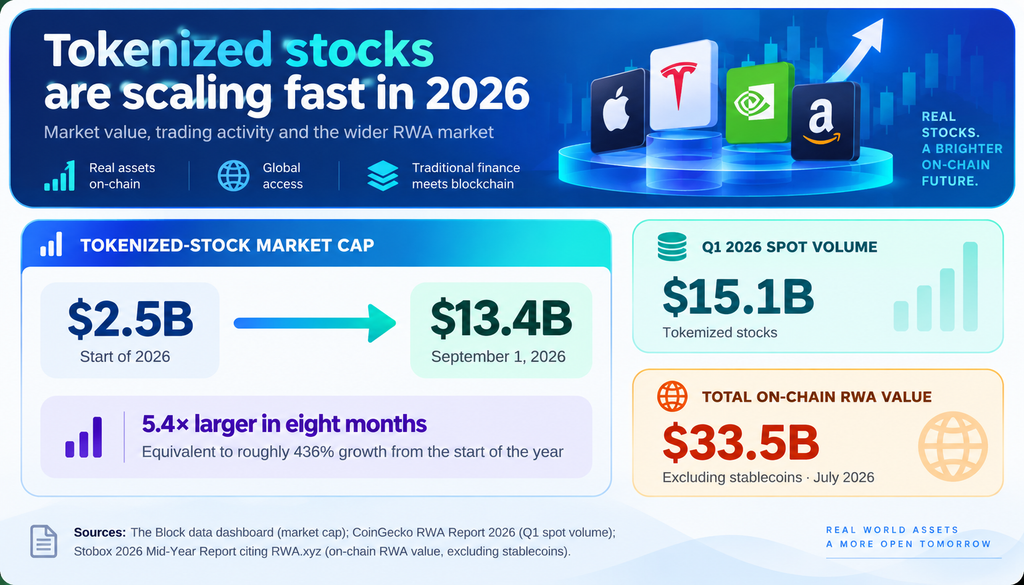
The dispute comes as tokenized equities expand rapidly. Tokenized stocks grew from $2.5 billion at the start of 2026 to $13.4 billion by September 1. CoinGecko’s RWA Report 2026 recorded $15.1 billion in first-quarter tokenized-stock spot volume.
Robinhood has helped drive that growth, listing more than 190 Stock Tokens. But infrastructure is still catching up. RWA.xyz found that Robinhood’s custom contracts can be misread by platforms expecting standard ERC-20 behavior and may not work cleanly with DeFi protocols built around those standards. The wider RWA market faces similar liquidity constraints. Stobox’s 2026 Mid-Year Report, citing RWA.xyz data, put onchain RWA value excluding stablecoins at $33.5 billion in July. AMC shares, meanwhile, rose nearly 21% in overnight trading to $3.07 after Aron’s posts, according to Cryptopolitan.

 cryptopolitan.com