Washington Goes All-In on Crypto: Trump Pushes Clarity, SEC Rules, and CFTC Warnings
decrypt.co
21 August 2026 19:36, UTC
In brief
In a packed week, Trump hosted crypto executives at the White House and pressed Congress to pass a "fair version" of the Clarity Act—a nod to disputed ethics provisions he says single him out.
At the CFTC's inaugural Innovation Advisory Committee meeting, Chairman Mike Selig framed the bill as protection against "another Gary Gensler" but warned that if Clarity stalls over "Democratic obstruction," the agency will use existing authorities to build its own crypto regime, having already directed staff to explore rules.
The SEC formally proposed Regulation Crypto Assets—allowing certain offerings up to $5 million over four years or $75 million annually without full registration, plus a conditional safe harbor.
Washington’s usual August lull disappeared this week.
The SEC unveiled its first crypto-specific rulemaking proposal on Tuesday, President Donald Trump hosted industry executives at the White House on Wednesday, and the CFTC convened the inaugural meeting of its Innovation Advisory Committee on Thursday.
Know when your coins move
Alerts, real-time prices, and market news — all in one app
4.8 based on 40K reviews in the App Store and Google Play
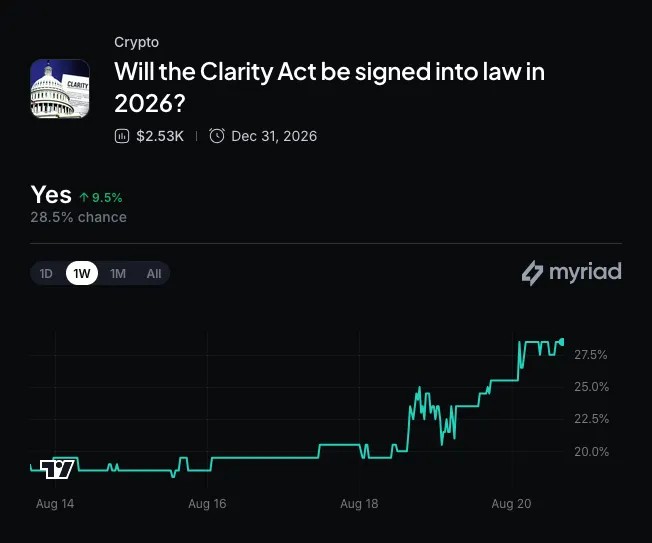
Myriad: Will the Clarity Act be signed into law in 2026? Click to make your prediction.
President Trump had a clear message for the crypto execs invited to the oval office: Pass the Clarity Act
Industry executives left Wednesday’s White House meeting with renewed optimism about the Clarity Act’s prospects. Trump urged Congress to pass a “fair version” of the bipartisan bill when lawmakers return next month, a reference to ethics provisions proposed by Sens. Thom Tillis (R-NC) and Ruben Gallego (D-AZ). Trump has argued that some of the provisions unfairly single him out, while the dispute over them has become the main obstacle to securing bipartisan agreement.
Ethics was also a focus behind closed doors. Ahead of the public remarks, Coinbase CEO Brian Armstrong, a16z Managing Partner Chris Dixon, Ripple CEO Brad Garlinghouse and Kraken co-CEO Arjun Sethi met privately with Commerce Secretary Howard Lutnick, according to two sources familiar with the meeting.
The discussion focused on the importance of passing the Clarity Act, including what it could mean for U.S. jobs, economic growth, and bringing crypto entrepreneurs and companies back onshore. The group also discussed the remaining hurdles, including ethics, and how the White House could help chart a path toward bipartisan agreement.
Thank you @POTUS for inviting crypto leaders to the White House yesterday and leading the push for CLARITY. I also appreciate @ChairmanSelig doing the same at the CFTC Innovation Advisory Committee meeting. It’s clear that there is a lot of support for crypto innovation from the…
— Chris Dixon (@cdixon) August 20, 2026
Getting crypto’s marquee legislation across the finish line was also a central theme at Thursday’s Innovation Advisory Committee meeting, which brought together leaders from traditional finance, crypto, prediction markets and AI.
“Passing Clarity is the surest way that we can prevent another Gary Gensler from running a rogue campaign of lawfare against the individuals and companies in this room today,” CFTC Chairman Mike Selig said, referring to the former SEC chief under whose leadership the agency brought 125 crypto-related enforcement actions.
But Selig also made clear that the commodities regulator is preparing to act if Congress fails to deliver.
“If Clarity continues to stall because of Democratic obstruction, the CFTC will utilize its existing authorities to begin establishing a regime for crypto asset markets,” he said, adding that he has already directed agency staff to begin exploring such rules.
Meanwhile, the SEC formally proposed Regulation Crypto Assets, a new framework for crypto fundraising in the U.S. The proposal would allow certain offerings of up to $5 million over four years or $75 million annually without full SEC registration, create a conditional safe harbor for crypto assets once an issuer’s essential managerial efforts have ended, and preempt certain state securities registration requirements.
The way the proposal was approved was also notable. The Commission voted through a “seriatim” process, meaning commissioners voted individually outside a public meeting, according to an SEC spokesperson. The SEC had been scheduled to consider Regulation Crypto Assets at an open meeting last Friday, but fueled intrigue when it abruptly canceled the meeting, citing an “unforeseen scheduling issue.”
Crypto In America reported earlier this week that pressure from both the White House and Wall Street groups contributed to the cancellation. The White House was concerned that Regulation Crypto Assets and a separate innovation exemption for tokenization could complicate negotiations over the Clarity Act. Wall Street groups have also raised legal concerns about the innovation exemption, arguing that changes of that scale should proceed through formal rulemaking rather than exemptions or no-action relief.
Semafor later reported that a “White House mix-up” also contributed to the cancellation, with officials confused about whether the SEC planned to advance Regulation Crypto Assets or the innovation exemption for tokenization.
Crypto in America is a newsletter written by Eleanor Terrett. Follow the link to read in full and subscribe.

 decrypt.co