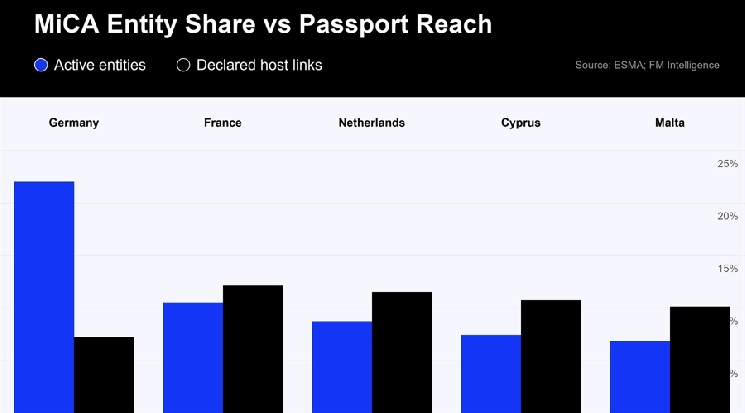
A large entity count can increase one authority's supervisory workload. It does not show where the provider has customers or generates revenue.
Five States Hold 55% of MiCA Entities
Germany has 71 of the 323 active entities. France follows with 34, the Netherlands with 28, Cyprus with 24 and Malta with 22. Together, the five jurisdictions account for 179 entities, or 55.4% of the total.
ESMA's raw file contains 330 rows, but a row is not always a separate provider. FM Intelligence excluded two withdrawn records and one authorization dated after the snapshot, leaving 327 active records. Combining repeated LEIs reduced that number to 323 legal entities.
The count also does not equal 323 independent competitors. One brand can operate through several authorized entities, while a single legal entity can appear in more than one row after a permission or name change.
Germany's Entity Lead Does Not Extend to Passporting
German entities contribute 330 of the register's 4,592 declared host-state links, or 7.2%. France accounts for 12.1% of links, followed by the Netherlands at 11.5%, Cyprus at 10.7% and Malta at 10.1%.
The difference complicates simple rankings of MiCA hubs. Germany has the largest entity base, while several smaller home states account for more declared cross-border reach.
ESMA's review of a Malta CASP authorization showed why home-state processes can affect clients elsewhere in the bloc.
MiCA provides two routes into the register. Crypto companies can receive a full authorization under Article 63.
Specified banks and other regulated financial institutions can notify equivalent crypto services under Article 60. ESMA's file does not include a structured field that separates the routes.
Passport Links Show Intent, Not Clients
The country field records where a provider intends to offer a service. It does not establish active clients, revenue, local marketing or confirmed product availability in each state.
The file stores services and countries as separate lists. It cannot show which service is intended for which country.
That distinction is important as firms and national regulators adjust to the post-transition MiCA market. A 29-country declaration is a regulatory footprint, not proof that the same product is live across the region.
The full FM Intelligence MiCA report includes the complete jurisdiction ranking, passport-footprint distribution, source files and calculation methodology.
ESMA updates its interim MiCA register weekly using information supplied by national authorities.

 financemagnates.com