
 cointelegraph.com

European authorities added 15 crypto companies including a BNY Mellon unit to the Markets in Crypto-Assets (MiCA) framework register in the third update of regulated providers since the July 1 transitional deadline.
With the European Securities and Markets Authority’s (ESMA) update on Friday, its interim MiCA register shows 309 licensed crypto-asset service providers (CASPs).
The latest entries include four banking institutions, including BNY SA/NV, the Belgian subsidiary of US banking giant BNY Mellon, and three German banks, alongside digital asset platforms such as BitPay, Coinify and Bleap.
The update comes as regulators continue building out the MiCA framework, which introduced the European Union’s first unified rules for crypto service providers and aims to bring more oversight to the sector.
Germany and Denmark lead latest CASP additions
Germany and Denmark accounted for the largest number of the latest additions, with three new CASPs registered in each country. Bulgaria and Latvia followed with two additions each, while Belgium, Cyprus, Liechtenstein and the Netherlands each added one provider.
The German additions included cooperative financial societies Spar-und Kreditbank Rheinstetten and VR-Bank Augsburg-Ostallgäu, along with Raiffeisenbank Falkenstein-Wörth.
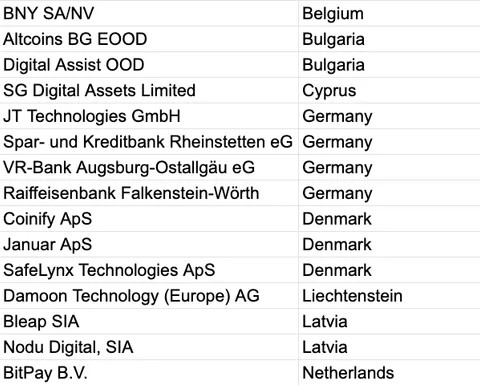
15 new CASPs in the MiCA register update on Thursday. Source: ESMA
Other newly listed providers include: Bulgaria’s Altcoins BG and Digital Assist; Denmark’s SafeLynx Technologies and Januar, a digital asset infrastructure company; and, Latvia-registered providers Bleap and Nodu Digital.
MiCA expansion continues after July deadline
The latest update follows ESMA’s previous register additions after the July 1 deadline, including 14 CASPs added in the regulator’s second post-deadline update, which included major industry companies such as Ripple Payments Europe.
While the CASP roster expanded, ESMA reported no changes to other MiCA-related registers in the latest update, including authorized issuers of asset-referenced tokens (ARTs), e-money tokens (EMTs), and crypto assets, as well as non-compliant entities.
The continued updates show that MiCA implementation remains an evolving process, with regulators still adding authorized providers as companies complete licensing procedures across European markets.
At the same time, some industry executives warn that the cost of maintaining a MiCA license could push smaller firms out of the market, with Gate Europe CEO Giovanni Cunti saying some licensed companies may struggle to sustain the compliance resources required over the long term.