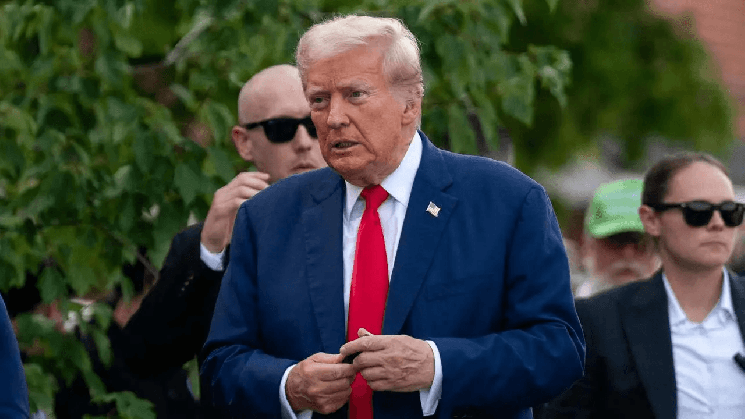
China‘s own approach reinforces the contrast. Beijing bans private crypto trading and mining at home while building out its central bank digital currency ( CBDC), the e-CNY. U.S. officials under Trump point to that split as proof that Washington needs its own clear rules rather than a ban.
Trump made a similar case in a July 2026 appearance on CNBC with Joe Kernen, telling him crypto is “a big deal” and that the U.S. needs to stay “number one in crypto and number one in AI.” He named Japan as a secondary contender in that same conversation, but kept the focus on China as the main rival.
The framing places crypto inside a wider push that the White House calls technological sovereignty. Officials argue that losing ground on blockchain and stablecoin infrastructure could weaken the U.S. dollar’s reach abroad, slow U.S. energy investment tied to bitcoin mining and push financial innovation offshore.
Policy Moves Back Up the Rhetoric
Trump’s second term has produced specific actions tied to this argument.
- The GENIUS Act, signed in July 2025, created a federal framework for dollar-backed stablecoins.
- An executive order established a Strategic Bitcoin Reserve, directing the government to hold seized Bitcoin rather than sell it.
- The SEC under Chair Paul Atkins and the CFTC shifted toward friendlier oversight, winding down several enforcement actions from the prior administration.
- Lawmakers continue work on the Clarity Act, aimed at setting federal rules for digital asset markets and custody.
Trump named David Sacks as White House Crypto and AI Czar, a move that placed both technologies under one policy office. Sacks has since left that position.
The ‘100 Million’ Figure
Trump’s claim of “100 percent of the vote” from “100 million people” is not a polling statistic. It reflects two things instead: a massive voting bloc that organized around crypto issues in 2024, and a fast-growing base of crypto owners.
Industry-funded groups such as Fairshake spent more than $170 million backing pro- crypto candidates in the last election cycle. Vice President JD Vance has cited estimates near 50 million American bitcoin owners, with projections pointing toward 100 million as adoption continues.
Family Earnings Draw Fresh Scrutiny
The remarks landed alongside renewed attention toward the Trump family’s crypto income. Trump’s personal disclosures show earnings in the range of $1 billion to $1.4 billion in 2025 tied to World Liberty Financial and related tokens.
Critics point to a conflict between the family’s holdings and the administration’s role in shaping crypto policy. Trump has responded by pointing to family management of the businesses and returning to the national argument: U.S. leadership in crypto matters more than any single investment.
How Traders on X Reacted
Grok detailed that social media posts referencing Trump’s July 6 remarks spread quickly on X, led by clips from several prominent accounts on Monday. Traders tied the comments to market momentum, calling the tone bullish.
A smaller share of replies pushed back. Some questioned whether the U.S. actually leads on infrastructure or access. Others pointed to Trump‘s crypto earnings as a reason for skepticism, with some calling the framing marketing language, not data points.
Roughly 60% to 70% of Grok’s sampled X reaction leaned positive, according to the AI model’s review of high-engagement posts and reply threads. The rest raised doubts about follow-through on legislation like the Clarity Act.
Some replies fell in between. Grok disclosed that one trader wrote that regardless of whether someone is bullish or bearish, crypto is now part of the broader economic conversation in Washington. Others pointed to a different reason Trump’s words carry more weight than they did in his first term: institutions now hold more than $100 billion in bitcoin, giving presidential statements a bigger audience than they had when crypto was mostly a retail market.
What Comes Next
Congress still has not passed comprehensive market structure legislation. That leaves the administration’s crypto agenda resting on executive orders, agency rule changes, and public statements like the ones Trump made on July 6.
Spot bitcoin and ethereum exchange-traded funds (ETFs) have already pulled in tens of billions of dollars since launch, and companies, including Strategy, continue to add bitcoin to corporate treasuries. But that traction changed today as Strategy sold more than 3,500 coins to pay dividends.
Whether Trump’s China-versus-America framing turns into durable policy will depend on what happens with pending legislation in the months ahead.

 news.bitcoin.com