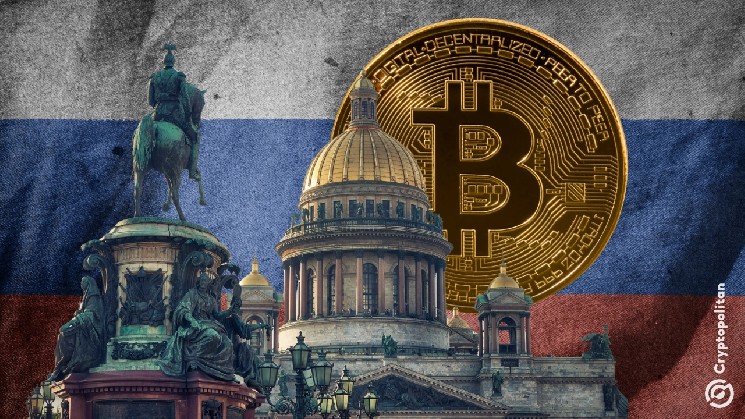
While it is ready for further consideration, this will take place “with a slight delay,” according to Alexey Yakovlev, head of the Minfin’s Financial Policy Department.
Quoted by the leading Russian crypto news outlet Bits.media, the unit’s director explained:
“Generally, everything is ready. We expect the State Duma [financial markets] committee to approve it soon, and then the second reading will follow.”
“We probably won’t be able to adopt it before July 1, but somewhere around that time,” Yakovlev added in comments for the Interfax news agency.
The draft is at its most advanced stage of preparation, and no major amendments are likely before it hits the floor of the Duma “in the next couple of weeks,” the official indicated.
To come into force, the law must also be passed on third and final reading in the lower house before it’s approved by the Federation Council, Russia’s senate, and sent to President Putin for signing.
The State Duma voted on the bill for the first time in April. According to earlier official statements, it had to be adopted and enforced no later than the first day of July.
Necessary bylaws and other regulations will be introduced by the Central Bank of Russia (CBR) this summer, and the country’s first regulated crypto transactions are expected in the fourth quarter.
Moscow to adopt comprehensive crypto rules
The upcoming cryptocurrency legislation is based on a new policy announced by Russia’s monetary authority in late December 2025.
The comprehensive legal framework will regulate various operations with digital coins, including investing, exchange and trading.
The CBR’s regulatory concept envisages expanding investor access to crypto assets beyond the current narrow category of “highly qualified investors.”
Ordinary Russian citizens will soon be able to legally buy cryptos through licensed intermediaries, although their investments will be limited to less than $4,000 a year.
Non-professional investors will be allowed to acquire only the largest coins, such as Bitcoin (BTC) and Ethereum (ETH), as well as major stablecoins like Tether’s USDT and Circle’s USDC.
Domestic transactions without the involvement of exchanges, brokers, trustees, and depositories authorized by the Bank of Russia will be prohibited, including transfers to non-custodial wallets.
Russia readies crypto advertising ban
Russian authorities are also preparing to ban advertisements for decentralized digital assets. For example, the use of the names of specific cryptocurrencies like “Bitcoin” in ads, videos and other materials will not be permitted.
The respective amendments will be introduced with the digital currency law, ahead of its second reading, the head of the CBR Department for Strategic Development of the Financial Market, Ekaterina Lozgacheva, unveiled at the end of May. At the time, she explained:
“Services can be advertised and communicated to clients, but we still believe that cryptocurrencies themselves should not appear in advertising, because they are such a high-risk asset.”
On Wednesday, the Chairman of the parliamentary Committee on Financial Markets Anatoly Aksakov confirmed the upcoming restrictions and made some clarifications.
Businesses from the industry will be able to reveal they are working in the crypto space, but without announcing their specific activities, the prominent lawmaker emphasized.
“We are banning the advertising of cryptocurrencies, but at the same time, allowing organizations operating in this market to say so,” he elaborated during the St. Petersburg International Legal Forum held this week.

 cryptopolitan.com