Inflows into digital asset treasury companies collapsed in May, plunging 95% from the previous month to just $180 million — the lowest monthly figure since October 2024. That total ran roughly 93% below the January-through-May monthly average, after two unusually strong months that delivered $4.2 billion in March and $4.4 billion in April. Bitcoin treasury vehicles accounted for nearly all of May's intake at $177 million, or about 98% of the total. Investors appear to be reassessing passive treasury models as altcoin exposure thins and net-asset-value compression mounts against listed accumulation vehicles.
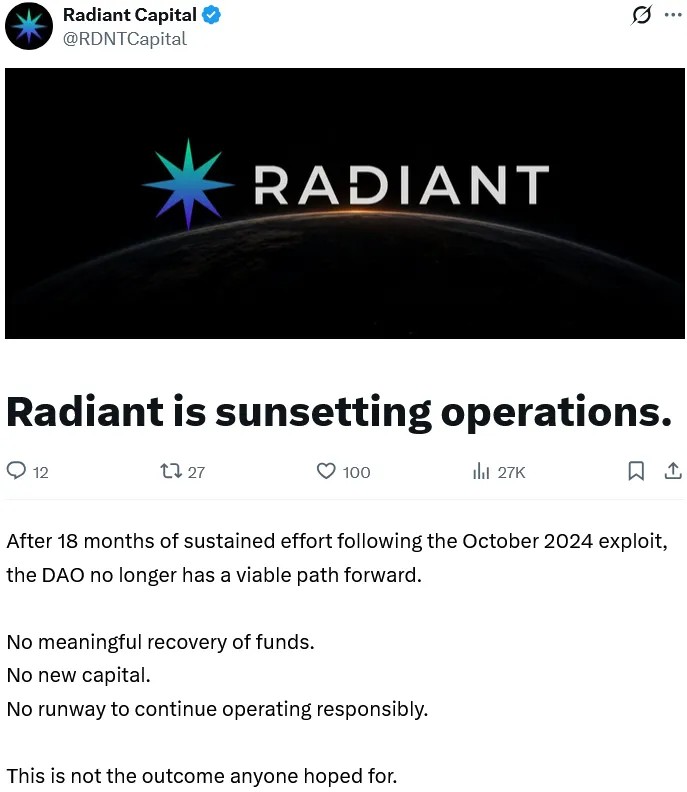
Decentralized lending protocol Radiant Capital confirmed it will wind down operations after failing to recover from a $50 million exploit attributed to North Korea's Lazarus Group in October 2024. The team said it could not secure a viable path forward, lacking the recovery, capital, or growth runway needed to operate responsibly. Total value locked collapsed from $75 million immediately after the breach to $5 million within weeks and never rebounded. Radiant will transition into a maintenance state in which the front end stays online and smart contracts remain accessible, allowing users to withdraw remaining positions while contributors step back from active protocol development.
On Capitol Hill, US senators return from recess this week with the CLARITY Act debate set to resume, reopening one of the most consequential market-structure discussions facing digital assets. The legislation seeks to delineate jurisdictional boundaries between the SEC and CFTC over crypto spot markets, an issue that has clouded compliance pathways for exchanges, custodians, and token issuers operating on blockchain rails. Industry advocates have framed the bill as essential for unlocking institutional flows and standardizing oversight of DeFi infrastructure. The outcome will shape whether US-based platforms can compete with European frameworks now hardening under MiCA.
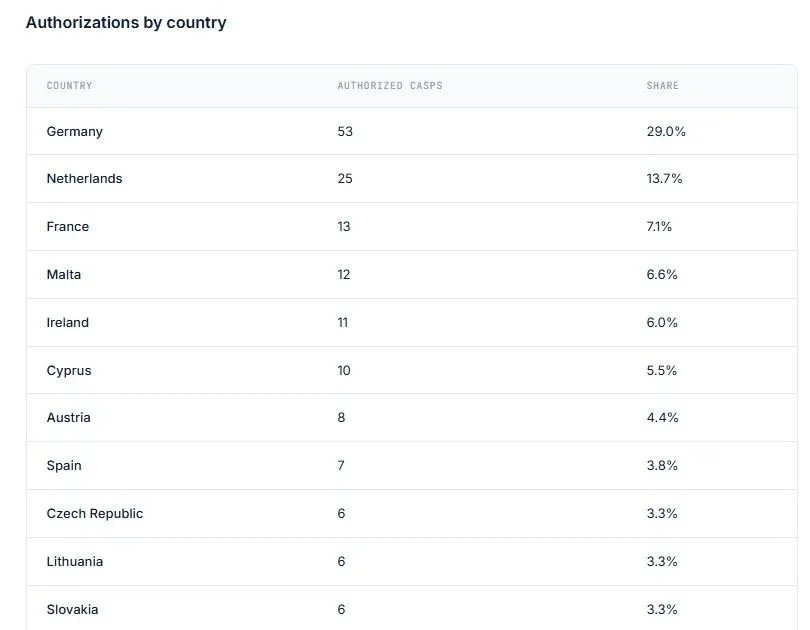
Estonia offers the starkest illustration of MiCA's compression effect on Europe's licensed crypto base. The country's Financial Intelligence Unit reported 641 active Virtual Asset Service Providers in June 2021, when Tallinn ranked among the continent's largest crypto hubs. That figure fell to 45 by October 2024 and slid further to 40 by February 2025 — a more than 90% decline in under four years. France paints a parallel picture: only 30% of roughly 90 unlicensed French operators had applied for MiCA authorisation by early 2026, while 40% confirmed they would not pursue licences at all, leaving a fragmented compliance map ahead of the July 1 cutoff.
The week's headlines trace a single arc — regulatory tightening on every front. Washington is weighing whether retirement savers should ever touch crypto while simultaneously debating the CLARITY Act's market-structure rewrite. Brussels is enforcing a licensing regime that has eliminated more than 90% of the continent's previously registered operators. Capital is responding accordingly: treasury inflows have collapsed, protocols without recovery paths are shutting down, and survivors are concentrating around compliance-ready balance sheets. The cycle's dominant narrative is no longer growth at any cost — it is the institutional filtering of an industry now forced to mature inside hardened legal perimeters on both sides of the Atlantic.

 en.coinotag.com