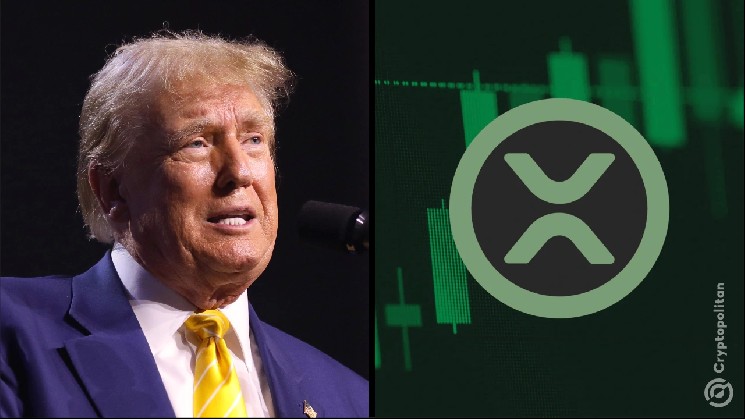
Trump’s latest fintech executive order could be the massive catalyst $XRP has been waiting for.
By directing the Fed to review giving crypto firms direct access to US payment rails, the administration is opening the door for players like @Ripple to bypass legacy banking… pic.twitter.com/nvB3aao1vI
— 𝗕𝗮𝗻𝗸XRP (@BankXRP) May 25, 2026
The executive order arrives as lawmakers continue advancing legislation on the crypto market structure in Washington. Together, the regulatory and banking changes are impacting discussions around how digital asset companies may operate within the U.S. financial system.
Federal Reserve access review reshapes crypto banking debate
For years, fintech and crypto firms have depended on partner banks to access core payment infrastructure. Transactions involving digital asset firms passed through intermediaries because direct access to central banks remained restricted.
Under Trump’s order, regulators will now decide whether firms, including Coinbase, Circle Internet Group, and Ripple, can obtain direct access to Federal Reserve services.
The review follows earlier reforms highlighted by Cryptopolitan, including Kraken, whose banking division secured limited access through a specialized charter structure. That decision laid the foundation for broader discussions about crypto participation in U.S. payment systems.
The executive order stated that current financial regulations may affect innovation within the fintech and digital asset industries. Banking organizations, however, have raised concerns surrounding stability and oversight if direct access expands beyond traditional financial institutions.
Ripple’s payment model faces a possible change case
Ripple has repeatedly positioned $XRP as a liquidity asset for cross-border payments and institutional settlement services. The company’s infrastructure was built to reduce delays and costs associated with international transfers.
However, if Ripple gains access to the Federal Reserve’s payment systems, the company may reduce its reliance on correspondent banking networks. That shift may eliminate other settlement layers that are linked to the institutional transfers.
The launch could influence transaction speed, liquidity transfer and enterprise payment activity costs for the $XRP network. If the regulations are approved, financial institutions that use Ripple’s services may be able to complete transactions with fewer intermediaries.
Further, the review might enable quicker settlements, reduced institutional expenses, and potential access to Federal Reserve payment infrastructure. If it gains approval as reported, the use of $XRP in regulated cross-border finance can grow.
CLARITY Act vote adds momentum to crypto regulation
The executive order came into effect during a period of digital asset legislation in Washington. On May 14, 2026, the Senate Banking Committee approved the CLARITY Act in a 15-9 vote, advancing the crypto market structure bill to the full Senate. Every Republican on the committee supported the legislation, alongside Democratic Senators Ruben Gallego and Angela Alsobrooks.
The legislation aims to define how digital assets are classified under U.S. law. It also seeks to clarify which assets fall under securities regulation and which qualify as digital commodities under the Commodity Futures Trading Commission’s oversight.
The House of Representatives previously passed its own version of the legislation in July 2025 by a 294-134 vote. Earlier this year, the Senate Agriculture Committee also advanced portions of the framework tied to spot digital commodity markets.
Debates surrounding stablecoin yield provisions delayed negotiations for months. The disagreement became big enough for the White House to organize discussions between banking groups and crypto industry participants in search of compromise terms.
Moreover, the latest Senate Banking Committee vote marked the resumption of those negotiations after months of stalled discussions surrounding crypto regulation and financial oversight.

 cryptopolitan.com