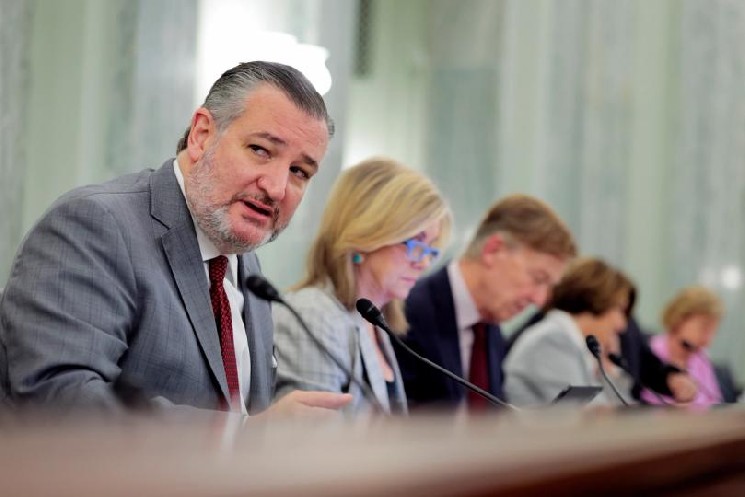
"It is not uncommon for fans scrolling Twitter on a Sunday afternoon in the fall to see posts speculating that a controversial call by an official was related to gambling," Cruz said.
Other lawmakers focused on marketing that fosters problem gambling or that has reached youths that are otherwise meant to be blocked from betting. Senator John Hickenlooper, a Colorado Democrat, accused the prediction markets businesses of unleashing the "hounds of hell" in social media and marketing to "prey on our young people."
Patrick McHenry, who was a prominent member of the House of Representatives until his recent retirement, is now an adviser at the Coalition for Prediction Markets that represents Kalshi, Crypto.com, Robinhood, Coinbase and others. He said trades aren't allowed for anybody under 18 and that the average age of users is 33.
Problem gamblers
Harry Levant, director of gambling policy at the Public Health Advocacy Institute, testified on Wednesday, telling the lawmakers he was a recovering gambling addict and lamenting the "avalanche of unregulated advertising" from prediction market firms.
"It's a known addictive product, just like heroin," he said.
Earlier this week, Kalshi co-founder and CEO Tarek Mansour posted on social media site X to highlight his company's $2 million commitment with the National Council on Problem Gambling to support an initiative on "trader health and safety.""As retail participation in markets increase, we have a responsibility to balance free markets and individual responsibility with customer education and safety guardrails," he wrote.
And still other lawmakers on Wednesday dove into the rapidly growing industry's avoidance of state regulators and competition with regulated gaming on U.S. tribal lands, where revenue is a core support of tribal reservations' financial health.
CFTC
Even as the senators put the event-contract space under the microscope, the Commodity Futures Trading Commission that regulates derivatives trading platforms is pursuing a lawsuit filed on Tuesday to stop a new law in Minnesota that was set to hold prediction market activity as illegal there. The regulator adds this to a growing list of lawsuits the federal agency has filed against states that have sought to limit prediction markets or declare them in violation of state gambling laws.
“This Minnesota law turns lawful operators and participants in prediction markets into felons overnight,” said CFTC Chairman Mike Selig in a statement, who added this suit alongside similar agency fights against Arizona, Connecticut, Illinois and New York.
Selig has led an agency legal campaign to defend his agency's authority to supervise and regulate prediction markets, which are managed on registered platforms under CFTC rules. Meanwhile, his agency — at which he's the sole member of what's meant to be a five-member commission — is also pursuing a formal rule to establish tailored standards for the sector.
McHenry defended the CFTC role on Wednesday.
"The CFTC, as a cop on the beat, has the capacity to oversee this market, just as they've done with the broader commodities marketplace that's been around and well versed for decades," McHenry said.
Senator Hickenlooper responded, "You're the first person who's told me you think that they think the CFTC is up to the standards."
One of the witnesses, Bill Miller, the president and CEO of the American Gaming Association, contended the federal regulators "are absolutely not competent to handle this, and two, they are absolutely hurting tribes and states financially." He added that, "it was never Congress's intent to create a federal department of gambling through the CFTC."
McHenry argued that these event contracts are derivatives that belong to "fundamentally different business models" from bets placed with gambling businesses. He equated them to long-regulated grain futures contracts, and he added that "our member companies have enhanced surveillance greater than any casino and greater than any sportsbook in the country."
In the end, Chairman Cruz said, "The Supreme Court may have to decide the issue."

 coindesk.com