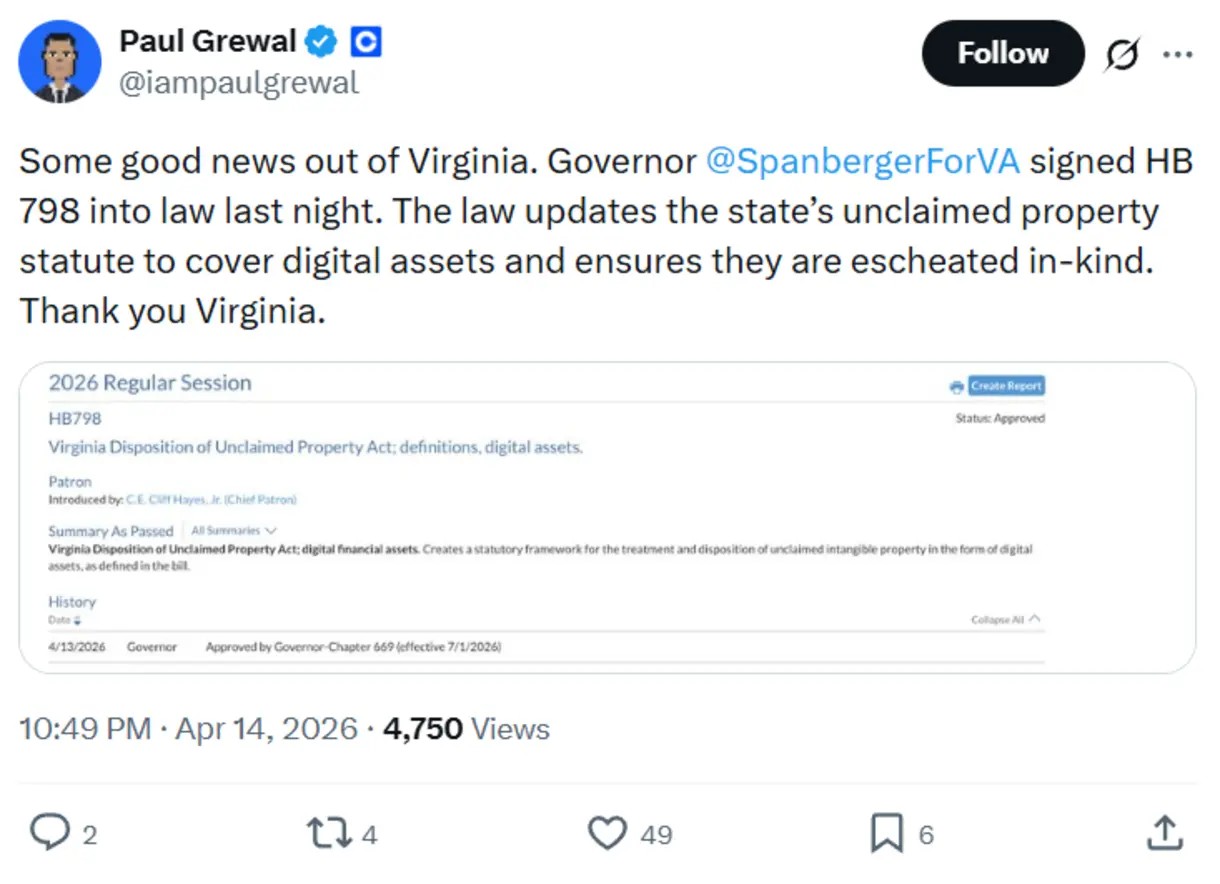
Virginia has passed a new law that could quietly fix one of crypto industry’s biggest long-standing issues: what happens when digital assets are left unclaimed. Governor Abigail Spanberger signed House Bill 798 into law, creating a formal framework for handling dormant crypto accounts. The change allows the preservation of assets like Bitcoin (BTC) instead of selling them off at potentially unfavorable prices.
Virginia updates rules for unclaimed crypto
Under the new law, the state will consider digital assets in inactive accounts abandoned after five years. At that point, they move to state custody, but crucially, the state holds them ‘in kind,’ which means it will preserve the actual tokens rather than liquidate them into cash.
An excerpt from the law. Source: Virginia State Legislative Information System
Know when your coins move
Alerts, real-time prices, and market news — all in one app
4.8 based on 40K reviews in the App Store and Google Play
This marks a significant shift from previous practices where states often sold crypto soon after taking custody. In those cases, owners who later reclaimed assets would receive cash based on past market prices, which led to potentially missing out on major upside.
The law also requires that the state holds the assets for at least one year before any liquidation can occur, which adds another layer of protection for owners:
“Unless the administrator deems it to be in the best interest of the Commonwealth to do otherwise, all securities and digital assets delivered to the administrator shall be held for at least one year before the securities or digital assets may be sold.”
Significance for Bitcoin holders
The implications for Bitcoin users are simple but important. If someone loses access to a wallet or forgets about an exchange account, the state will now longer automatically convert their holdings into fiat at whatever price exists at the time of state seizure.
Instead, the assets remain exposed to market movements. This means that owners could recover the actual crypto rather than a potentially outdated cash equivalent. This aligns more closely with how crypto investors view long-term value storage.
The law also introduces a broad definition of digital assets, covering cryptocurrencies used as a store of value or medium of exchange. At the same time, it excludes items like in-game currencies or certain regulated securities.
Industry figures have welcomed the move, including Coinbase chief legal officer Paul Grewal, who described it as “good news” for ensuring digital assets are handled properly.
Coinbase legal executive’s comment on the developments. Source: Paul Grewal/X
Virginia now joins a growing list of states modernizing their legal frameworks around crypto, which signals a gradual shift toward treating digital assets more like long-term financial property rather than something to get rid off quickly.

 techgaged.com