Banks are required to establish separate Client Money Accounts (CMAs) for handling customer funds associated with VASP activities, ensuring strict segregation between VASP’s own funds and those of its clients.
These accounts must be denominated in Pakistani Rupees, remain non-interest-bearing, prohibit cash deposits and withdrawals, and cannot be used as collateral for financing or credit purposes.
In addition to standard AML/CFT requirements, banks must carry out enhanced due diligence by thoroughly understanding the VASP’s business model, customer base, operational scope, and geographic exposure. They are also required to update their risk assessment frameworks, continuously monitor transactions, and report suspicious activities.
The framework allows entities with a No Objection Certificate (NOC) from PVARA to open limited-purpose accounts to facilitate licensing, but full banking services can only be extended after obtaining a formal license.
Banks are explicitly prohibited from investing in, trading, or holding virtual assets using their own funds or customer deposits, and they remain fully responsible for complying with all regulatory requirements, including foreign exchange regulations, regardless of any arrangements with VASPs.
New law sets up oversight framework for virtual assets in Pakistan
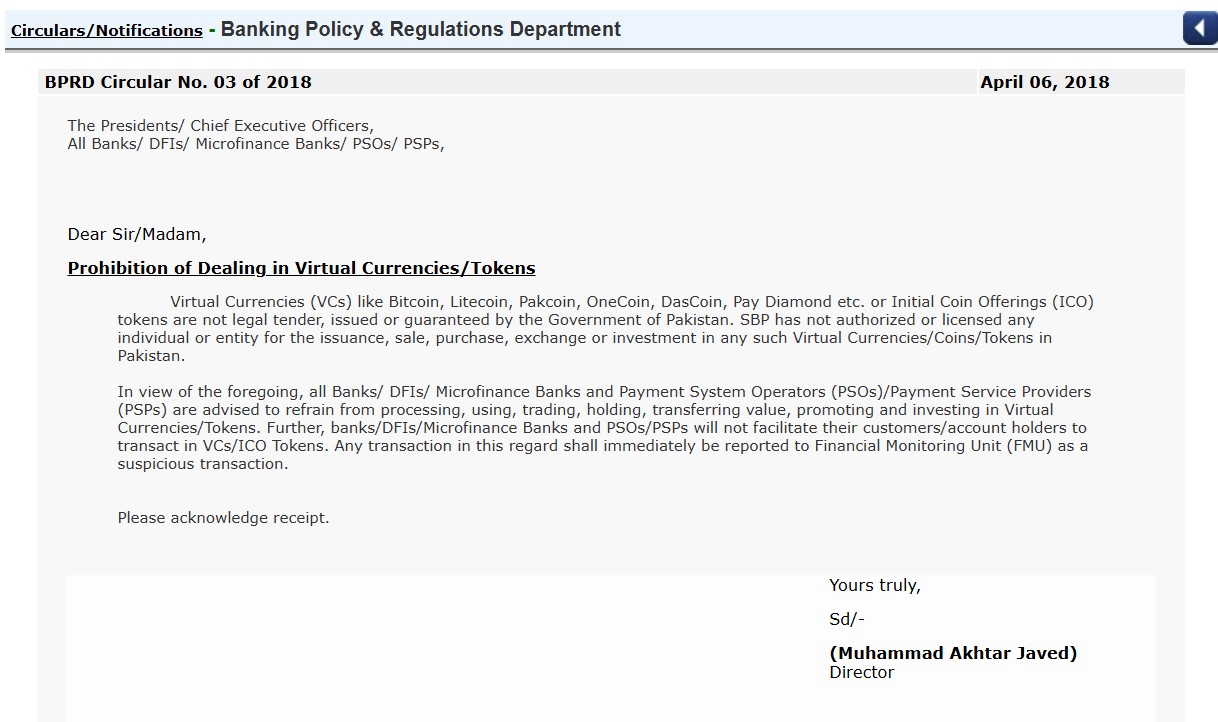
The replacement follows the enactment of the Virtual Assets Act, 2026 and the establishment of PVARA.
Pakistan’s Virtual Assets Act is designed to protect investors, preserve market integrity, and enable regulated blockchain innovation within a strong anti-money laundering framework. It establishes licensing and supervision of VASPs to ensure customer protection, compliance controls, and tighter oversight of virtual asset activity.
At the same time, it seeks to unlock innovation through sandboxes, virtual asset zones, and support for tokenized financial systems.
Pakistan’s restrictions push crypto activity
Rather than slowing demand, the 2018 restrictions drove crypto activity underground.
Peer-to-peer activity surged, with usage reportedly jumping by over 700% in the years that followed, as users found ways around the formal banking system, according to the Federation of Pakistan Chambers of Commerce and Industry.
By early 2024, most retail crypto transactions were happening through informal P2P channels or so-called “Digital Hundi” networks.
Binance, the world’s largest crypto exchange, has also become widely recognized in Pakistan, helping drive a user base now estimated at over 20 million.

 cryptobriefing.com