
 cryptonews.net
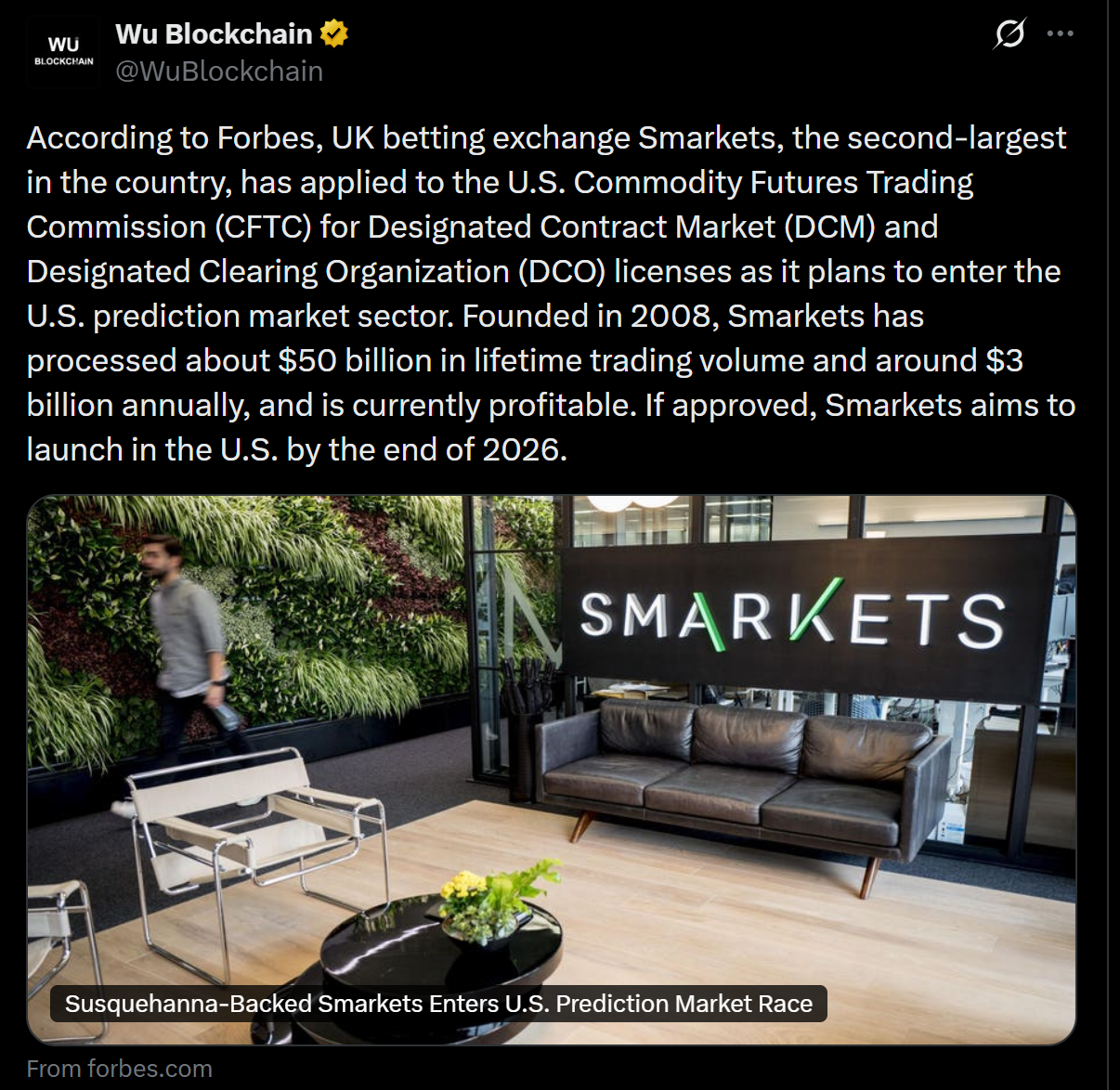
The U.K.-based betting exchange Smarkets has sought authorization with the U.S. regulators to run a prediction market exchange, the biggest indicator yet of what could become a significant corporate spread into one of the fastest-growing financial trading segments in the world.
The company has submitted applications to the Commodity Futures Trading Commission (CFTC), a regulatory body in the United States, to become both a Designated Contract Market (DCM) and a Derivatives Clearing Organization (DCO), both of which would enable it to list and clear event-based contracts in the United States.
Assuming that its proposal is approved, Smarkets anticipates opening its prediction market platform in the U.S. by the end of 2026, and this will bring it to a fast-changing industry where traders bet on the likelihood of real-world events, such as elections, or economic indicators. The relocation puts the London-based exchange and a wider number of fintech companies that are seeking regulatory permission to conduct prediction markets in the U.S. derivatives system.
Source: X
The model that Smarkets operates is not comparable to the traditional sportsbooks due to the fact that it acts as a peer-to-peer platform. The participants are trading contracts amongst each other, and the mediator merely receives a fee on executed contracts instead of opposing users. This form of exchange is much more similar to derivatives markets than to traditional gambling systems and this aspect has assisted prediction markets to achieve regulatory acceptance in the United States.
Major trading firms have also supported the company, such as one of the Chicago-based proprietary trading giants, Susquehanna International Group, who has been dealing with derivatives and options markets long before. Such support grants credibility whereby Smarkets tries to comply with the tough regulatory and compliance needs to conduct business within the U.S. financial markets.
Understanding the Regulatory Approval Process
The entry of Smarkets into the U.S market is subject to the approval of the CFTC, the federal agency that regulates the trading of Futures, swaps among other derivatives in the United States market. The commission was formed in 1974, to monitor exchanges referred to as Designated Contract Markets and the clearinghouses which transact derivatives.
In order to run a full-fledged prediction market exchange, Smarkets needs to receive two licenses. The platform would be designated as a Designated Contract Market to enable it list and trade event contracts, a type of derivative based on the performance of an actual event. In the meantime, becoming a Derivatives Clearing Organization would allow the company to clear and settle such contracts internally as opposed to using a third party clearinghouse.
The acceptance process normally involves companies having well developed compliance procedures, ability to monitor the market, anti-manipulation control measures and financial security. Also the exchanges must demonstrate that their contract arrangements are in compliance with the Commodity Exchange Act and other rules.
These presuppositions indicate the increasing attention that regulators paid to prediction markets that have rapidly gone mainstream but also suggest the possibility of manipulation and insider trading and a gray area between financial derivatives and gambling.
Prediction markets enable traders to buy and sell contracts which are a representation of the likelihood of upcoming events. Prices are volatile because the players in the markets revise their forecasts regarding the outcomes of variables like election outcomes, economic news releases, or sports championships, or the geopolitical news.
Even though the idea is not new (decades old), the overall prediction market business has been booming in recent years thanks to the enhancement of the digital infrastructure and the legal transparency.
A significant milestone came in 2021 when Kalshi was the first federally-regulated exchange of an all-event contracts nature following approval as a Designated Contract Market. It subsequently received permission to have its own clearinghouse which allowed it to control the entire lifecycle of the trades itself.
Concurrently, decentralized platforms have also increased on an international scale. Another illustration is Polymarket which became one of the influential cryptocurrency-based prediction markets, allowing users to trade on the probability of events around the globe by utilizing blockchain infrastructure. Nevertheless, the service had difficulties with regulation in the United States and had to prevent its American users until it transitioned towards a regulated service.
This activity has been so intense that prediction markets have turned into more than experiments by becoming multi-billion dollar trading platforms.
Regulatory Scrutiny and Legal Debates
Prediction markets are controversial even after they grow. Critics say that letting people speculate on political or geopolitical events would create a motive to manipulate or would bring up ethical issues of betting on sensitive events.
The regulators have reacted by placing greater regulation on the industry. Early in 2026, the CFTC issued guidelines outlining its plans to monitor risks, such as insider trading, market manipulation, and misuse of confidential information, and to strengthen enforcement of prediction markets.
The agency has also been drawn into the continuing debates of whether some contracts, especially those relating to the results of sports events should be considered as a financial derivative or should be perceived as gambling products in the state law. A number of states in the U.S have gone to court against federal jurisdiction on the issue of sports related events contracts, claiming that local gaming laws apply.
These lawsuits may influence the business landscape of firms such as Smarkets that will want to join the market.
The Smarkets move indicates wider institutional concern in the new category of financial tools, prediction markets. Event contracts are becoming more attractive to hedge funds, proprietary trading firms, and retail investors due to an ability to hedge risks or give opinions on political and economic events.
Prediction markets have also started to be incorporated into the mainstream apps of financial technology platforms. Other analysts are of the view that this would ultimately render event contracts as one of those most actively traded derivatives.
The growing participation of large trading companies and financial institutions poses a possibility that prediction markets are becoming an important part of the world derivatives market.
The move by Smarkets to seek U.S. regulatory accreditation happens at an instance when the prediction market terrain is changing at a significantly fast rate. The United States is experiencing new avenues through regulatory change, judicial decisions and technological advances that can allow companies to conduct business within the nation without violating the law.
Meanwhile, competition is increasing. The current platforms are extending their service, and new ones supported by large financial institutions are looking to bring event trading into the wider trading systems.
In case Smarkets receives its licenses, it would be able to compete directly against existing U.S. prediction markets and use its experience as a large-scale betting exchange.