Carter found that Binance’s “new world” rhetoric about operating in a decentralized manner did not change the basic contract law analysis for internet‑based agreements.
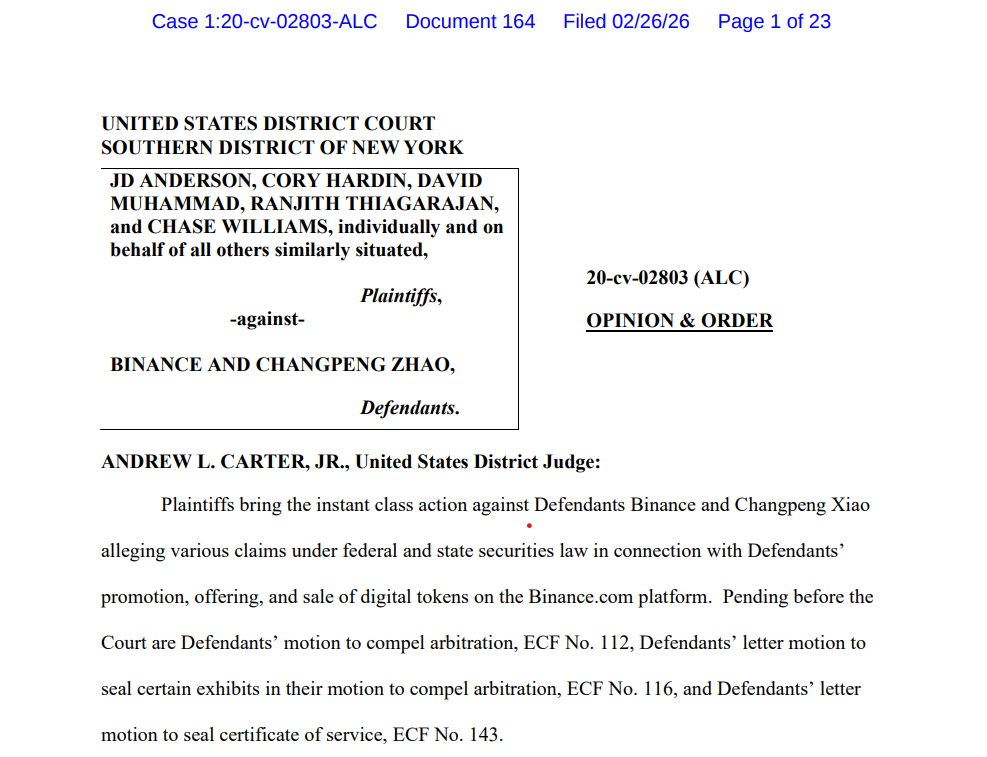
Williams vs. Binance. Source: CourtListener
He concluded that the 2019 arbitration clause could not be applied retroactively to claims that arose before its Feb. 20 effective date, because the contract never clearly said it would cover earlier conduct.
Related: US senator launches probe into Binance over Iran, Russia sanctions claims
Carter also held that a purported US class action waiver embedded in a section heading of the 2019 terms was unenforceable in federal court because the contract never actually sets out the terms of any such waiver and had to be interpreted narrowly against Binance as the drafter.
Binance says post‑2019 claims already dismissed
The case, Williams v. Binance, is a proposed class action brought by five US investors from California, Nevada and Texas who claim that Binance and founder Changpeng Zhao (CZ) illegally sold unregistered securities on Binance.com and failed to register as a broker‑dealer.
The case was previously dismissed in 2022 before the Second Circuit revived the investors’ claims in 2024, sending the dispute back to Carter’s court.
In a statement to Cointelegraph, a Binance spokesperson said that “in response to our motion on this issue plaintiffs voluntarily and correctly dismissed all claims that accrued on or after Feb. 20, 2019.” They added that Binance would “vigorously defend the limited claims that remain in this meritless case.”
The remaining claims will now proceed in a federal US court rather than private arbitration in Singapore, as judges, rather than arbitrators, assess whether crypto platforms can rely on unilaterally updated online terms to limit investor lawsuits.
Magazine: Big Questions: Is China hoarding gold so yuan becomes global reserve instead of USD?

 cointelegraph.com