
 coindesk.com
Frontline crypto developers wouldn't be subject to treatment as regulated financial firms in the latest U.S. crypto markets legislation, according to bill text that emerged on Wednesday in advance of next week's planned Senate Agriculture Committee hearing.
But the crypto market structure bill seems to be moving without the bipartisan backing the industry had hoped for as lawmakers head toward what would be the first significant Senate vote on crypto market structure. Despite the need — both political and practical — for Democrats to support the final legislative product, the process is speeding toward its first hurdle as a Republican-driven bill.
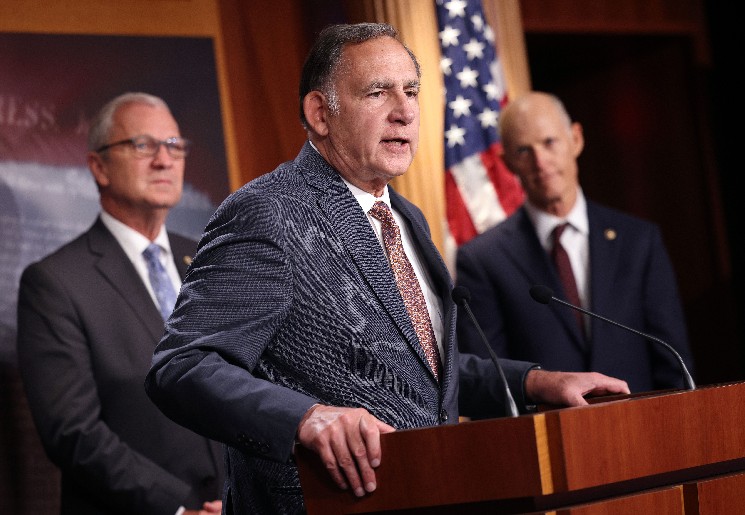
In a statement, Committee Chairman John Boozman said, “I appreciate Senator [Cory] Booker and his staff for working with us and providing thoughtful additions as we advance consumer protections and provide new authority to the CFTC."
"While differences remain on fundamental policy issues, this bill builds on our bipartisan discussion draft while incorporating input from stakeholders and represents months of work. Although it’s unfortunate that we couldn’t reach an agreement, I am grateful for the collaboration that has made this legislation better. It’s time we move this bill, and I look forward to the markup next week,” Boozman said.
A markup hearing, as is planned for Tuesday, is one chance that Democrats will have to introduce amendments to change the legislation before its primetime vote on the Senate floor, if the effort makes it that far. Another opportunity could be when the two versions of the bill — whatever is approved by the Agriculture Committee and the text that emerges from the Senate Banking Committee — are unified into one piece of legislation for the overall Senate's consideration.
In the meantime, the Agriculture Committee has finally produced a working text that the many individual interests can begin digging into. At this stage, the bill represents a more Republican-leaning, pro-crypto approach. (But it's also absent some of the more controversial sections that belong more in the jurisdiction of the Banking Committee, including stablecoin yield and crypto's illicit-finance dangers.)
If the committee maintains its January 27 markup plans next week, this version of the bill will become the first to make it that far after many years of crypto lobbying that have primarily celebrated victories in the House of Representatives, such as after that chamber passed the similar Digital Asset Market Clarity Act last year.
As the Senate legislation stands, it maintains the legal liability shield for developers — as long as they don't control customers' assets — and it elevates the Commodity Futures Trading Commission toward its expected role as the watchdog of the spot markets for tokens such as bitcoin BTC$89,961.36 that aren't securities. But crypto lobbyists will be poring through the text to better understand its details in the coming days.
From the beginning, one of the fundamental missions of the industry has been to make legal space for decentralized finance (DeFi) to operate without rules the platforms would have a difficult time complying with. Democrats have worried that such entities wouldn't properly protect consumers, and the securities industry has contended that DeFi firms need to be regulated in much the same way as traditional financial firms, which DeFi advocates say is impossible.
Democrats have had some additional concerns, including President Donald Trump's seeming unwillingness to appoint Democrats to fill out the regulatory rosters at places such as the CFTC and Securities and Exchange Commission. Some Democrats have also advocated for an ethics ban that would keep senior federal officials such as Trump from cashing in on crypto personally.
The Agriculture Committee's Republican chairman, Boozman, had sought to continue negotiating with Democrats on his committee even after an earlier effort in the Senate Banking Committee fell apart last meek amid a rapid, contentious push toward its now-postponed markup. His panel has prized bipartisan outcomes more than most, but it may proceed next week without the other party signing on.
Before it can become law, the final take on the Clarity Act needs to find the support of at least seven Democrats in the Senate. If it passes that chamber, it's widely expected to sail through the House. Crypto bills in recent memory have drawn major bipartisan votes.
Whether or not this new version pleases the industry, this bill needs both committees before it can advance. The Senate Banking Committee effort remains the more difficult of the two negotiations. Just one aspect — the fight over whether stablecoins can offer rewards to customers — became a major fight that bank lobbyists argue will threaten the core deposit-taking of U.S. banking.
Coinbase withdrew support over that and other points in the hours before the planned markup. That committee hasn't yet scheduled its next hearing.
Now that this agriculture bill is out, the many factions will have something concrete to debate.
Trump signaled to a global audience in Switzerland on Wednesday that the U.S. will produce a wide crypto law soon, and a top White House crypto adviser expanded on that.
"It’s a question of when, not if," Patrick Witt wrote in a posting on social media site X. "Assuming a multi-trillion-dollar industry will continue to operate indefinitely without a comprehensive regulatory framework is pure fantasy."