Stablecoin rewards have become a major point of contention between crypto companies and banking groups. Banking groups have argued that yield-bearing stablecoin products resemble deposit-taking or unregulated investment vehicles. Crypto companies say such programs function more like loyalty points or payment incentives common in fintech.
Draft bill exempts payments, loyalty, staking rewards
Under the draft, the prohibition would not apply to incentives connected to everyday financial activity. These include rewards linked to payments, transfers, remittances and settlements, as well as benefits tied to the use of wallets, accounts, platforms or blockchain networks. Loyalty and promotional programs, subscription-based incentives, and rebates related to the use of stablecoins are also covered.
Related: Banks’ stablecoin concerns are ‘unsubstantiated myths‘: Professor
The exemption extends further into crypto-native activity. According to the text, rewards associated with providing liquidity or collateral, as well as participation in governance, validation, staking or broader ecosystem activity, would be permitted.
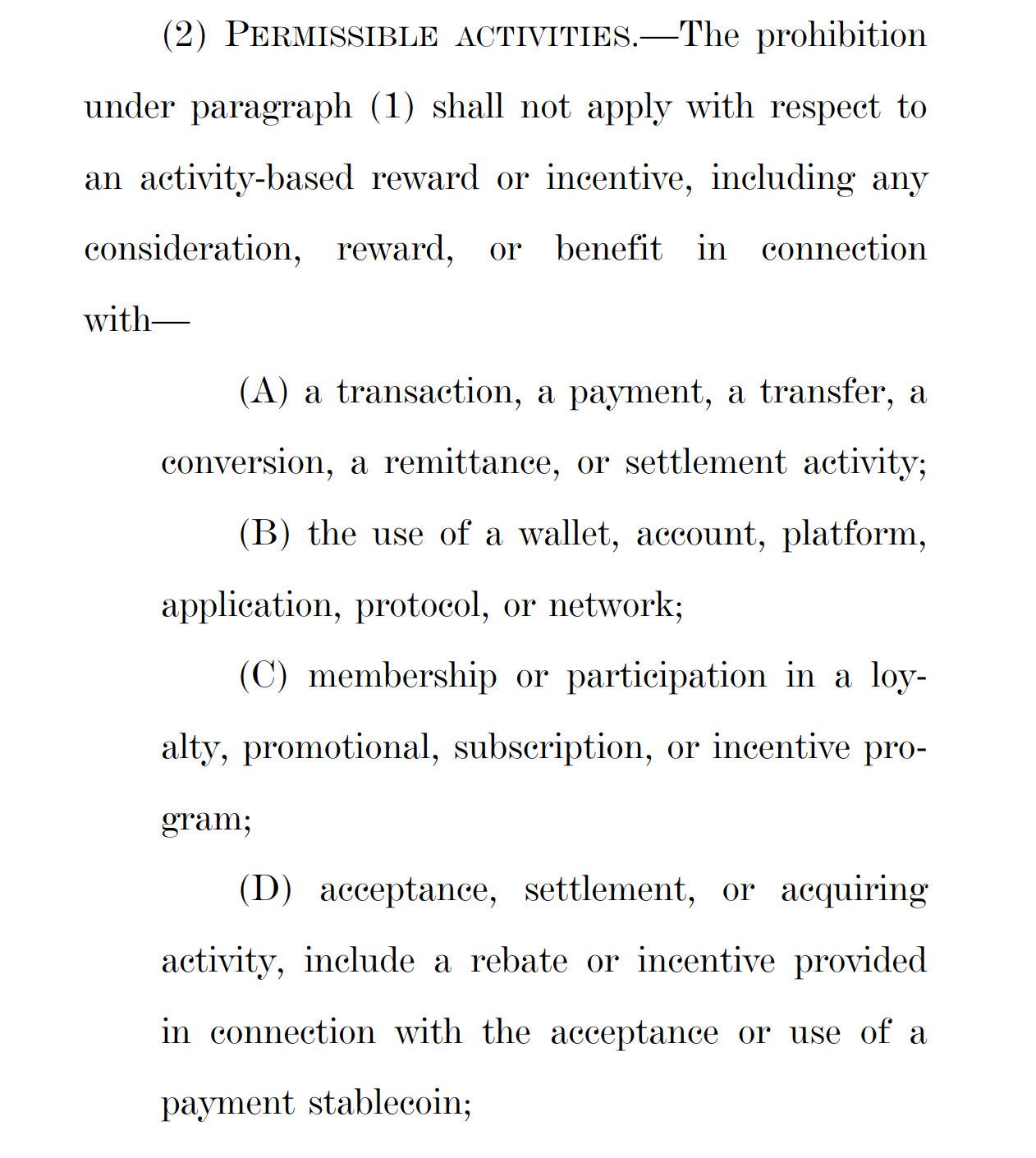
Draft bill identifies permissible activities. Source: Senate
The draft clarified that a digital asset service provider “may not pay any form of interest or yield (whether in cash, tokens, or other consideration) solely in connection with the holding of a payment stablecoin.”
The US Senate Agriculture Committee has delayed its markup of the crypto market structure bill until the final week of January, with Chairman John Boozman citing the need for more time to secure broad bipartisan support.
Related: Charles Hoskinson doubts CLARITY Act timeline, says Trump crypto czar should quit
Community banks urge Congress to close stablecoin yield “loophole”
Last week, a group of US community bankers urged Congress to amend the GENIUS Act, arguing that stablecoin issuers are exploiting a loophole that allows yield to be passed to tokenholders indirectly through exchanges and other partners.
The bankers warned that reward programs offered by crypto exchanges could pull billions of dollars away from community banks, weakening their ability to lend to small businesses, farmers, students and homebuyers.
The Crypto Council for Innovation and the Blockchain Association, two major crypto advocacy groups, rebuffed the banks in a letter to the Senate Banking Committee last month, arguing “payment stablecoins are not used to fund loans” and that the revisions would stifle innovation and consumer choice.
Magazine: How crypto laws changed in 2025 — and how they’ll change in 2026

 cointelegraph.com