
 bravenewcoin.com

The approval grants Ripple Markets UK Ltd registration under the country’s Money Laundering Regulations and an Electronic Money Institution license, positioning the blockchain payments company to scale its operations in one of the world’s most stringent financial regulatory environments.
The FCA approval, confirmed on January 9, 2026, allows Ripple to provide regulated payment and e-money services in the UK under official supervision. This marks a critical step for the San Francisco-based company as it expands its footprint in global markets where regulatory compliance has become essential for crypto firms seeking to work with traditional financial institutions.
What the Approval Means for Ripple
The Electronic Money Institution license enables Ripple to offer payment services and issue electronic money in the UK market. This authorization is particularly significant for Ripple’s dollar-backed stablecoin, RLUSD, which currently has a market capitalization of approximately $1.38 billion. The EMI status provides a regulated framework for Ripple to potentially deploy RLUSD in UK payment operations, though specific restrictions still apply.
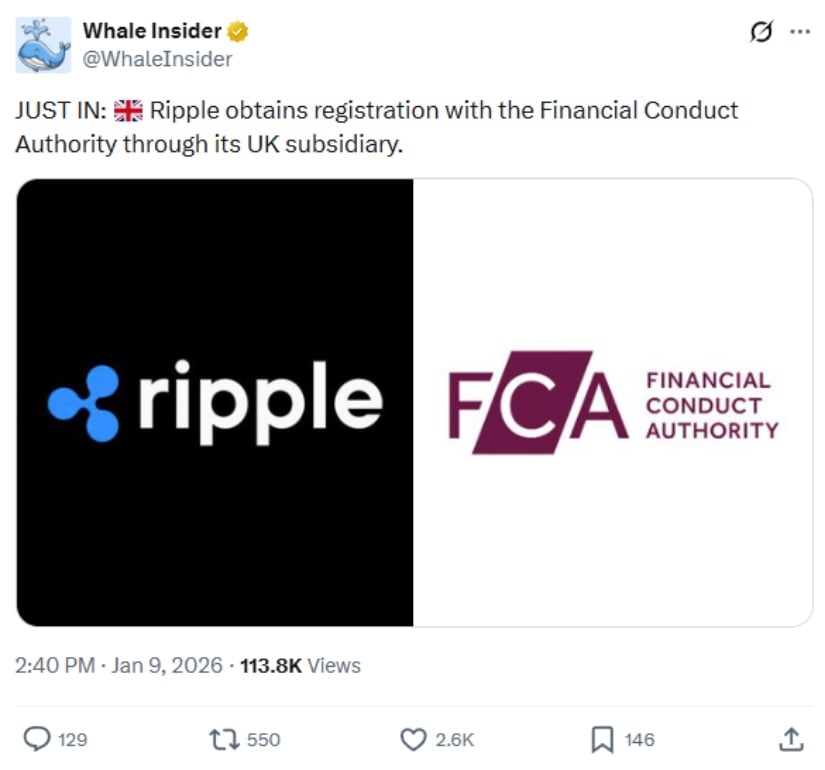
Source: @WhaleInsider
The approval comes as the UK advances plans to establish a comprehensive regulatory framework for digital assets. The government intends to regulate crypto assets as financial products by 2027, with the FCA prioritizing areas such as stablecoin payments and market integrity.
Operational Limitations and Future Requirements
Despite the approval, Ripple Markets UK faces significant operational restrictions. According to FCA records, the subsidiary cannot operate cryptocurrency ATMs, serve retail customers, or appoint agents or distributors without prior written consent from the regulator. Additionally, the company is currently prohibited from issuing electronic money or providing payment services to consumers, micro-enterprises, or charities.
These limitations narrow the initial scope of operations to institutional and wholesale use cases until Ripple secures additional approvals. The restrictions reflect the FCA’s cautious approach to crypto regulation, allowing controlled entry while preserving the option to expand or tighten permissions based on supervision outcomes.
The registration also comes with important timeline considerations. The FCA expects to open a formal gateway for crypto asset firms to apply for full authorization in September 2026, with a new regulatory regime taking effect in October 2027. Firms currently registered under Money Laundering Regulations must apply for complete authorization under the Financial Services and Markets Act by this deadline or exit the market.
Significance in Global Context
Ripple’s FCA approval is particularly noteworthy given the regulator’s selective approach to crypto registrations. Nearly 90% of crypto firms attempting to register with the FCA have failed to meet the authority’s stringent standards. This high failure rate underscores the significance of Ripple’s achievement and demonstrates the company’s ability to meet robust governance, capital, and anti-money laundering requirements.
The UK approval follows a series of regulatory victories for Ripple. In December 2025, the company received conditional approval from the US Office of the Comptroller of the Currency to establish a national trust bank in New York. Ripple’s RLUSD stablecoin was also cleared for institutional use in Abu Dhabi after receiving recognition as an Accepted Fiat-Referenced Token from local regulators.
Cassie Craddock, Managing Director of UK and Europe at Ripple, emphasized the company’s commitment to regulatory compliance: “The UK has a well-deserved reputation for high regulatory standards. The FCA’s rigorous approach to compliance mirrors Ripple’s commitment to adhering to regulations.”
Market Response Remains Muted
Despite the regulatory milestone, XRP’s price reaction was subdued. The cryptocurrency traded around $2.09-$2.11 following the announcement, representing only a 0.7% to 1% increase. Trading volume actually decreased by approximately 18.56%, suggesting traders may have already priced in expectations around Ripple’s UK regulatory progress or remained focused on broader market factors.
Analysts note that XRP has historically been more responsive to regulatory developments than pure market sentiment. While the immediate price impact was minimal, the FCA registration reduces regulatory uncertainty and positions Ripple as a compliant player in the institutional payments space. This could have longer-term implications for XRP adoption as banks and financial institutions increasingly require regulated counterparties.
Ripple’s UK Investment and Commitment
Ripple has maintained a strong presence in the UK since opening its London office in 2016, with the location serving as a strategic base for European operations. The company has committed more than $6.6 million to UK universities through its University Blockchain Research Initiative, supporting blockchain research and development in the academic sector.
The regulatory approval underscores Ripple’s strategy of building a licensed, regulated profile across major financial markets rather than operating in jurisdictions with lighter oversight. With over 55 licenses globally, including authorizations from the Monetary Authority of Singapore and registration as a Virtual Asset Service Provider with the Central Bank of Ireland, Ripple has positioned itself as one of the most comprehensively regulated blockchain payments companies.
Building Bridges Through Compliance
Ripple’s FCA approval represents more than a procedural checkbox. It signals the company’s ability to navigate one of the world’s most demanding regulatory environments while positioning itself for the UK’s evolving digital asset framework. As the country moves toward comprehensive crypto regulation by 2027, Ripple’s early compliance positioning could provide competitive advantages over firms that delay regulatory engagement.
However, significant work remains before Ripple can fully leverage its UK authorization. The company must secure additional FCA approvals to expand beyond institutional services, navigate the upcoming full authorization process, and demonstrate that its regulated infrastructure can scale effectively. With the September 2026 application window approaching, Ripple’s next 18 months in the UK will prove critical to determining whether early compliance translates into market leadership.