“Doing so would support a primary objective of the Anti-Money Laundering Act of 2020, which sought to modernize the Bank Secrecy Act,” he added.
Coinbase’s chief policy officer, Faryar Shirzad, reiterated this stance in an X post on Monday, arguing the US government should follow in the footsteps of crypto exchanges by embracing “innovation to modernize AML with proven digital tools like AI, APIs, digital IDs and blockchain analytics.”
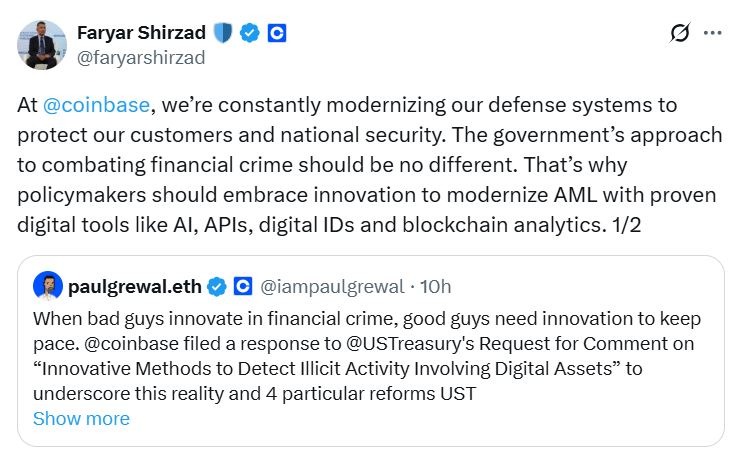
Source: Faryar Shirzad
Regulatory clarity for AI and API key to battling financial crime
Among the measures Grewal wants Treasury to consider is a regulatory exception under the Bank Secrecy Act for companies using AI and Application Programming Interfaces (API) driven monitoring tools.
“The conditions for that safe-harbor should focus on governance and outcomes, as opposed to forcing a one-sized-fits-all model,” he said in a follow-up X post on Monday.
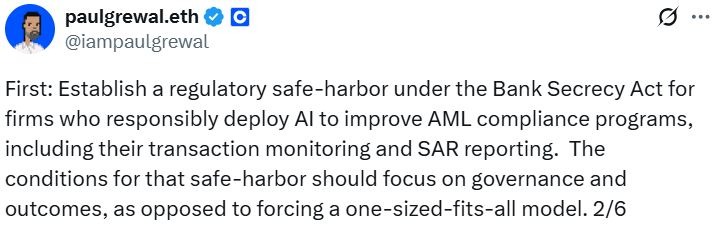
Source: Paul Grewal
Companies have been hesitant to fully unlock AI in Anti-Money Laundering measures because of a lack of regulatory clarity, according to Grewal.
He also thinks APIs face challenges such as a lack of standardization and regulatory fragmentation, which a guidance “outlining acceptable use cases” would solve by clearly showing “data privacy requirements and standards for interoperability — allowing firms to confidently adopt and integrate APIs into their programs.”
Blockchain technology needs clearer rules, too
At the same time, Grewal wants Treasury to publish guidance recognizing and incentivizing decentralized IDs and zero-knowledge proofs as valid forms of customer verification and blockchain analytics clustering for Anti-Money Laundering compliance.
“The updated guidance should further encourage the sharing of information relevant to potential illicit activities routed through blockchains, while being careful not to overimpose recordkeeping obligations on everyone involved in a blockchain transaction,” Grewal added.
In its Aug. 18 notice, the US Treasury asked for comments, which closed last Friday, on innovative methods to detect illicit activity involving digital assets, as required by the GENIUS Act.
Think tank wants a communication system
Meanwhile, Jim Harper, a non-resident Senior Fellow with the public policy think tank the American Enterprise Institute, had a different approach.
Related: Coinbase claims ‘key role’ in Secret Service’s biggest-ever crypto seizure
In his Monday blog post, which drew on his Sept. 15 paper pushing the same idea, he argues that a communication system should be established where law enforcement agencies can directly query crypto firms for investigative purposes.
“Such a system would maintain or strengthen law enforcement capabilities while obviating the existing broad and costly financial surveillance regime," he said.
Magazine: Review: The Devil Takes Bitcoin, a wild history of Mt. Gox and Silk Road

 cointelegraph.com