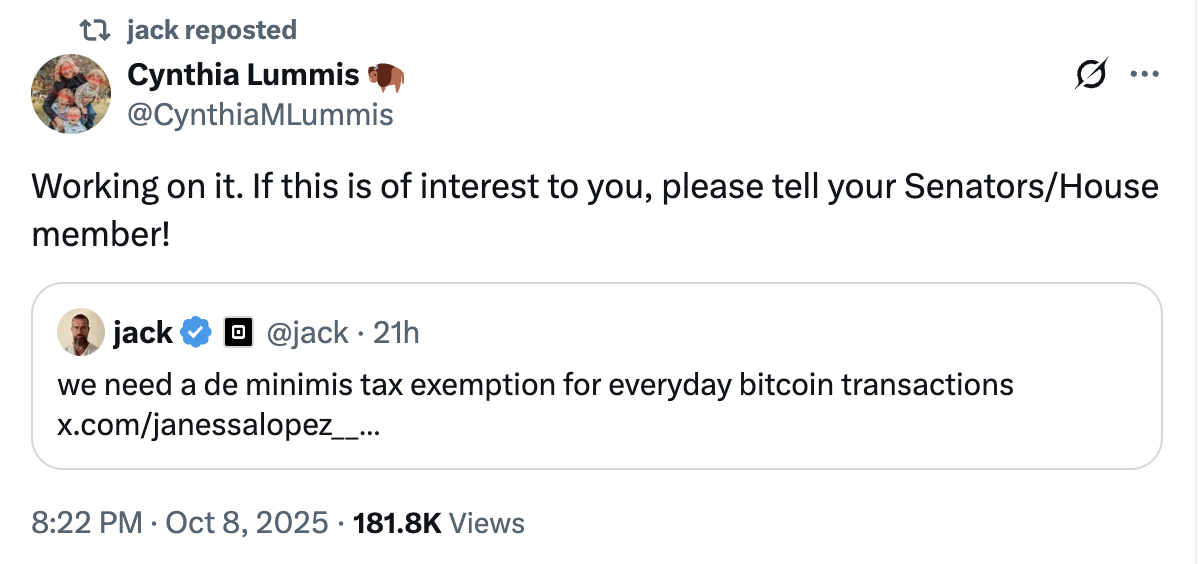
Source: Cynthia Lummis
Under current US tax laws, all Bitcoin transactions are subject to capital gains tax, which the holder must pay if the price of $BTC rises above the initial purchase price, limiting Bitcoin’s use as a medium of exchange.
Bitcoin advocates continue to push for tax exemptions on small $BTC transactions to encourage the digital currency’s use as a peer-to-peer digital cash system envisioned in $BTC creator Satoshi Nakamoto’s whitepaper, alongside its use as a store-of-value asset.
Related: US lawmakers grapple with crypto tax policy amid government shutdown
Crypto industry executives and supporters push for tax exemption
The United States Senate Committee on Finance held a hearing in October to discuss crypto tax regulation amid the US government shutdown.
Lawrence Zlatkin, the vice president of tax at crypto exchange Coinbase, asked the Senate to codify a de minimis tax exemption for crypto transactions of up to $300.
Zlatkin argued the exemption would encourage crypto payments in retail commerce and ensure that payment innovation takes place in the US and not abroad.
Several jurisdictions already feature favorable tax treatments on digital assets in order to attract investment, including the United Arab Emirates (UAE), Germany, and Portugal.
The favorable tax treatment in other countries makes it attractive for crypto companies and funds to establish operations in those jurisdictions, leaving the US at a competitive disadvantage compared to these first movers.
Magazine: The one thing these 6 global crypto hubs all have in common…

 cointelegraph.com