It also exempts the exchanging of digital assets if the transactions don’t involve the “conversion to legal tender” or bank deposits.
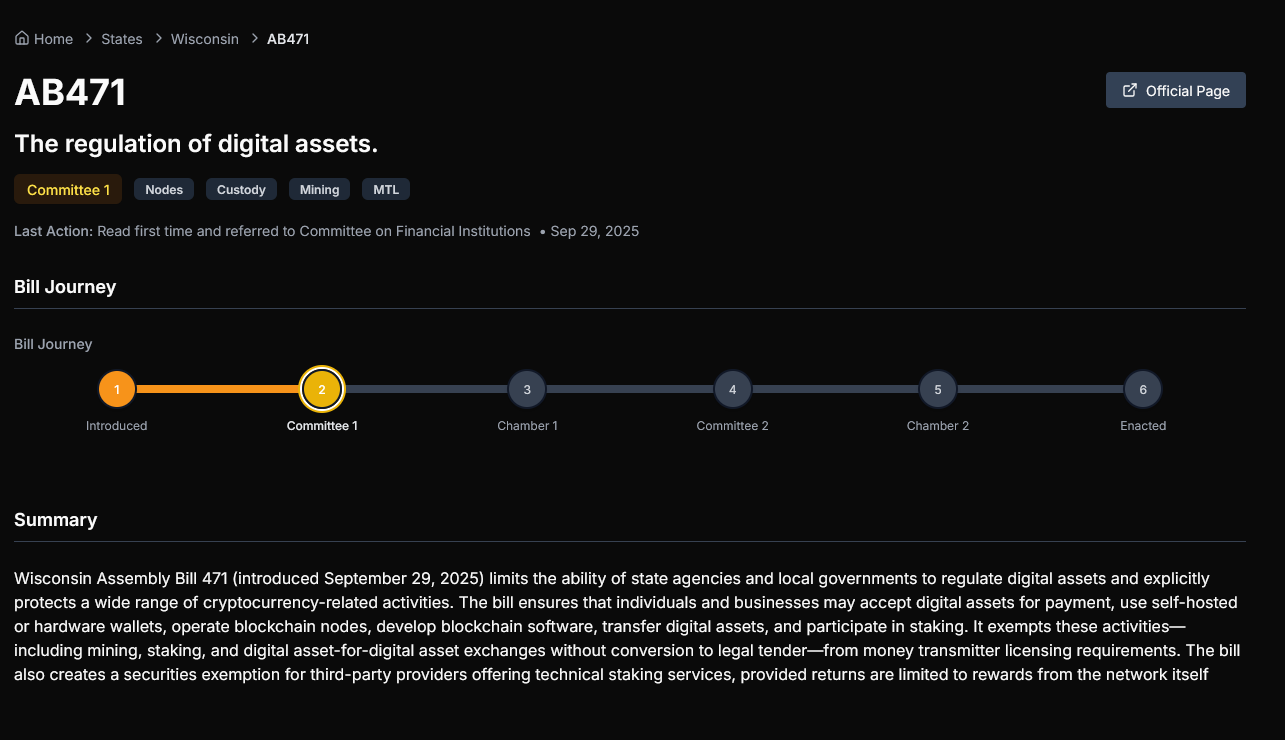
Progress of AB471 Bill. Source: Bitcoin Laws
“Under the bill, neither a state agency nor a political subdivision may prohibit or restrict a person in accepting digital assets as a method of payment for legal goods and services or in taking custody of digital assets using a self-hosted wallet or hardware wallet,” the document reads, adding that:
“The bill also specifies that a person in this state may 1) operate a node for the purpose of connecting to a blockchain protocol and participating in the blockchain protocol’s operations; 2) develop software on a blockchain protocol; 3) transfer digital assets to another person utilizing a blockchain protocol; and 4) participate in staking on a blockchain protocol.”
The bill marks another attempt to reduce some of the legal gray area surrounding state-based crypto regulation. There is still a lack of clear rules across the country for crypto despite increasing adoption.
Wisconsin bill still has hurdles to pass
The bill is sponsored by seven Republican members at the House level, and two Republican co-sponsors from the Senate, and has since been referred to the Committee on Financial Institutions.
According to Legiscan, the bill has a current progression rate of 25%, as it still has to pass through one chamber and two more committees before it could potentially be enacted.

 cointelegraph.com