
 crypto-news-flash.com
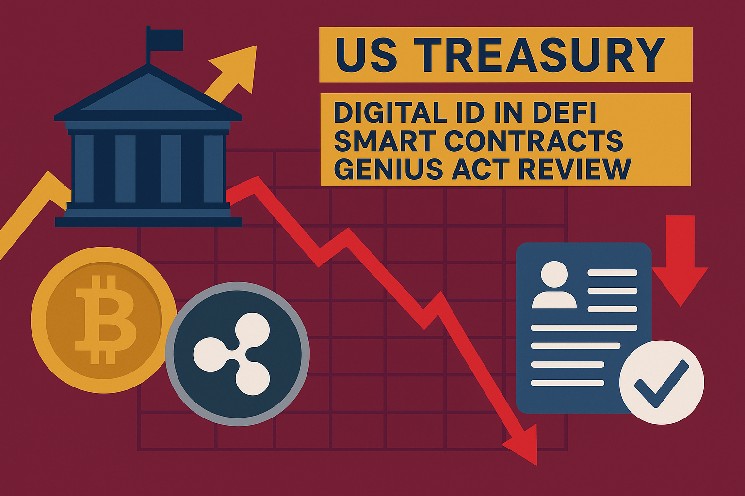
- The U.S. Treasury’s exploration of digital ID integration in DeFi under the GENIUS Act could reshape compliance and institutional adoption, creating both short-term volatility and long-term growth potential.
- Both $XRP and $BTC cryptos have reacted to regulations uncertainty with notable price declines, reflecting market caution as investors await clarity on the stablecoin and DeFi regulations.
The U.S. Department of the Treasury is again advancing efforts to regulate decentralized finance (DeFi) by exploring the integration of digital identity (ID) verification into smart contracts, as part of the public consultation under the Guiding and Establishing National Innovation for U.S. Stablecoins Act (GENIUS Act).
What is the background on the GENIUS Act? Following a recent Crypto News Flash highlight on The U.S. crypto re-Banking wave has officially started, available reports indicate that the GENIUS Act was signed into law on July 18, 2025, by President Donald J. Trump. The act establishes the first U.S. federal framework for stablecoin regulation.
It mandates 1:1 reserve backing with cash or high-liquidity assets like U.S. Treasury securities, regular audits, and compliance with AML/KYC rules.
Digital IDs in DeFi: A Compliance Game-Changer? Yes. DeFi platforms, which enable intermediary-free financing transactions on blockchains, often operate pseudonymously, raising concerns about money laundering and sanctions evasion. As tweeted by DustyBC Crypto on X, the U.S. Treasury is considering digital ID checks for DeFi smart contracts to combat illicit finance. This could change the future of DeFi.
💥BREAKING
US TREASURY IS CONSIDERING DIGITAL ID CHECKS FOR DEFI SMART CONTRACTS TO COMBAT ILLICIT FINANCE.
THIS COULD CHANGE THE FUTURE OF DEFI. pic.twitter.com/wpWkJHEput
— DustyBC Crypto (@TheDustyBC) August 17, 2025
What are the Global Implications? In short, the U.S.’s regulatory approach could influence global standards, with jurisdictions like the European Union (under MiCA) potentially adopting similar measures. This could lead to a fragmented DeFi market, with higher costs potential limiting access in emerging markets where stablecoins are vital for remittances and inflation hedging.
Implications for Ripple ($XRP) and Bitcoin ($BTC) Market Prices
According to current market trading reports, both Ripple ($XRP) and Bitcoin ($BTC) are currently experiencing price declines, reflecting broader market uncertainty amid regulatory developments and macroeconomic factors. The Treasury’s exploration of digital IDs in DeFi and the GENIUS Act’s stablecoin framework carry significant implications for both cryptocurrencies.
At the time of writing, $BTC is trading at $115,720.45, reflecting a decrease of 2.16% in the past day and 5.34% in the past week, according to CoinMarketCap data. Meanwhile, $XRP is trading at $3.00 USD, reflecting a 4.29% drop over the past day and 8.36% over the past week.
As for the market outlook, It is worth noting that the current price drops in $XRP and $BTC reflect market caution as investors await clarity from the Treasury’s consultation and broader regulatory developments. In addition, nevertheless, the GENIUS Act’s focus on stablecoins and DeFi compliance could drive long-term growth. See $XRP price chart below.
Recommended for you:
- Buy Bitcoin Guide
- Bitcoin Wallet Tutorial
- Check 24-hour Bitcoin Price
- More Bitcoin News
- What is Bitcoin?