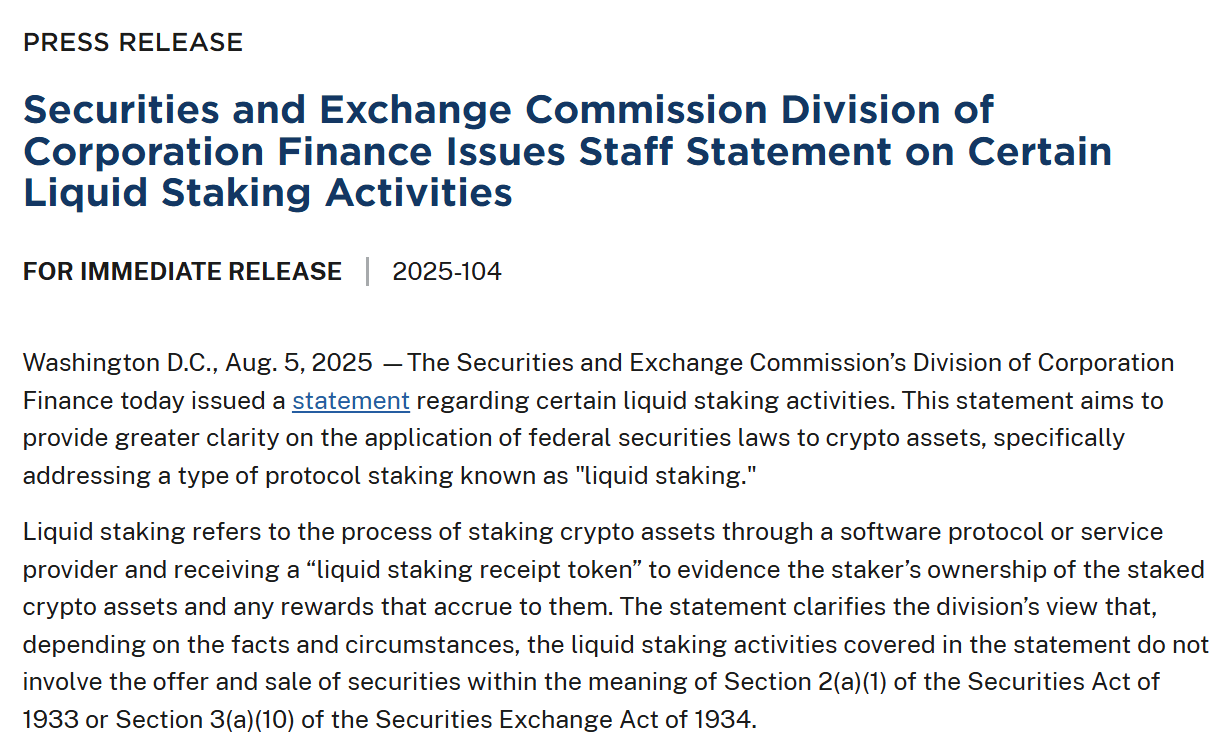
An excerpt of the SEC’s Staff Statement on certain cryptocurrency liquid staking activities. Source: SEC
The SEC’s clarification comes amid rising institutional interest in liquid staking exchange-traded funds (ETFs), with firms like Jito Labs, VanEck and Bitwise urging the agency to approve liquid staking strategies for Solana (SOL)-based funds.
Liquid staking has become one of the largest subsectors in crypto, with total value locked (TVL) nearing $67 billion across all protocols, according to DefiLlama. Ethereum alone accounts for $51 billion of that total.
Advertisement
Start Your Crypto Journey with Coinbase! Join millions worldwide who trust Coinbase to invest, spend, save, and earn crypto securely. Buy Bitcoin, Ethereum, and more with ease!
Related: Crypto Biz: Digital gold rush intensifies as Tether Gold surges, institutions double down on BTC
SEC adopts pro-crypto approach under Paul Atkins
The announcement follows the SEC’s launch of Project Crypto — a sweeping initiative to overhaul the regulatory framework for cryptocurrency trading in the United States. As SEC Chair Paul Atkins noted last week, the project was developed in response to recommendations from the White House’s Working Group on Digital Assets
Since taking office, Atkins has led a more lenient approach to digital asset regulation, moving away from the agency’s prior “regulation by enforcement” stance under former Chair Gary Gensler. That shift included a May clarification that proof-of-stake protocols do not constitute securities transactions.
Under Atkins’ leadership, the SEC has also taken meaningful steps to ease regulatory burdens on cryptocurrency exchange-traded funds (ETFs).
Notably, on July 29, the agency approved in-kind creations and redemptions for Bitcoin and Ether
ETFs, allowing authorized participants to exchange ETF shares directly for the underlying assets rather than cash.
The US crypto industry is also gaining momentum from sweeping policy reforms designed to make digital assets more accessible. These include the passage of the GENIUS Act, a landmark stablecoin bill, and House approval of market structure and anti-CBDC legislation ahead of the August recess.

 cointelegraph.com