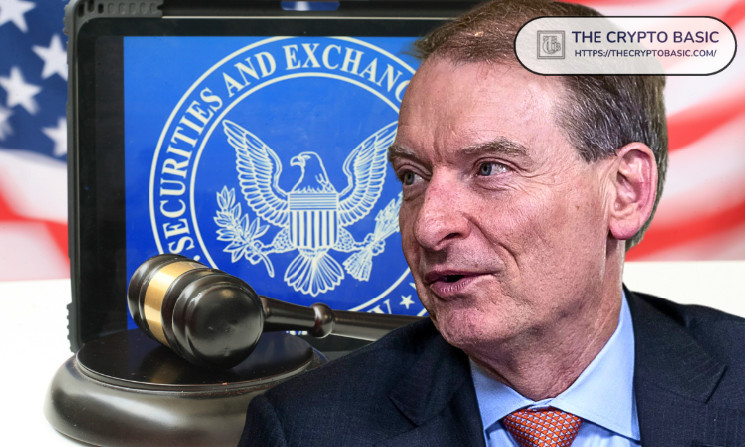
SEC’s Shift on Digital Asset Regulation
The SEC Chairman also noted the need for congressional approval to enforce any lasting policies on staking-as-a-service providers. He emphasized the importance of ensuring that these policies are grounded in legislative authority rather than the agency’s interpretation alone.
Meanwhile, Atkins voiced his support for flexible market structures that allow participants to self-custody their assets, particularly when intermediaries impose unnecessary transaction costs or limit the ability to engage in activities like staking.
Clarification on Staking and Self-Custody
Recall, the SEC has recently moved to ease its approach toward staking in proof-of-stake (PoS) networks. The Division of Corporation Finance clarified on May 29 that specific staking activities do not fall under the scope of federal securities laws.
This guidance exempts activities like self-staking by node operators and self-custodial staking through third-party services from registration requirements.
Atkins also praised the agency’s current stance, stating that voluntary participation in proof-of-work or proof-of-stake networks, such as mining or staking, is not subject to federal securities laws.
However, he acknowledged that this clarification is not yet a formal rule with the force of law, suggesting that the SEC must continue refining its approach.
SEC’s Ongoing Actions
In addition to these comments, the SEC has made significant moves regarding its legal battles with major exchanges. Recently, the agency filed a joint stipulation with firms like Coinbase and Binance to dismiss the civil enforcement action against the platform.
This aligns with the SEC’s broader efforts to establish a more transparent regulatory framework for digital assets. Notably, the SEC also dropped its efforts to classify ten cryptocurrencies, including Solana and Cardano, as securities in the Binance lawsuit.

 thecryptobasic.com