Maple Finance CEO targets up to $15B in assets by the end of 2027
cointelegraph.com
58 m
Onchain asset manager Maple Finance is aiming to grow its assets under management (AUM) to between $10 billion and $15 billion by the end of 2027 as it looks to attract more traditional financial (TradFi) firms, according to CEO Sidney Powell.
In an exclusive interview with Cointelegraph on Monday, Powell said the company is also targeting a loan book of around $4.5 billion to $5 billion.
The plans come as Maple looks to grow beyond lending backed primarily by cryptocurrencies such as Bitcoin (BTC) and attract more traditional financial firms, with Powell expecting tokenized assets and stablecoins to play a major role in the company’s growth.
Know when your coins move
Alerts, real-time prices, and market news — all in one app
Point your phone camera to install
4.8 based on 40K reviews in the App Store and Google Play
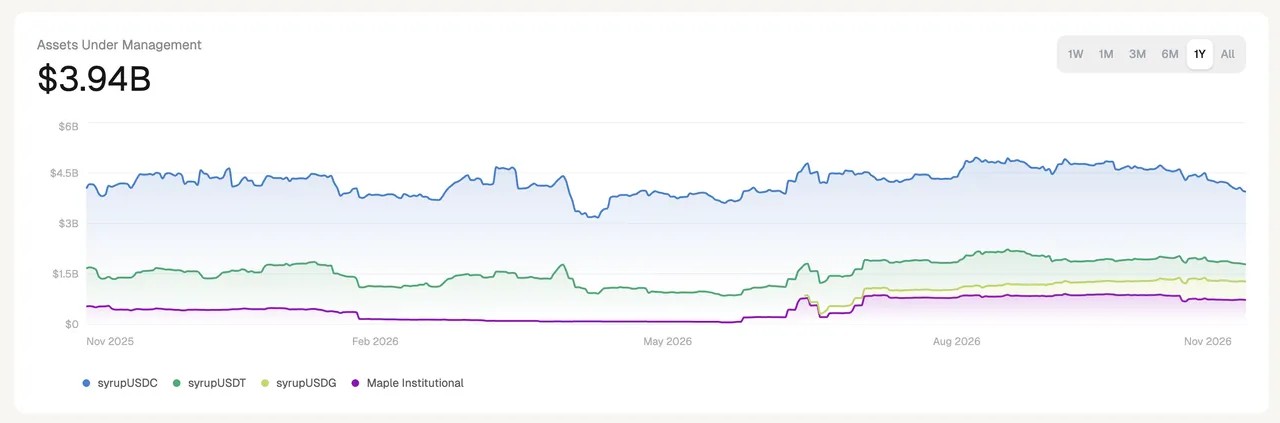
Maple reported $4.7 billion in AUM at the end of the third quarter, up 18% from a year earlier. However, Maple’s dashboard showed around $3.9 billion in AUM on Tuesday.
Outstanding loans rose 12% from a year earlier to $1.7 billion, while quarterly revenue increased 5% to $4.4 million, bringing annualized revenue to $17.6 million. Still, outstanding loans fell 9% from the previous quarter, while quarterly revenue remained flat.
Tokenized assets are digital versions of traditional assets, such as stocks and bonds, that can be held and traded on a blockchain. Separately, stablecoins are digital tokens designed to maintain a stable value relative to a reference asset, most commonly a currency such as the US dollar.
The market for tokenized real-world assets has grown significantly over the past year, with their value on public blockchains reaching about $39.9 billion as of Nov. 11, up 52% year-over-year, according to RWA.xyz. The value of tokenized stocks alone rose from about $678 million in January to nearly $3.9 billion in November.
Maple assets under management. Source: Maple Finance
Maple looks to TradFi for its next stage of growth
Powell expects tokenized stocks to grow fivefold to tenfold in 2027, which could allow Maple to offer loans backed by tokenized shares rather than relying mainly on cryptocurrency collateral.
“I think tokenized equities are going to be really big,” he said. “You’ll start to see more tokenized equity lending.”
Under this model, borrowers could use tokenized stocks as collateral to obtain loans without having to sell their investments, similar to how Bitcoin-backed lending works today.
“Ultimately, that’s really positive for the space because it gives you tokenized assets to lend against that are not correlated with Bitcoin,” Powell said. Bitcoin is the largest cryptocurrency with a market capitalization of over $1.28 trillion as of Nov. 17.
Maple is also discussing credit facilities through which banks would finance its Bitcoin-backed lending, Powell said.
“At the moment, we’re looking at a first deal where we’re speaking with banks about warehouse facilities for the Bitcoin-backed lending, so they would be a funder to us,” Powell said.
Maple already provides financing for a warehouse facility supporting Kraken’s crypto-backed lending program, which was announced in June. The proposed bank arrangements would instead bring funding into Maple’s lending business.
Powell added that Maple could pursue separate deals with US banks and lenders involving loans originated by TradFi institutions and subsequently brought onto blockchain networks. “I think that’s going to be a big market for 2027,” he said.
Maple outlined plans in September to lend against portfolios of asset-backed and mortgage-backed securities and finance loans originated by fintech companies. It said at the time that each new strategy would initially be capped at 5% of its overall deposit base.
Another priority is expanding partnerships with financial technology companies and digital banks that want to offer customers ways to earn interest on their stablecoin holdings. Powell said Maple is already in discussions with several large firms about potential products, with announcements possible in the first quarter of 2027.
“My view is that’s the kind of path Maple has to go down in order to grow, and we have to focus more on these larger institutional allocators,” Powell said. “That’s ultimately where most of the balance sheet is in traditional finance.”
That approach to expansion is also at the center of the leadership disagreement, according to Powell.
Leadership shakeup comes amid expansion plans
Maple’s growth plans come amid a leadership shakeup after co-founder and executive chairman Joe Flanagan and chief operating officer Ryan O’Shea announced plans last week to leave over disagreements about the company’s future direction.
Flanagan said his differences with Powell involved strategy and leadership, while O’Shea said he had reached a different view on the direction Maple should take.
Powell said the differences centered on how best to expand the business, particularly as TradFi institutions become more involved in crypto lending.
“We had a difference of opinion on the best way to scale things,” he told Cointelegraph. “This year, I think, more than ever, we started to see that real convergence with traditional finance, fintechs and neobanks. And my view is that that is kind of the right path for us to scale.”
The planned departures prompted questions from Maple’s investors, partners and clients, some of whom contacted Powell seeking clarification. Powell said the departures were unrelated to problems with Maple’s loan book or the health of the business.
“The important thing is conveying to them and reassuring them that this wasn’t to do with any issues in Maple’s loan book or any issues with the business,” Powell said. “It is just a difference on what is the best pathway to scale Maple from here.”
Maple Finance’s native token, SYRUP is currently trading at $0.103 as of 6:50 pm UTC on Tuesday, with a market capitalization of $123 million, according to CoinMarketCap. The token is down about 46% over the past 30 days and 74% over the past year.

 cointelegraph.com